...


By Ellie Cook and John Feng
0
Share
Newsweek is a Trust Project member
See more of our trusted coverage when you search.Prefer Newsweek on Googleto see more of our trusted coverage when you search.
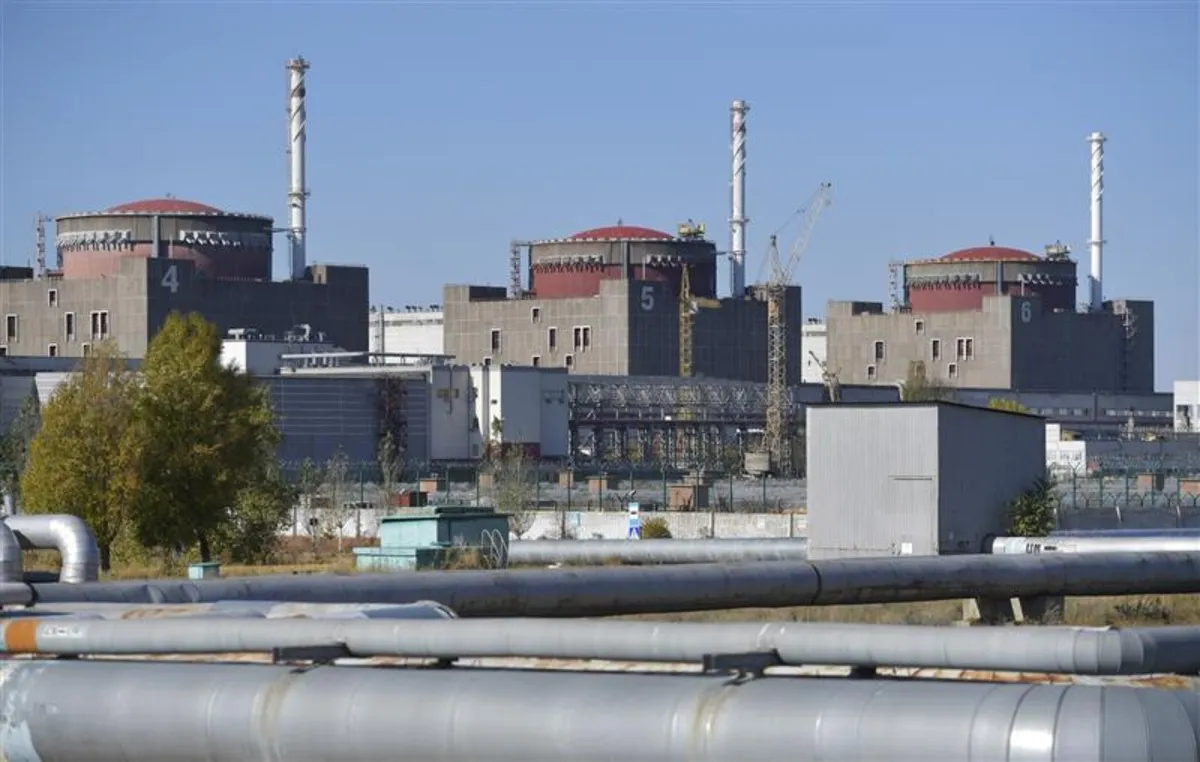
A vital power line is back up and running at the Zaporizhzhia nuclear power plant (ZNPP), the facility that has been at the center of pervasive concerns over nuclear safety in Ukraine throughout the war and a major obstacle in U.S.-brokered peace talks.
Repairs to a power line linked to the plant have "been successfully completed," Rafael Grossi, the chief of the International Atomic Energy Agency (IAEA), the United Nations' watchdog, said on Monday. Ukraine's energy ministry said in its own statement the work will "ensure a more stable and reliable power supply to the station" if the main power link, the Dniprovska power line, is damaged or destroyed. There are two power lines connected to the ZNPP.
The facility is one of the most contentious points in long-running peace negotiations led by Washington with Kyiv and Moscow. Most countries recognize the plant as Ukraine's, although it's currently run by Russian authorities.
Read More on World
Under a Ukrainian 20-point proposal, Ukraine could end up receiving half the ZNPP's electricity with the U.S. deciding how to divvy up the remaining 50 percent. A previous plan had suggested the U.S., Ukraine and Russia could jointly operate the facility with Washington as the chief manager.
But with both Kyiv and Moscow still yet to sign on, the ZNPP could be one of the battleground issues that jeopardize the inking of a deal.
...
What Is The Zaporizhzhia Nuclear Power Plant?
The six-reactor facility in southeastern Ukraine is Europe's largest nuclear power plant. It is not currently operational but needs access to off-site power to keep it safe.
Russian forces quickly seized control of the plant after taking the town of Enerhodar, although Ukrainian operators continued to work at the site. Reports quickly emerged of violence directed at Ukrainian staff from Russian troops.
Energoatom, Ukraine’s state nuclear operator, said in May Russia had put "unprecedented pressure on nuclear employees who refused to defect" and said 13 ZNPP employees had been detained by Russian forces or were missing. A September report from the Royal United Services Institute (RUSI), an influential British think tank, said at least 19 residents of Enerhodar, including "at least a dozen" ZNPP employees, were believed to be in Russian custody.
"Russia has repeatedly demonstrated a serious disregard for the safety of the ZNPP and its personnel," the think tank said.
Why Does Ukraine Want It?
The ZNPP has economic, strategic and political value for both Russia and Ukraine. Before Russian tanks rolled over the border to kick off Moscow's full-scale invasion, it's estimated the ZNPP was responsible for generating more than a fifth of Ukraine's energy.
It is a major "economic asset," Oleksandr Merezhko, the chair of Ukraine's parliamentary foreign affairs committee, told Newsweek.
Russia has hammered Ukraine with persistent attacks on its critical energy infrastructure, and is invested in cutting off Kyiv's access to power. Ukrainian officials said more than 170,000 people had lost power in just the country's southern Odesa region as of Wednesday morning.
But there's obvious political value for Ukraine, too. Permanently losing control of the facility would be a stinging blow under a peace deal that will very likely involve other tough concessions for Kyiv.
What Is Russia's Interest?
On the banks of the Dnieper River, the power plant hovers on the edge of the broader Zaporizhzhia region. Russia has laid claim to the entire region—Zaporizhzhia was one of the four mainland Ukrainian regions the Kremlin declared it had annexed in September 2022, along with Donetsk, Luhansk and Kherson. Russia has controlled the Crimean Peninsula since seizing the territory from Ukraine in 2014.
Russia has not indicated it is willing to give up on its claims to these regions or the sites within them.
Much like Ukraine, Russia could benefit from the significant energy the site is capable of generating. Also up for discussion is whether Russia could supply Ukraine with energy from the site, according to Russian media.
Alexei Likachev, the head of Russia's Rosatom nuclear agency, has said Russia is the only party able to safely operate the plant. Ramil Galiev, the top Russian official at the ZNPP, said earlier this week operations could be relaunched at the plant by mid-2027 if a deal is reached soon, according to Russia's state-run RIA Novosti news agency.
The Safety Concerns
Russia and Ukraine have accused one another of attacking and endangering safety at the facility. International experts have, throughout the conflict, urged both sides to steer away from military activity close to the ZNPP.
The potential for a nuclear disaster hangs heavy over Ukraine; north of Kyiv lies the Chernobyl nuclear power plant, which became the site of the world's worst nuclear accident when one of the reactors exploded in 1986 in the then-Soviet Union. At least 30 people died in the aftermath of the disaster, with millions more exposed to radiation.
The Zaporizhzhia site has lost access to off-site power a dozen times since February 2022, including in mid-December, according to the IAEA.
"Each instance of loss of external power imposes thermal and operational stress on safety systems, increasing the chance that at some point the on-site backup systems will not perform as designed," said Vitaly Fedchenko, a senior researcher with the Stockholm International Peace Research Institute (SIPRI)'s weapons of mass destruction program. "Each loss of external power and the need to rely on diesel generators should be seen as a safety risk and a near-miss."
The IAEA "is right to characterize ZNPP’s power situation as fragile and inherently unsafe," Fedchenko told Newsweek.
All six reactors at the plant were put in cold shutdown in April 2024, although the site stopped generating electricity in September 2022, according to experts. In simple terms, this means all the reactors are off and no chain reactions are happening.
Because of the cold shutdown, the risks of both on-site and off-site power loss are much lower than for a fully operational nuclear power plant like Fukushima, said Fedchenko.
A tsunami triggered by an earthquake hitting Japan in 2011 cut power to the Fukushima plant and stopped the cooling of the reactors, meaning the cores melted and radioactive material escaped.
Experts restored power between the switchyards of the ZNPP and the nearby thermal power plant during what the IAEA termed a local ceasefire. Electricity generated from a power plant heads to a switchyard to be sent out to the grid.
Grossi said Monday "both sides engaged constructively with the IAEA to help strengthen nuclear safety during military conflict," according to a statement from the watchdog.
The IAEA separately said on Tuesday that the Khmelnytsky and Rivne nuclear power plants, both in western Ukraine, had reduced power after their substations were affected by military attacks. Ukraine currently has three operational nuclear power plants.
"The whole of Europe will live in danger" if Russia retains control of the ZNPP, Ukraine's Oleksandr Merezhko said.
View 0 Comments
Submit Correction
View Editorial & AI Guidelines