...

By Alyce Collins
Senior Reporter
0
Share
Newsweek is a Trust Project member
See more of our trusted coverage when you search.Prefer Newsweek on Googleto see more of our trusted coverage when you search.
A then-24-year-old woman who struggled with agonizing pain was told it was just period pain—until a blood test uncovered the horrifying truth months later.
Megan Jones noticed an unusual pain in her legs in April 2024, which felt like numbness in her upper thighs. The pain seemed to coincide with her periods, so doctors suggested it was painful menstrual cramps.
That was "so frustrating" for Jones, who told Newsweek that it felt more serious and she wanted it to be investigated. The level of pain she was experiencing did not correlate to the answers she was given.
Read More on Health
In the weeks that followed, the pain continued to progress. Jones, from the U.K., said it became "a deep pain in [her] left leg," which radiated down to the back of her thigh, all the way to her knee. She returned to the doctor who diagnosed her with sciatica, scheduling her for an over-the-phone physiotherapy appointment.

...
"At the start of June, I got back in touch with the GP because I needed stronger relief as the leg pain was disrupting my life," Jones, now 26, said. "This was when I noticed the smaller symptoms, too; getting out of breath, dizziness, tasting blood, weight loss, bloating, loss of appetite, extreme fatigue and itchy skin."
At the time, Jones had joined a gym, she was watching what she ate, and was going through a busy spell at work. So, the symptoms seemed easy enough to explain. But, as the pain progressed, Jones was sent home from work because she could barely stand, and she would get out of breath while sitting down.
"I felt like there would be no fixing the amount of pain I was in. It was indescribable, yet somehow, I was expected to live as normal," Jones said.
Doctors recommended that Jones manage her condition with Ibuprofen, which, little did they know, was very dangerous for her. Despite regularly taking pain medication, nothing helped, and the leg pain was relentless.
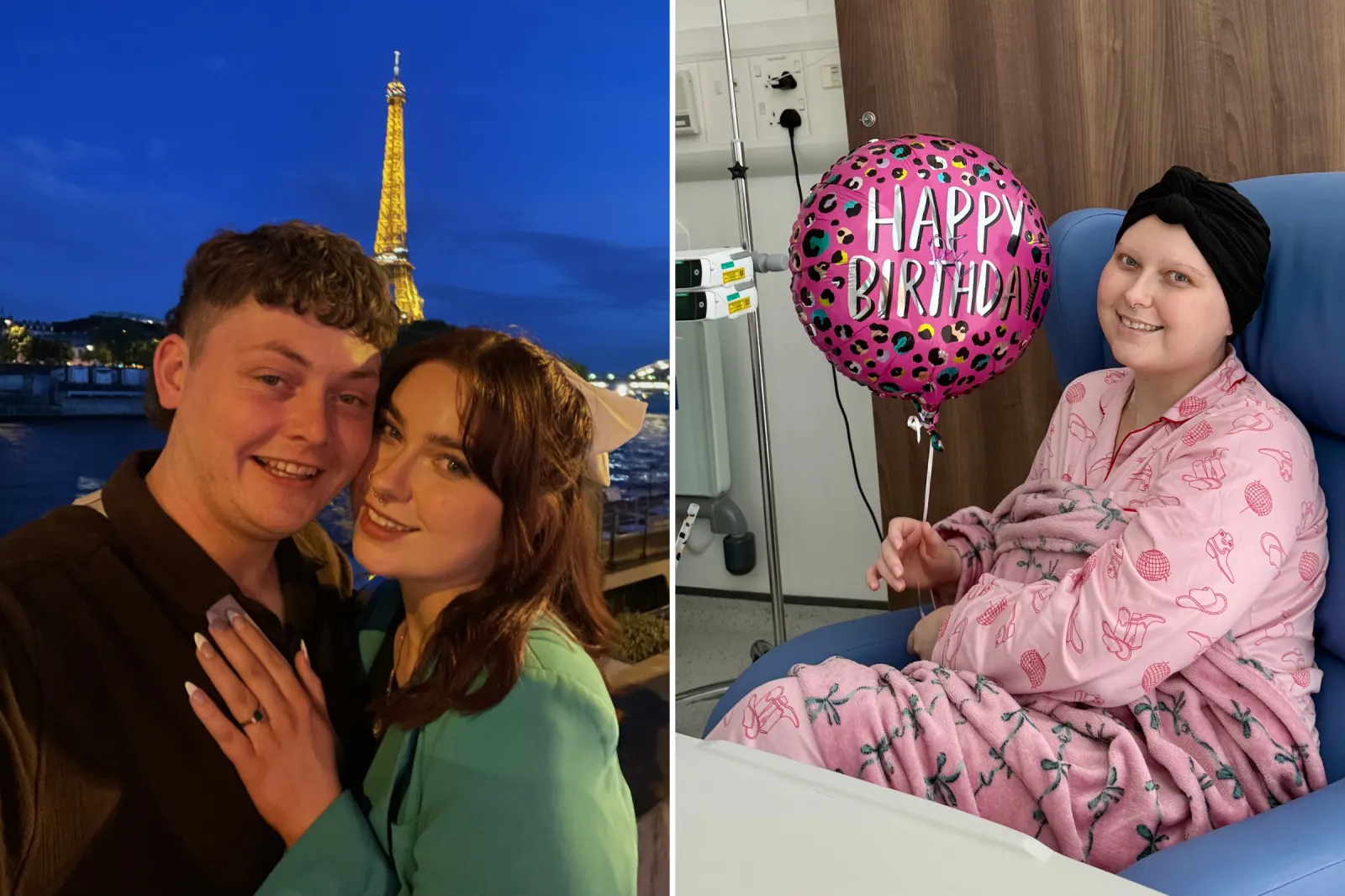
Amid the pains and symptoms, she and her partner went to Paris in June 2024, where they got engaged in the beautiful scenery of Montmartre.
...
Jones said: "I remember getting upset just before the trip as I wasn’t sure how I’d cope with the amount of pain I was in. I think the high of getting engaged helped me push through.
"During the trip, I got a new and alarming symptom of night sweats. I would wake up absolutely drenched in the morning, but I assumed it was from too much Ibuprofen and drinking alcohol. Still, I knew something definitely wasn’t right."
Two weeks after their engagement, Jones began to notice strange red spots on her legs, and bruising on her body. She went to the GP once again, this time concerned it was meningitis. While that theory was quickly dispelled, she was taken to the A&E department [ER] for a blood test nonetheless, which proved life-changing.
To her surprise, Jones was seen by a consultant the following morning to inform her that the hospital she was in couldn’t treat leukemia, so she was being transferred to a larger facility.
"My initial reaction was shock," Jones told Newsweek. "I had nothing to say apart from asking if I would be OK, as the only understanding I had of leukemia was from reading and watching [the Cameron Diaz film] My Sister's Keeper."
A bone-marrow biopsy confirmed that Jones had B-cell acute lymphoblastic leukemia, and it had progressed rapidly. Jones had to call her mom and break the news that her firstborn child had cancer at just 24 years old.

...
Delaying treatment wasn’t an option, and Jones had to begin chemotherapy straight away. She wasn’t able to retrieve her eggs, which was devastating to accept. Jones had always dreamed of one day starting a family, but now she was faced with the potential loss of fertility.
Jones was transferred to The Christie, a specialist hospital that offers services for teens and young adults battling cancer.
Jones said: "I initially began treatment with a high dose of steroids to bring down the high white-cell count, as well as antibiotics to treat and prevent infection. Then, chemotherapy started, which I had four cycles of, before starting maintenance chemo, which should have been almost two years long."
Chemotherapy was tough, as Jones faced many ups and downs. She had to be admitted to hospital on several occasions to treat infections, including sepsis on one occasion.
Jones said: "When I started to see changes in my body, I struggled. I put on quite a bit of weight, my face was swollen from steroids, my body shape changed, and none of my clothes fit. These drastic changes are a lot to cope with, which is why I believe cancer is equally a mental battle as much as it is physical."
Living Through a Relapse
After ringing the bell in April 2025, Jones’s journey was far from over. She was due to continue maintenance chemotherapy for almost two years, until a relapse derailed that.
Three months into the maintenance chemotherapy, the leg pain returned. It was also radiating through her chest, ribs and arms, so Jones rushed to the hospital.
Unfortunately, testing didn’t show signs of cancer, and doctors didn’t listen when Jones explained her medical history. She was told that the pain was "neurological and to stop eating sugar."

...
When she finally returned to The Christie hospital, it was discovered that she had in fact relapsed and the leukemia was 60 percent in her bone marrow. A cancerous lesion was found in a bulge on her spine, causing metastatic spinal cord compression. This required more intense chemotherapy to try to shrink the lesion.
"Consultants weren’t sure how I would respond to the chemotherapy, but it was extremely effective and got me into remission," Jones said. "That was such a relief after how hard the chemo was; there were points I was worried I wouldn’t make it through."
Jones’ treatment included CAR-T (Chimeric Antigen Receptor T-cell) treatment, a relatively new form of immunotherapy that involves genetically engineering a patient’s T-cells to attack cancerous cells.
Navigating Life With Cancer
Throughout her cancer journey, Jones has been documenting the experiences on social media (@m.egnolia on TikTok and Instagram). She has opened up about her symptoms, being dismissed by doctors, and how she is coping with treatment, to raise awareness and educate others.
While Jones was dismissed and deemed too young for cancer, she said she hopes to inspire others to be their own best advocate.
"You know your normal, so, if anything slightly differs from that, do not hesitate to get advice. If you’re not satisfied, keep pushing for answers or a second opinion," Jones said.
"You are still a person, not just a diagnosis, even though sometimes it feels that way. If you are struggling with a cancer diagnosis, reach out to charities that can help. They can be for advice, financial help or just to chat."
View 0 Comments
Submit Correction
View Editorial & AI Guidelines