...

By Alice Gibbs
Senior Reporter
0
Share
Newsweek is a Trust Project member
See more of our trusted coverage when you search.Prefer Newsweek on Googleto see more of our trusted coverage when you search.
What began as a genealogy project placed Anne Grady, who lives in Ohio, at the edge of a criminal investigation.
For years, Grady had immersed herself in family history, building an expansive family tree and tracing lineages that stretched back centuries.
Along the way, she uncovered painful truths about America’s past and her own family’s place within it. Eventually, she decided to take another step and upload her DNA to the nonprofit DNA Justice, a database that allows volunteers to submit their genetic information for use in law enforcement investigations.
Read More on Life
"I uploaded my DNA and then they said if I was a match I would get a letter," Grady told Newsweek.
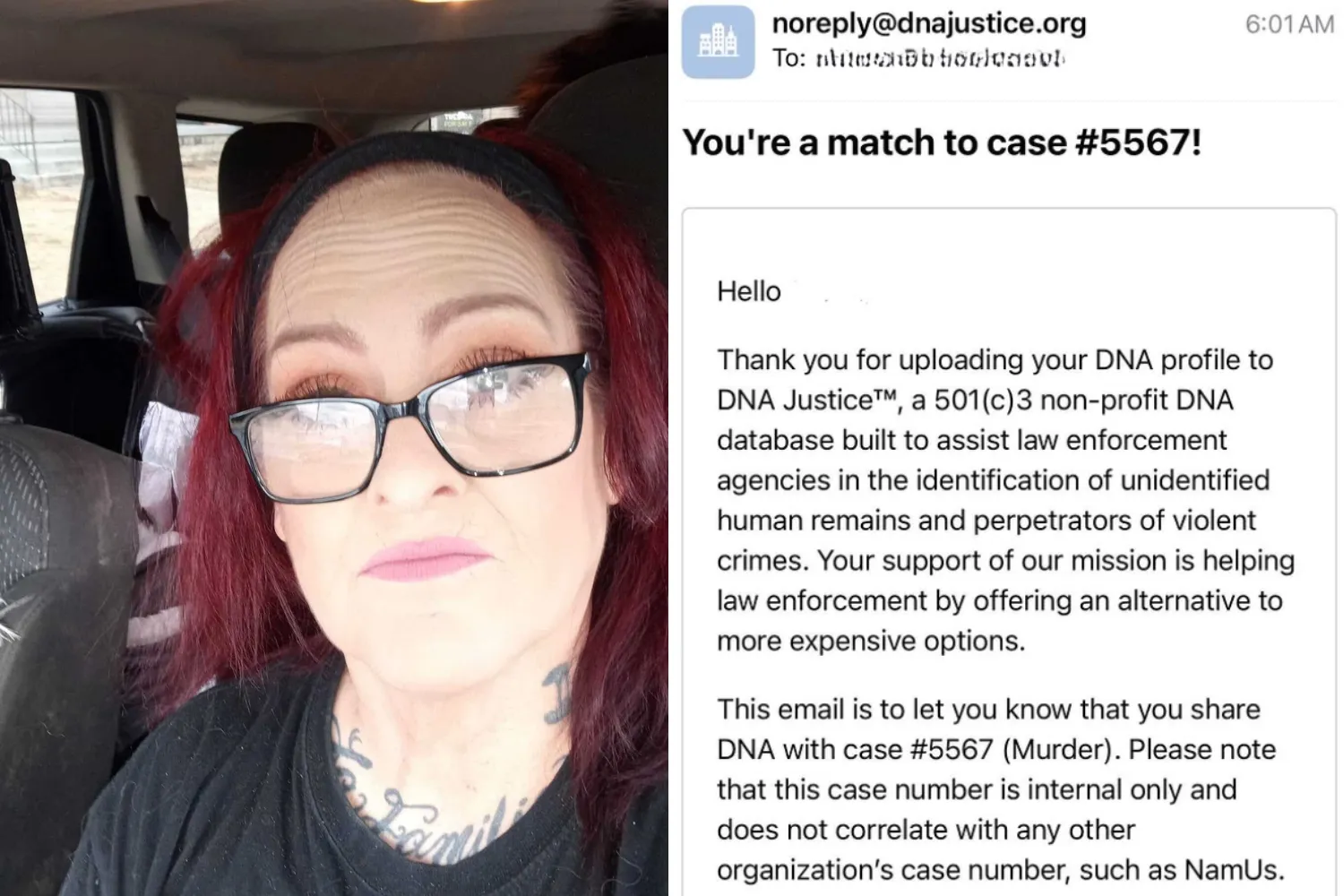
The letter came. DNA Justice contacted her to say that her genetic information may be relevant to an active case. The email did not specify whether her DNA was connected to identifying a suspect or identifying unidentified remains, and Grady said that uncertainty has stayed with her.
...
"I want to know, especially if it is unidentified remains," she said.
"The emails go out automatically to anyone who uploads their DNA profile to DNA Justice if they share 7 centiMorgans or more with any of the law enforcement DNA profiles that have been uploaded," Margaret Press, Ph.D., a co‑founder of DNA Justice, told Newsweek. "We aren't permitted to share case details beyond the internal DNA Justice ID number they received in their email."
Grady said her decision to upload her DNA came from a deep concern for people whose cases remain unresolved.
"People who have been harmed and victimized… for me, that’s the most important thing, knowing that I’m able to help," she said. "Knowing that I’m able to help do something right and help bring a family closure."
That sense of responsibility, she said, has only grown stronger as she has continued her genealogy work.
Discovering Her Family’s Ties to Slavery
Grady’s interest in genealogy began as a personal project and eventually grew into an expansive family tree that includes more than 7,000 people. While researching her mother’s side of the family in Tennessee, she uncovered a discovery that fundamentally changed how she understood her past.
"I learned that my ancestors on my mother's side, my great‑grandparents were all slaveholders," Grady said.
The realization hit close to home.
"My children are Black. My grandchildren are Black. So this was disturbing," Grady said.
As she pushed further into her research, Grady said she reached a point where historical records could no longer provide answers.
"I hit a roadblock. I couldn't get any further," she said, adding that she understood what that silence reflected about America’s past. Submitting her DNA helped her move beyond what written records could reveal.
Meeting a Cousin—and Apologizing
DNA testing connected Grady with relatives she had never known existed, including a cousin in Alabama descended from enslaved people linked to her family.
"It’s just so emotional," she said. "Slavery, we all know it happened, but it hits different when you realize that you’re about to meet someone who’s the product of that, and your lineage had something to do with it."
The discovery pushed her to do something she said she had never done before.
"One thing that I’ve never done as a white person, I’ve never apologized to anyone of color for what’s happened in this country," Grady said.

...
While acknowledging she was not personally responsible for slavery, she said she was raised in a system shaped by it.
"This country was built on systemic racism, and so for the first time in my life, I apologize," she said.
Her cousin’s response, she added, was immediate.
"He said apology accepted. And that healed my heart."
Building Family Trees for Victims of Racial Violence
Grady said that reckoning with her own family history led her to expand her work beyond her relatives. While examining historical mortality schedules, she said she began uncovering records tied to racial violence.
"Sometimes it’ll say ‘hanged by a mob,’" she said.
The pattern, she said, was unmistakable. "People of color, right, by racism and the KKK."
She now spends countless hours reconstructing family trees for victims of lynching and racial terror and searching for their descendants. The work, she said, is emotionally exhausting.
"I cannot tell you the number of hours and coffee and sleepless nights that I have spent," she said.
Still, she feels compelled to continue.
"We cannot let them be forgotten."
That same sense of responsibility, Grady said, is what made the email from DNA Justice feel so heavy—and so important.
She said she is less concerned with what the case might reveal about her own family than with the possibility that her DNA could help identify someone who has remained unnamed.
"I just think it’s so important that we identify these unidentified women, children and men," Grady said.
For Grady, genealogy has become more than a search for names and dates. It is, she said, about accountability, remembrance, and the possibility of repair—whether that means apologizing to a newly found relative or helping bring closure to a family she may never meet.
View 0 Comments
Submit Correction
View Editorial & AI Guidelines