10
Loading video...

By Jack Beresford
Senior Reporter
0
Share
Newsweek is a Trust Project member
See more of our trusted coverage when you search.Prefer Newsweek on Googleto see more of our trusted coverage when you search.
A woman in Alaska was about to take her dogs for a walk when the dramatic arrival of an unexpected guest sent everyone rushing back inside.
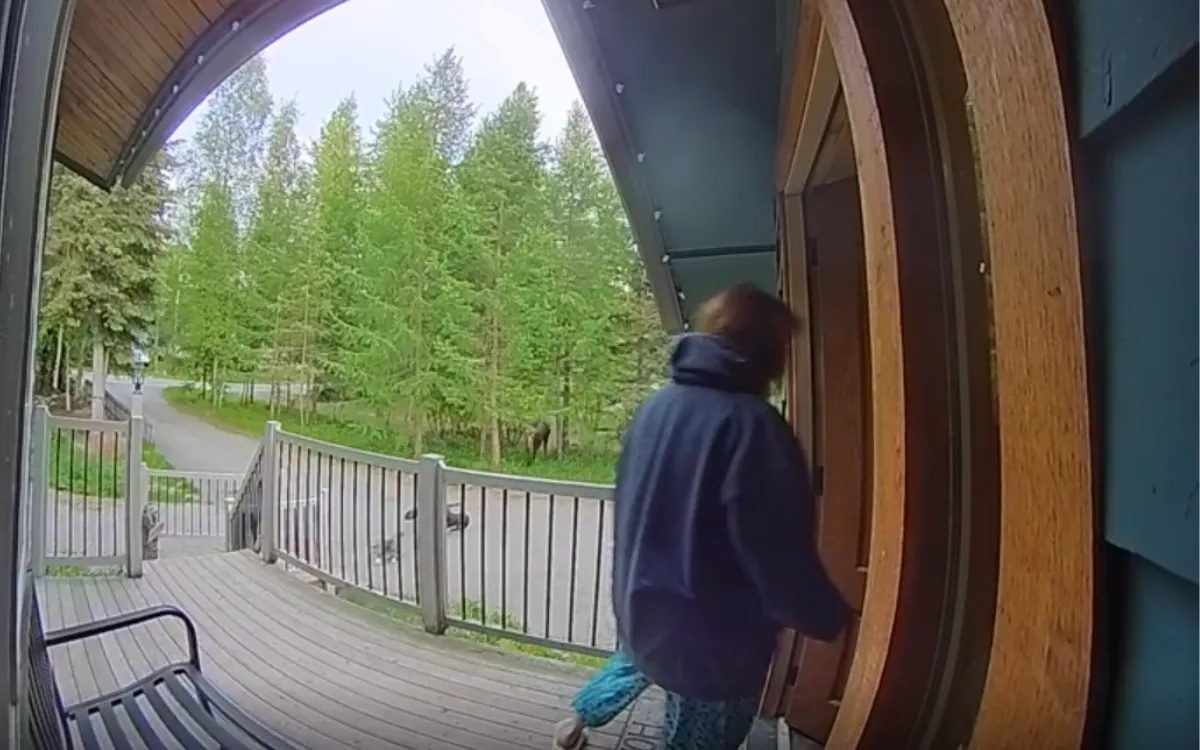
Video footage captured on Corrine Chaplin from Anchorage’s Vivint security camera shows the moment her day took a wild turn. In the clip, which was shared with Newsweek by Vivint, Chaplin can be seen preparing to leave her home with her three dogs.
At first, everything seems normal. The dogs run around the yard, playfighting and exploring the various sights, sounds, and smells around them. Then one of the dogs stops near an area of woodland and begins barking at something that’s initially not visible in the video.
Read More on Pets
That quickly changes, however. Coming outside to see what her dog is barking at, Chaplin is witness to the moment a moose, minus their antlers, comes charging out of the woods, heading directly for her barking dog.
The three dogs scatter, with two of them making their way back up to the steps towards Chaplin’s porch and front door. Though the moose stops short of going after any of the three dogs, the large animal’s presence in the yard appears to be enough to put Chaplin off the idea of venturing outside.
As the video concludes she is shown, rather wisely, calling her dogs back into the house. Though there is a little hesitation from the three pups, they ultimately decide they are better off inside and go scurrying in.
Given the moose in the video appears to be without antlers, it could be a female, as cows do not grow antlers. It may even be a young calf, as they do not grow full antlers until they are older. However, the fact it came in the period between winter and early spring, when male bulls shed their antlers, makes it more likely that the animal in the video was a male. Their size and aggressive behavior certainly backs up that assertion.
...
How common are moose sightings in Alaska?
Alaska is home to an estimated 175,000–200,000 moose, which is by far the largest population in the U.S. Sightings are to be expected.
However, Anchorage is a particularly notable hotspot for sightings. Biology Insights suggests that several hundred moose can be found within the municipality at any given time.
This is largely down to the extensive green space found across the region, with Anchorage home to over 200 miles of trails, parks, and connected greenbelts. It’s an area with a plentiful supply of willow and birch-rich vegetation.
What Should You Do If You Encounter A Moose?
If you encounter a moose, the key is to stay calm, give it space, and avoid provoking it. Moose may look slow or relaxed, but they can be aggressive—especially if startled, protecting a calf, or during mating season.
Stay at least 50 yards away if possible. Do not shout, wave your arms, or make sudden movements. Increase distance quietly while keeping the moose in sight. Large trees, cars, or buildings can offer protection. If the moose hasn’t noticed you, leave quietly. Avoid drawing attention to yourself.
There are also some warning signs that a moose may charge that are important to look out for. If their ears are laid back against their head or you can see their hackles are raised, it’s crucial to keep as much distance as possible.
Any repeated yawning or licking of lips may be an indication of danger, as is the sight of a moose lowering or swinging their head from side to side. If a moose does charge, run away and try to either zigzag your run or get behind some form of cover. If the moose does knock you down, curl into a ball, making an effort to protect your head and stay still until the moose retreats.
View 0 Comments
Submit Correction
View Editorial & AI Guidelines