10
Loading video...

By Rachael O'Connor
Reporter
0
Share
Newsweek is a Trust Project member
See more of our trusted coverage when you search.Prefer Newsweek on Googleto see more of our trusted coverage when you search.
A woman was relaxing with a solo swim when she suddenly realized she was in danger.
Mélanie, 28, is a French woman now living in Okinawa in Japan, and calls Ukun Beach "one of my favorite spots" in her new home.
She regularly goes swimming and snorkeling in the "shallow and calm" waters, and has never encountered any problems—until a recent trip which left her shocked and in pain.
Read More on Life
"I've been there many times over the years and had never experienced anything like this before," she told Newsweek.
"Since it was early, there was almost no one around, and the water is usually shallow and calm, so I thought it would be a relaxing swim. I swam a little way from the shore when I spotted the first box jellyfish."
The Japanese box jellyfish, also known as Chironex yamaguchii or habu-karage in Japanese, has powerful venom and a strong, painful sting that causes welts in the skin.
They are typically sighted between May and October in Okinawa, can be difficult to see, and can be found in shallow water, according to the Visit Okinawa website.
...
A video shows her snorkeling in the clear water, when suddenly multiple ghostly white jellyfish with long tendrils begin appearing in front of her.
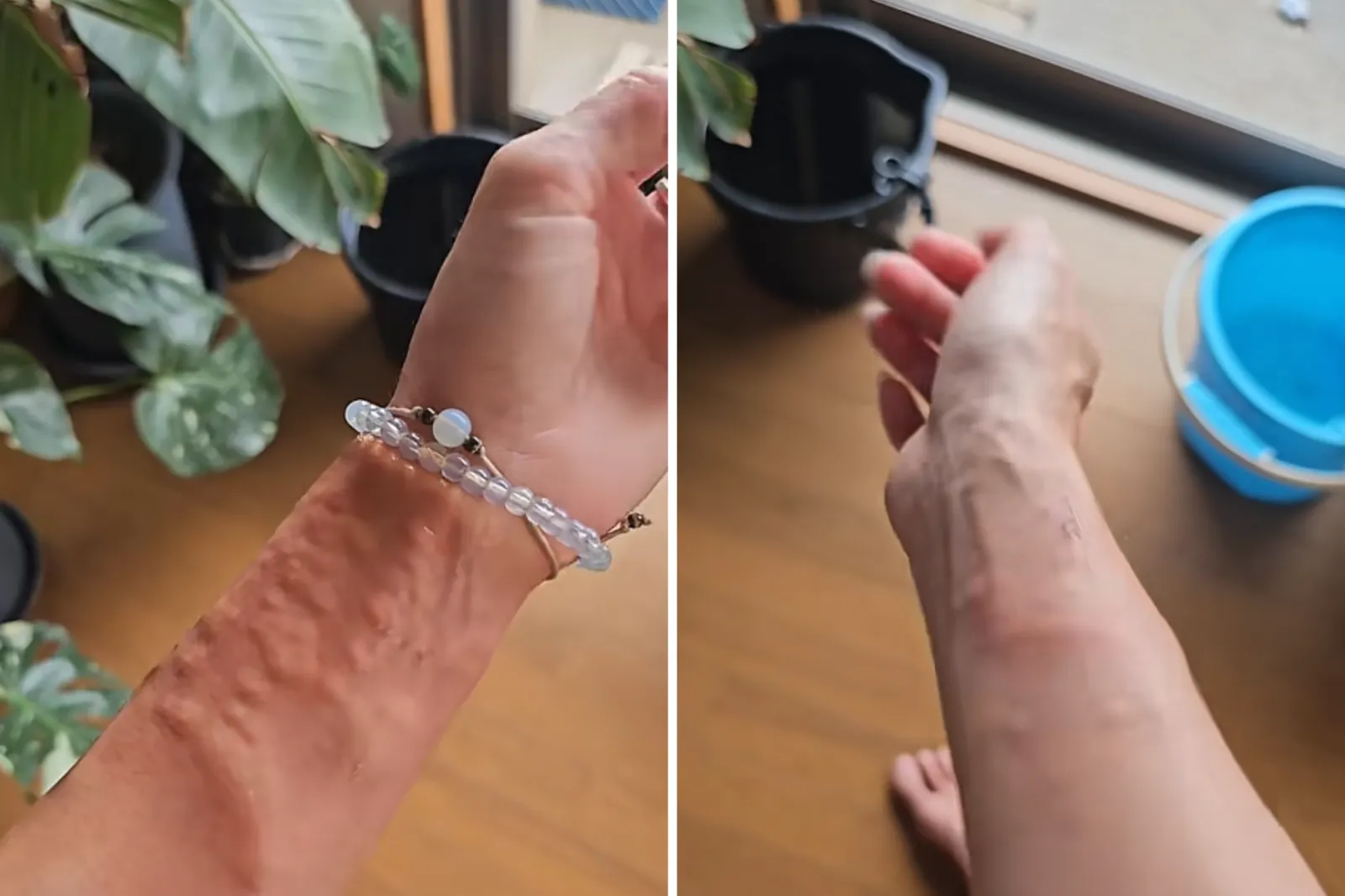
She tries to find a way out of the water without touching the jellyfish, which have a vicious sting—but the clip ends with her showing the marks they had left on her arms and legs as their tendrils wrapped around her.
Raised, red and white bumps cover both of her wrists and the area above her knee.
She recalled the terrifying moment to Newsweek: "As soon as I realized I needed to head back, I noticed they were everywhere around me. I wasn't extremely far from shore, but I was far enough that I had no choice but to swim back through them."
Mélanie tried to "carefully weave between" the "dozens" of jellyfish, even being forced to try and move some aside with her hand without being stung, which she called "incredibly difficult because they are almost completely transparent."
"Even with a snorkeling mask, they're very hard to see," she said. "Their tentacles are also much longer than you expect."
She added: "Looking back, I realize I was very lucky. I wasn't stung on my face or head, and considering how many jellyfish surrounded me, it could have been much worse."

...
The Okinawa Prefectural Department of Health and Welfare warns that serious injuries from the jellyfish may be fatal, and advises anyone stung to immediately leave the water, not to rub the stung area, to pour vinegar on the area and chill the painful area with ice or cold water.
Mélanie, however, had grown up in France, and "instinctively rubbed the stings with sand" once she got out of the water as she "didn't know what else to do"—and throughout the day, "the stings became more and more swollen, painful, and uncomfortable."
"The stings have now healed, but they still itch from time to time, and I still have visible marks on my arms that will likely leave scars," she said.
She later met a local who told her the correct way to treat box jellyfish stings in the future, but "by then it was already too late for me to follow those recommendations."
Mélanie says that, having lived in Okinawa for three years, before that day she had only ever seen a single box jellyfish, and "seeing dozens at once was something I had never experienced."
"Some local residents have suggested that warmer sea temperatures may be contributing to changes in jellyfish activity, although I can't say for certain whether that explains what happened that day."
Contact Newsweek editors on this story: Rebecca Flood and Emma Lee-Sang
View 0 Comments
Submit Correction
View Editorial & AI Guidelines