...

By Soo Kim
Reporter
0
Share
Newsweek is a Trust Project member
See more of our trusted coverage when you search.Prefer Newsweek on Googleto see more of our trusted coverage when you search.
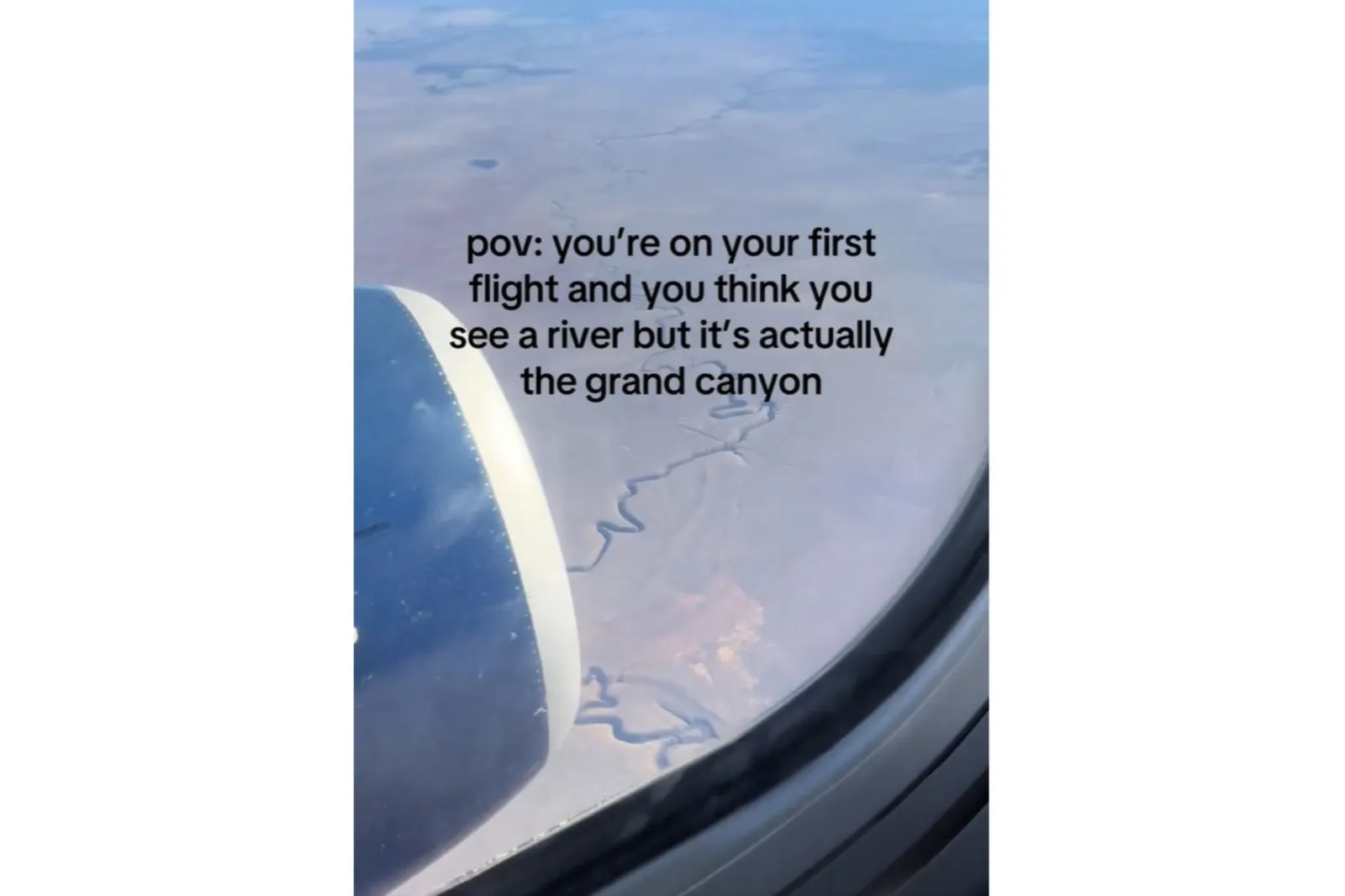
A video capturing a woman’s disbelief over a view of the Grand Canyon from above has gone viral on TikTok.
The clip was posted by user @hazygrim and has garnered around 3.7 million views since it was shared on January 31.
Filmed from the window seat of an airplane, the video shows an aerial view of what initially appears to be a winding river cutting through the landscape below. Text overlaid on the clip explains the moment of realization: “pov: you’re on your first flight and you think you see a river but it’s actually the grand canyon.”
Read More on Travel
In the caption accompanying the post, the creator summed up her reaction succinctly, writing: “I was like no wayyyyyy.” The brief description echoes the sense of shock captured in the video, as the scale of what she is seeing becomes clear.
From the air, the Grand Canyon can appear deceptively subtle at first glance, especially to first-time flyers unfamiliar with the immense size of the landscape. What might resemble a river or shallow valley from thousands of feet above is, in reality, one of the most expansive and dramatic geological formations in the world.
The National Park Service (NPS) explains that Grand Canyon National Park is located entirely within the state of Arizona and encompasses 278 miles of the Colorado River and its surrounding uplands. The park sits on the ancestral homelands of 11 present-day Tribal Communities and is widely regarded as “one of the most spectacular examples of erosion anywhere in the world,” the NPS notes. The canyon reaches a depth of approximately a mile and is known for the sweeping vistas it offers from both the North Rim and the South Rim.
The grandeur that surprises many first-time observers is the result of an extraordinarily long and complex geological history. According to the NPS, the park preserves a range of geological resources that span vast stretches of time, including igneous and metamorphic rocks dating back 1.8 billion years to the Precambrian era, sedimentary rocks from the Triassic period roughly 230 million years ago, and volcanic deposits as recent as the Pliocene epoch, around 5 million years ago.
The Colorado River, which runs through the canyon and can be misleadingly understated when viewed from high altitude, established its course approximately 6 million years ago. According to the NPS, the river likely evolved from pre-existing drainage systems and was shaped over time through a combination of erosion, groundwater emergence from springs, tributary development and active tectonic forces. These ongoing processes continue to shape the canyon today.
Beyond its striking appearance, the canyon serves as an important scientific record. The NPS notes that the geologic record preserved within the Grand Canyon is a key reason for its “inspirational scenery” and scientific value. Paleontological resources found within the park include nearly 350 fossil sites of global significance, ranging from 1.2-billion-year-old stromatolites to Paleozoic-era trilobites, plants, reptile tracks and marine invertebrates. Remains of Pleistocene megafauna have also been found preserved in caves within the canyon.
Newsweek has contacted the original poster for comment via TikTok. This video has not been independently verified.
Do you have a travel-related video or story to share? Let us know via life@newsweek.com, and your story could be featured on Newsweek.
View 0 Comments
Submit Correction
View Editorial & AI Guidelines