
...

By Adeola Adeosun
Weekend Night Editor
0
Share
Newsweek is a Trust Project member
See more of our trusted coverage when you search.Prefer Newsweek on Googleto see more of our trusted coverage when you search.
Department of Homeland Security (DHS) Secretary Kristi Noem indicated on Sunday that Venezuelans previously under Temporary Protected Status (TPS) will have the opportunity to apply for refugee status but will not automatically be allowed to remain in the United States.
During a Fox News Sunday interview, Noem defended the Trump administration's decision to end TPS protections while stating that "Venezuela today is more free than it was yesterday."
DHS later clarified on X that the characterization of Noem's statement was inaccurate, in a response to an account that posted Venezuelan migrants could apply to become refugees in the U.S., writing: "This is not what Secretary Noem said. President Trump is bringing stability to Venezuela and bringing to justice an illegitimate Narco Terrorist dictator who stole from his own people."
Read More on News
The post added: "Secretary Noem ended Temporary Protected Status for more than 500,000 Venezuelans and now they can go home to a country that they love."
Newsweek reached out to DHS via email on Sunday for additional comment.
Why It Matters
Congress created TPS in 1990 to prevent deportations to countries experiencing political unrest, natural disasters, civil strife, or other dangerous conditions. The designation is granted in 18-month increments by the DHS secretary.
President Donald Trump took issue with the way the Biden administration had used TPS, arguing that multiple extensions of TPS designation for different countries had led to abuse, saying that those with TPS were really in the U.S. illegally. Under immigration law, the DHS secretary has the power to extend TPS status every 18 months or allow it to lapse. Noem has opted for the latter as various countries have come up for renewal, most recently South Sudan. Similar arguments have been made by Noem and DHS that conditions that had led to TPS being granted in the first place have improved, and so the protections are no longer needed.
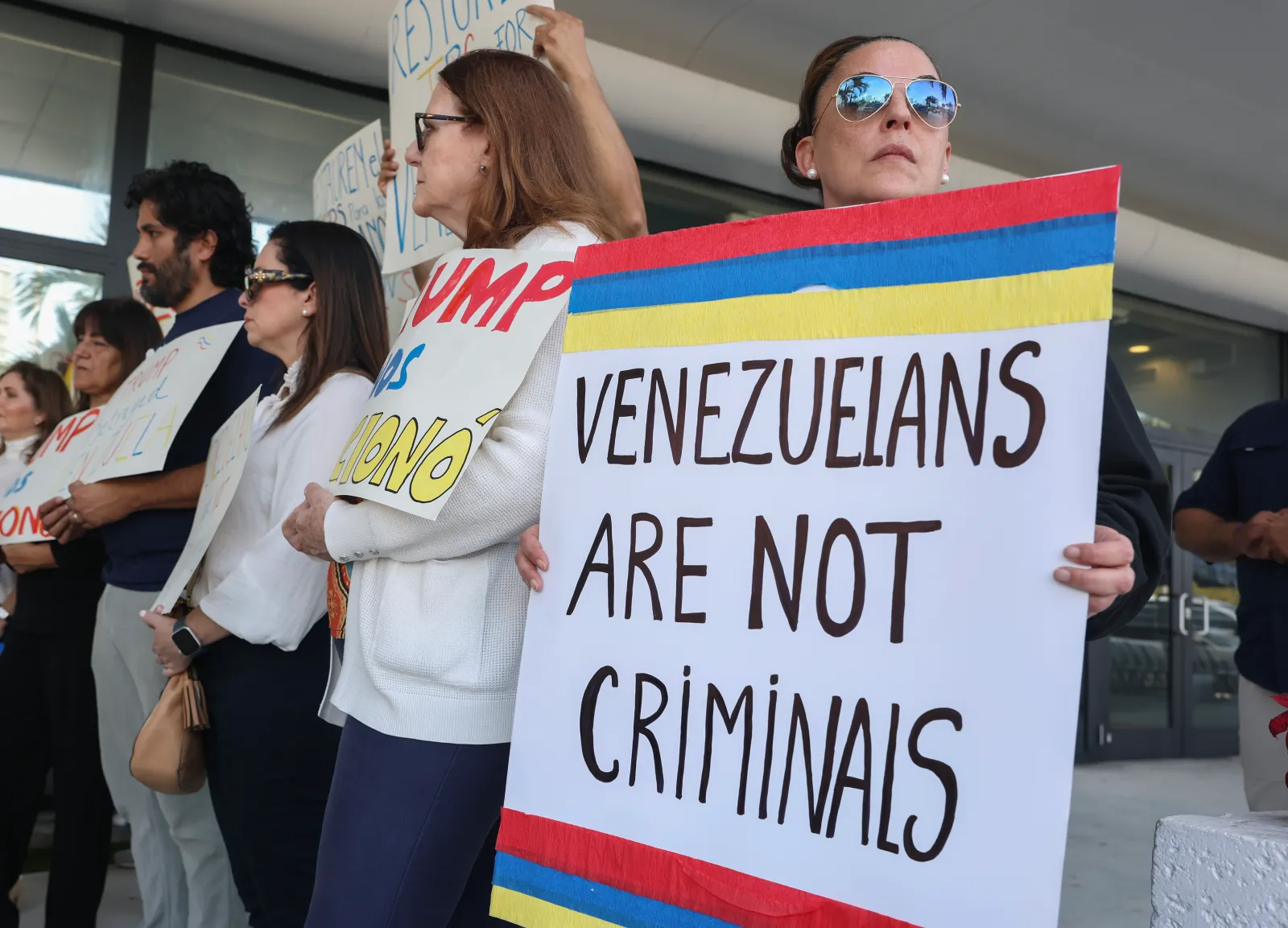
Meanwhile, the termination of TPS affects hundreds of thousands of Venezuelans who have been living and working legally in the U.S., some after many years.
The timing is particularly significant as then-Venezuelan President Nicolás Maduro was detained on Saturday by U.S. forces, marking a dramatic shift in the country's political landscape. Newly elected Miami Mayor Eileen Higgins called the elimination of TPS "reckless, dangerous, and wrong," urging President Trump to reinstate protections.
Miami has the largest Venezuelan population in the U.S., especially the Doral and Weston suburbs.
Since January, the Trump administration has cancelled or attempted to cancel TPS for nine countries, affecting hundreds of thousands of immigrants.
What To Know
Noem's statement comes after the Trump administration struck Caracas in a "large scale strike" early Saturday morning and Maduro, along with his wife, was captured and taken out of Venezuela to the U.S. following the military operation.
Maduro, wife, and son have been formally indicted in the Southern District of New York, including on charges of narco-terrorism conspiracy, U.S. Attorney General Pam Bondi said. Maduro had previously been indicted in March 2020 on "narco-terrorism" conspiracy charges in the same district, and in August 2025, the U.S. doubled its bounty to $50 million for information leading to his arrest. Maduro has denied any wrongdoing.
According to the DHS's X statement on Sunday, Noem ended TPS for more than 500,000 Venezuelans, stating "now they can go home to a country that they love." During her interview on Fox News Sunday, when asked whether the administration would force TPS holders to return to Venezuela amid a governmental flux, Noem responded that decisions regarding TPS "are made in conjunction with the State Department, with the White House, and then we at the Homeland Security implement them." She emphasized that "every individual that was under TPS has the opportunity to apply for refugee status."
"That evaluation will go forward, but we need to make sure that our programs actually mean something, and that we're following the law," she added.
The Supreme Court ruled on October 3, 2025, allowing the administration to strip legal protections from more than 300,000 Venezuelan migrants, putting on hold a lower-court ruling that had blocked the TPS termination. The Trump administration has moved to end TPS for 600,000 Venezuelans and 500,000 Haitians who received protection under former President Joe Biden.
U.S. District Judge Edward Chen in San Francisco had ruled last year that the DHS "acted with unprecedented haste" to terminate Venezuelan migrants' TPS status, finding that DHS made "decisions first and searched for a valid basis for those decisions second."
Immigration advocates have said many of those in the program face difficulties adjusting their U.S. immigration status when they want to remain in the country long term, and that returning to their home countries is not a safe option for them or their families. These advocates are among the plaintiffs who have brought legal challenges against the Trump administration for trying to revoke TPS for various countries, including Venezuela and Haiti—two countries the State Department still warns Americans about traveling to, despite determining they are safe enough for Venezuelans and Haitians to return to.
Noem has also ended TPS status for Nicaraguans, Hondurans, Afghans, and Cameroonians, all under similar determinations of improved conditions.
...
What People Are Saying
Julia Gelatt, associate director of the U.S. Immigration Policy Program at the Migration Policy Institute, told Newsweek in November: “Litigation is keeping some grants alive for the time being. Haitians have TPS through early February thanks to ongoing litigation. And some Venezuelans, who applied to renew earlier this year, had their TPS extended through early April. But all face the shadow of losing their protections and work authorization and face stark choices about what comes next, and whether it's feasible to continue their lives in the United States.
Adelys Ferro, co-founder and executive director of the Venezuelan American Caucus, previously told Newsweek: "We, more than 8 million Venezuelans, just didn't leave the country just because it's fun, it's because we had no choice...Venezuelans with TPS are not a threat to the United States."
What Happens Next
Affected Venezuelans can apply for refugee status, though the evaluation process and approval rates remain uncertain.
View 0 Comments
Submit Correction
View Editorial & AI Guidelines