
...

By Shane Croucher
Senior Editor
0
Share
Newsweek is a Trust Project member
See more of our trusted coverage when you search.Prefer Newsweek on Googleto see more of our trusted coverage when you search.
The Bible says Jesus Christ rose again on the third day. Jensen Huang, the Messiah of semiconductor chips and, by his own admission, a very naughty boy, might need a little longer to resurrect his professional career at Nvidia. He is trying.
Huang has discussed a comeback with confidants, according to The Financial Times. One ally told the paper they are assembling a "war room" of tech bigwigs to convince the Nvidia board to reinstate him—and to seek the White House’s support.
He resigned last Thursday amid reports of extramarital affairs. One was said to have been with a woman whom U.S. intelligence officials suspect is a Chinese intelligence asset, though this is unproven; until last year, she led a Singapore-based customer of Nvidia’s highly prized—and strictly controlled—chips.
Read More on Analysis
Investigations are ongoing, including an independent inquiry by Nvidia’s board and a Justice Department criminal investigation into that customer, Megaspeed.
Much is still unknown about Alice Huang, the former Megaspeed executive named as Jensen Huang’s mistress (they are not related), and it is unknown whether she really was aiding Chinese intelligence.
But what we do know is the whole Nvidia saga has exposed a war within the Trump administration about what really counts as "America First," the campaign slogan-cum-governing ideology that drives the current White House.
Bessent Versus Lutnick
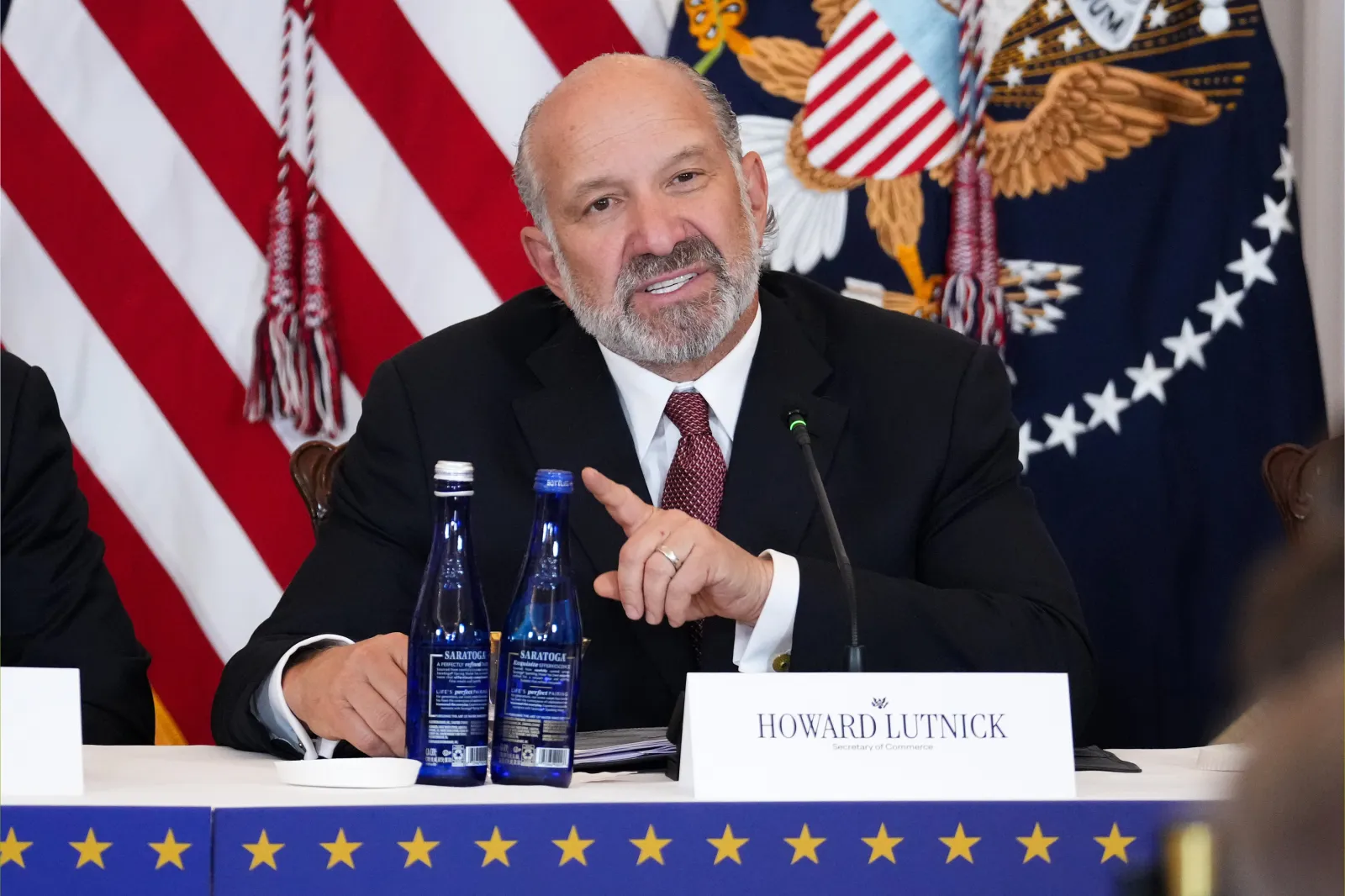
The two tribal leaders in this civil war are Treasury Secretary Scott Bessent and Commerce Secretary Howard Lutnick.
They have competing visions of how to win the great power competition with China, especially the race on artificial intelligence, in which access to Nvidia’s chips is a major strategic advantage.
Put simply, Bessent’s camp believes the way for America to emerge first is to cut off China’s access to advanced American technology, preserving as much of the advantage as possible exclusively for the U.S. for vital economic and national security reasons.
Related Story

Where Jensen Huang Ranks Among History’s Biggest Honey Traps
Bessent told CNBC’s Squawk Box that Treasury, State, Defense, and the U.S. Trade Representative’s office had wanted Megaspeed on an export blacklist for months over concerns about China accessing Nvidia chips, but "Commerce has the pen."
Lutnick, by contrast, sees that tech as a tool of dependence: hook your competitors on it so they are reliant, and you create a customer who won’t easily buy elsewhere. That means lots of leverage and money. America emerges first by other means.
He said as much in July 2025, explaining that Washington wanted to sell China enough that "their developers get addicted to the American technology stack" while keeping its best chips at home.
Jensen Huang Seeks the China Market
Huang had made the commercial case two months before Lutnick, calling export controls "a failure" that had shrunk Nvidia’s share of China’s market from almost 95 percent to 50 percent as Chinese rivals moved in.
"I really do hope that the U.S. government recognizes that the ban is not effective and give us a chance to go back and win the market as soon as possible," Huang had said at the Computex conference in Taipei, Taiwan.
In an April 2026 podcast interview with Dwarkesh Patel, Huang said China already has abundant energy and chips, and it can simply manufacture and use more of the less-advanced chips than Nvidia’s for its compute needs.
What is preferable, Huang argued, is for China to be reliant on an American tech stack rather than allowing a layer of the American AI industry to lose a major market inside a rival power.

...
"Conceding the entire market is not going to allow the United States to win the technology race long-term in the chip layer, in the computing stack. That is just a fact," Huang said.
This is a genuine America First argument, not just a corporate one. A Chinese lab that builds on Nvidia hardware and software pays an American company, trains its engineers on American tools, and finds it costlier to switch.
Walk away, and Chinese money funds the rivals who will one day take on American firms everywhere else. And when the U.S. needs to apply pressure on Beijing, it no longer has the lever of its world-leading tech stack.
Controlling the Dependence
The opposing argument starts with the special nature of the product. Revenue is not national power. An American firm can grow richer while its Chinese customers grow evermore capable. Advanced chips are the raw material of the AI race. Why help China run?
The denial camp doesn’t need to prove that much stricter export controls can stop Chinese innovation forever, only that they buy America more time as the global AI leader and raise costs for the competition trying to close the gap.
So the real dispute isn’t necessarily sell versus don’t sell. It’s whether they can control the dependence. Addiction is leverage only if the dealer really controls the supply.
Related Story

Megaspeed’s Megafast Money: Bad Tradecraft?
That’s why Megaspeed matters more than the alleged infidelity. The company bought billions of dollars’ worth of Nvidia processors and stands accused of routing some of them to blacklisted Chinese buyers, which it strongly denies.
Bessent reportedly confronted Lutnick in the Situation Room over why Megaspeed was not yet blacklisted, despite long-running concerns. Commerce denies the exchange happened, though Bessent’s recent comments show there is clearly tension on this issue.
If restricted chips can still reach China through intermediaries, America is handing over computing power while gaining none of the promised leverage. The Lutnick and Huang argument would be that this is the reality, and so it’s better to just own the whole market.
China Is Already Looking Elsewhere
Dependence also cuts both ways. Beijing doesn’t intend to stay reliant on American compute. After Lutnick’s remark, Chinese regulators pressed tech firms to stop ordering Nvidia’s H20 chip, reportedly finding his words insulting.
Washington’s licenses haven’t guaranteed sales either. Nvidia told investors that Beijing restricted H200 purchases the U.S. had approved, and those shipments came to under 1 percent of its data center revenue in its last reported quarter.
As Huang told Patel, China is a huge manufacturer of chips already. It can generate massive amounts of compute even without access to the most advanced American chips.
Moreover, China is focusing its AI development in part on improving the efficiency of its models, and so reducing the need for as much compute.
"Compute constraints are driving innovation in architecture, systems engineering, and domestic chip substitution—turning limitations into competitive advantages," said a recent analyst note from the investment bank William Blair.
Two Strategies Coexist
Each America First camp owes an answer to the following questions. For those who want to sell to China: what makes this dependence durable and enforceable? For those who want restrictions: how much time do controls buy, and what stops it being squandered?
Some might argue that the two strategies already coexist happily enough. In January, Commerce began reviewing H200 exports to China case by case, provided buyers screen their own customers and the chips pass U.S. testing.
Jeffrey Kessler, Commerce’s undersecretary for industry and security, said controlled sales "will strengthen the American technology ecosystem."
Related Story
The Nvidia ‘Spy’ Was Real, But China Export Controls Are Realer
A well-policed mix of selling and withholding may be a best-of-both strategy. But defending licensed sales is not the same as excusing suspected diversion. The Megaspeed fight in particular is about enforcement, not doctrine.
Trump, who says the U.S. must win the AI race against China, has so far not stepped in to settle the argument. He travels to Shenzhen this week to meet Xi Jinping, with Lutnick expected to join him, and the White House does not expect him to raise the Nvidia affair.
But Trump should hold both camps to the same standard. Selling chips advances America First only when Washington retains credible control over the dependence it creates: licenses enforced, intermediaries policed, and supply that can genuinely be withheld.
Restricting chips advances America First only where the time it buys is spent strengthening America’s own position: shoring up cyber defenses, patching vulnerabilities, improving domestic models, and adding safeguards against catastrophic misalignment.
Huang’s allies want the White House behind his reported comeback. Lutnick, under pressure from Bessent, is in his camp already. Whether or not Huang rises again, the doctrine he sold Washington—that dependence is dominance—may need a resurrection of its own.
View 0 Comments
Submit Correction
View Editorial & AI Guidelines