...

By Tom O'Connor
Deputy Editor, National Security and Foreign Policy
0
Share
Newsweek is a Trust Project member
See more of our trusted coverage when you search.Prefer Newsweek on Googleto see more of our trusted coverage when you search.
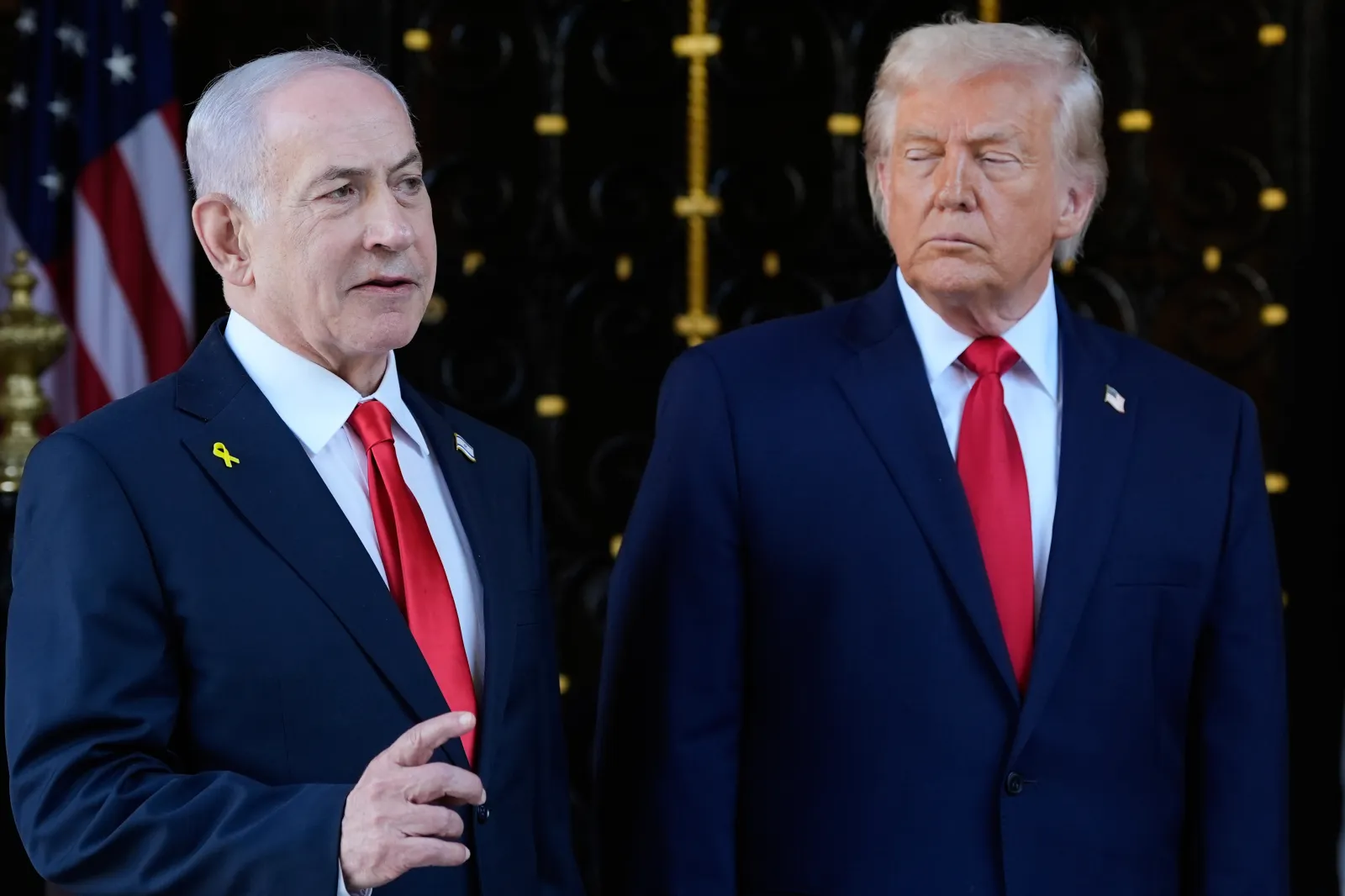
As Israeli Prime Minister Benjamin Netanyahu arrives for his seventh meeting with President Donald Trump since the U.S. leader took office a year ago, former officials identify potential gaps in the two allies' position on the White House's ongoing effort to pursue a new deal with Iran.
Trump has repeatedly threatened military action against Iran since nationwide protests devolved last month into the deadliest clashes in the history of the Islamic Republic, with the U.S. accusing security forces of perpetrating the systematic killing of demonstrators. Trump's warnings have been accompanied by a substantial build-up of U.S. assets in the region, including the arrival of the USS Abraham Lincoln carrier strike group, which last week targeted an Iranian drone operating over the Arabian Sea.
Yet Trump, who became the first U.S. leader to order direct strikes against Iran during its 12-Day War with Israel in June, has also consistently voiced his desire to reach a diplomatic rather than military solution, with new talks held between the two sides in Oman on Friday. Vice President JD Vance reiterated this position Monday, telling reporters that "reaching an agreement with Iran would benefit everyone.”
Read More on Analysis
With the conditions of such a deal still unclear, Netanyahu, a longtime critic of the previous U.S.-Iran nuclear agreement reached in 2015 and abandoned by Trump three years later, said Tuesday he will present to Trump his "principles" for a more stringent arrangement that concerns not only Iran's nuclear activities but also its ties to non-state actors across the region and its vast missile arsenal.
"The Prime Minister believes any negotiations must include limitations on ballistic missiles and a halting of the support for the Iranian axis," Netanyahu's office said in a statement referred to Newsweek by the Israeli Consulate General in New York.
Rachel Brandenburg, former State Department and Pentagon official now serving as managing director of the Israel Policy Forum and adjunct senior fellow at the Center for a New American Security, argued that the White House may be going down a path that does not sufficiently meet Netanyahu's threshold, setting the stage for a potential clash.
"I think President Trump wants a win—but it's not clear yet whether that win needs to be related to Iran's nuclear program, its ballistic missile program, both, or regime change," Brandenburg told Newsweek. "If his team can conclude an agreement that he can spin as halting Iran's nuclear program, for example, that may be enough for him to claim victory and walk away."
"Prime Minister Netanyahu, on the other hand, wants to finish the job he started in June 2025—whether by striking additional targets that get at Iran's ballistic missile and nuclear program, or taking out the current Iranian regime entirely," Brandenburg said. "It is unlikely that any deal the Trump team can conclude will sufficiently assuage Israel's concerns about Iran's nuclear program or ballistic missile program."
Newsweek has reached out to the White House for comment.
...
The Making of a Deal
After overseeing U.S. strikes against three Iranian nuclear facilities last year, Trump once again demonstrated his willingness to carry out military action amid negotiations when he ordered the U.S. Delta Force raid that captured Venezuelan President Nicolás Maduro and his wife from their home in Caracas in early January.
The operation added new weight to Trump's threats directed toward Iran as unrest swept the nation that same month. Iranian officials, who have blamed most of the violence on infiltrators backed by foreign intelligence agencies, have counted at least 3,117 dead, including more than 500 members of the security forces, while some watchdogs based abroad have placed the overall death toll as much as 10 times higher.
As the Iranian government sought to restore order through crackdowns and pro-government rallies, Trump called on Iranians to continue taking to the streets, as "help is on the way." By around the middle of the month, however, the demonstrations had largely dissipated, and Washington reopened talks with Tehran, calling for a new agreement under the threat of intervention.
"Almost a month later, he has moved a significant amount of military assets to the Middle East and re-entered negotiations with Iran over its nuclear program, but he hasn't actually sent any help," Brandenburg said. "It is not clear that he wants to strike militarily, and it is highly unlikely he wants to enter into as prolonged an engagement as would be needed for regime change. Not to mention risk the instability that might follow. Iran is not Venezuela, neither in construct, population size, or proximity to the United States."
She argued that Netanyahu, on the other hand, appeared more poised to conduct or support a military operation against Iran, not least because Iran's nuclear program and missile arsenal "present a more proximate and acute threat to Israel" and "Netanyahu sees a weakened Iranian regime as a window of opportunity to re-engage militarily."
A decisive defeat for Iran would mark perhaps the most ambitious achievement yet for Netanyahu after the Israeli premier oversaw victories against Tehran's Axis of Resistance coalition on several key fronts following the regional war sparked by a Hamas-led attack on Israel in October 2023.
In Lebanon, Israel continues to strike Hezbollah despite a November 2024 ceasefire reached after intensive Israeli strikes that killed scores of top commanders, including longtime Secretary-General Hassan Nasrallah. In Syria, where a rebel offensive toppled Iran-aligned President Bashar al-Assad, whose family had dominated the country for more than half a century, Israel also continues to operate, even with Trump courting Damascus' new leadership.
But an attack on Iran may require explicit buy-in from the White House.
"Given how reliant Netanyahu is on Trump, however, it is unlikely that he would engage in another war against Iran without at least a green light from the United States, and preferably, U.S. involvement," Brandenburg said. "He is likely coming to Washington to make this crystal clear to Trump as he watches Trump engage in negotiations that I expect Bibi views as relatively useless and a complete waste of time."
David Schenker, senior fellow at the Washington Institute who previously served as assistant secretary of state for near eastern affairs during the first Trump administration, noted that some administration officials have openly discussed seeking to include Tehran's Axis of Resistance ties and missile stockpile in an agreement, though such items have rarely been mentioned by Trump himself.
Pointing to some of Trump's past agreements, like his late-first-term United States-Mexico-Canada Agreement (USMCA), which Schenker described as "largely the same deal" as the North American Free Trade Agreement (NAFTA) it replaced six years ago, Schenker told Newsweek that "the Israelis are concerned about that trajectory."

...
Competing Agendas
When Netanyahu presents his case to Trump on Wednesday, he will be competing with other regional allies and partners, including Saudi Arabia, Qatar, Turkey and the United Arab Emirates, each of whom have expressed opposition to U.S. military action against Iran that may prove destabilizing across the Middle East.
Noting Trump's "excellent" relationships with the leaders of these countries, which extend in many cases to personal and business ties, Schenker said that when "they weigh in heavily against a military strike, this is something that certainly resonates, I think, with the president," who also has made clear his favorability toward reaching an agreement.
"I think the president himself, notwithstanding some very discreet uses of force that have been highly successful, understands that a strike against Iran could be more complicated and involved and riskier for the United States and a more prolonged involvement," Schenker said. "So, all of which is to say is that he's always inclined to go for the deal first."
"And so, I think this is consistent with his modus operandi, which is send the military, maximize pressure and leverage, go to the negotiating table, get concessions, cut a deal," he added. "But the Iranians have an interest in prolonging this, you know, not moving off the nuclear front. And so, this is going to be, ultimately, a choice for the president."
There is also the risk of Netanyahu potentially overreaching in his quest to push Trump toward a harder position on Iran, especially at a time when the U.S. leader was looking to showcase progress in his new Board of Peace, an initiative formed to advance the Gaza ceasefire that includes Netanyahu and the majority of regional leaders.
"Just to start off with, the prime minister is coming to talk about Iran. The president may very well want to talk about the Board of Peace meeting," Schenker said. "That could be a bit of a divergence."
"Netanyahu is ambivalent about the Board of Peace. He doesn't want to be in the same room as the Emir of Qatar and the president of Turkey," he continued. "At the same time, I think he feels that good relations with the United States [are important], but the rest of the room at that meeting would not be so sympathetic, necessarily, to Israel's position."
Trump hinted at his frustration over recent measures announced by Israel’s far-right Finance Minister Bezalel Smotrich and Defense Minister Israel Katz toward annexing the West Bank, which is divided between Palestinian, Israeli and joint administration in line with the 1990s Oslo Accords.
"We have enough things to think about now. We don't need to be dealing with the West Bank," Trump told Axios on Tuesday.
Brandenburg, for her part, felt that Netanyahu was already at risk of alienating Trump at a time when the U.S. leader remained committed to advancing the Gaza ceasefire, an endeavor that would necessitate regional support.
"I do think Netanyahu's advocacy for military engagement against Iran is backfiring, particularly as he is seen to be a roadblock for progress on Gaza, which many of those same key U.S. partners view as a priority for progress politically and with respect to reconstruction," Brandenburg said. "Trump has come to understand that implementation of his 20-point plan to rebuild and stabilize Gaza, a political horizon for the Palestinians in the West Bank and Gaza, and avoiding Israeli annexation over the West Bank—for example—are important to Arab states whom he views as key partners in the region."
"Although none of them want to see a nuclear Iran or resurgence of Iranian proxy capabilities in their backyards, they also preference stability over another war—particularly initiated by Israel," she added.
Michael Rubin, former Pentagon official who is today a senior fellow at the American Enterprise Institute, also saw a divergence between Trump and Netanyahu. But he felt these differences were rooted more in concern that the Trump administration may prioritize limited military action over a more comprehensive approach that would both topple the Islamic Republic and ensure lasting stability.
"The two leaders differ on consistency and mission. The biggest fear in the region is Trump's strategic Attention Deficit Disorder. No one wants him to start a war he is not committed to finishing," Rubin told Newsweek. "For Netanyahu, the problem is also divergence of mission. Trump often puts Trump first. He craves a Nobel Prize. Netanyahu likely fears Trump will build up to war, declare success and demand a prize. For Netanyahu, Israel's existence is at stake; there can be no compromise."
As for the regional countries, he argued "the desire of these states for restraint has less to do with strategic divergence with Israel and the U.S. on the Iran question, and more to do with fear that Trump is not serious about finishing the job." He added: "Israel and the Gulf Arab states want Trump to get rid of the hornet's nest; they all fear he'll knock it a few times with a stick and then walk away.
"Iranian officials will also likely be watching Trump and Netanyahu's interactions closely. Iranian Foreign Ministry spokesperson Esmaeil Baghaei was cited by the Fars News Agency as telling reporters that "our negotiating party is America, and it is up to America to decide to act independently of destructive pressures and influences that will certainly harm the region and without considering America's interests."
"One of the problems of American foreign policy in West Asia is its compliance with and adherence to Israel’s demands, which has been the main cause of insecurity and security problems in our region for the past eight decades," Baghaei said. "The root of turning Iran’s nuclear program into an artificial crisis was the Zionist regime, which has been repeating the proposition for about 40 years that Iran is seeking nuclear weapons and instilling a kind of fear in the world."
"This regime has repeatedly shown itself to be a destructive actor," he added. "It is America’s responsibility not to let others decide for America’s foreign policy."

...
Strategic Alignment
Both the U.S. and Israel have traditionally downplayed reports indicating any friction between the two allies and their leaders and the messaging leading up to the next Trump-Netanyahu meeting appears to be following a similar trend.
“I think there’s an extraordinary alignment between Israel and the United States," U.S. Ambassador to Israel Mike Huckabee told The Jerusalem Post on Tuesday. "Everyone would love to see something that would resolve without a war, but it will be up to Iran. If they insist on holding nuclear weaponry and enriched uranium, then I think the president made it very clear that this is not acceptable."
Gregg Roman, executive director of the Middle East Forum who previously worked at the Israeli Defense Ministry and served as adviser to the Prime Minister's Office, similarly argued that" the premise that Trump and Netanyahu are far apart on Iran deserves scrutiny."
"Secretary of State Rubio has defined four clear American objectives: elimination of Iran’s nuclear weapons capability, restrictions on its ballistic missile program, an end to its support for regional proxies, and protections for the Iranian people. Those four pillars align closely with Israel’s longstanding position," Roman told Newsweek. "The question is not whether Washington and Jerusalem agree on what a good deal looks like. The question is whether Tehran will accept those terms."
"The record demonstrates that both countries prefer diplomacy first and are willing to act when diplomacy fails," Roman said. "Before the 12-day war last June, the United States gave Iran a 60-day window to negotiate in good faith. Iran squandered that opportunity. The joint U.S.-Israeli strikes on Natanz, Fordow, and Isfahan that followed were not an impulsive escalation. They were the logical consequence of a regime that refused to engage seriously when given every chance to do so."
Today, Roman argued, "the strategic environment now favors a comprehensive agreement more than at any point in the history of this conflict," given the destruction of Iranian nuclear infrastructure, along with the setbacks faced by Hamas, Iran's Axis of Resistance in Lebanon and Syria, and even Iran's own internal security situation.
"A deal that met those four objectives would not constitute a missed opportunity for Netanyahu. It would validate the strategy Israel has pursued for years," Roman said. "The real missed opportunity would be allowing Iran to use negotiations as a stalling tactic to reconstitute capabilities that both the United States and Israel sacrificed enormously to degrade. Both leaders understand this."
As such, he argued that "the risk of a serious rupture between Trump and Netanyahu is overstated."
"The four objectives Rubio outlined are objectives Israel shares. Both leaders understand that Iran is weaker than it has been in decades and that the current leverage was built together through a deliberate sequence of diplomacy, pressure, and military action," Roman said. "The Israeli position is straightforward: hold firm on all four pillars, because Iran’s weakness makes a comprehensive deal achievable for the first time."
As for the positions of other regional countries, however, he questioned the inclusion of Qatar and Turkey in any diplomatic initiatives, including the issues of Iran and Gaza. Israel has accused both nations of maintaining ties to Hamas and the Muslim Brotherhood movement, even as Trump has praised the two countries' role in supporting the U.S. ceasefire agreement first signed in October.
"On the Board of Peace, the composition matters as much as the mandate. Countries that funded Hamas before, during, and after October 7 should not be architecting Gaza’s future," Roman said. "Saudi Arabia and the UAE, nations that have demonstrated genuine commitment to reform, normalization, and countering radical Islam, are the credible Arab partners for any reconstruction framework."
"The question is whether the Board of Peace will be shaped by those who invested in Gaza’s destruction or by those invested in a genuinely new regional order."
View 0 Comments
Submit Correction
View Editorial & AI Guidelines