
Photo-Illustration by Newsweek/Associated Press

By Jesus Mesa
Reporter
0
Share
Newsweek is a Trust Project member
See more of our trusted coverage when you search.Prefer Newsweek on Googleto see more of our trusted coverage when you search.
As news of Nicolás Maduro’s dramatic ousting by U.S. special operations forces spread on Saturday, a wave of surprise and joy surged through Venezuela’s opposition and its exiled supporters—many of whom had spent years trying to win over Donald Trump, believing he, and only he, could do what they had dreamed of for decades.
But within hours, that initial triumph soured. From the man they had courted, praised, and trusted came a blunt rejection: María Corina Machado, their chosen leader and the most recent Nobel Peace Prize winner “doesn’t have the support or the respect” within Venezuela to lead its 30 million people, as Trump put it at a Mar-a-Lago press conference while Maduro was still in transit to the U.S.
"My jaw hit the floor,” said Adam Isacson, a regional expert at the Washington Office on Latin America. “It tells me they’re thinking about who controls the weapons, the capacity for violence—and that’s not María Corina.”
The Washington Post reported on Monday, citing two sources close to the White House, that Trump had soured on Machado because of her decision to accept the Nobel, an award the president has long and openly coveted. “If she had turned it down and said, ‘I can’t accept it because it’s Donald Trump’s,’ she’d be the president of Venezuela today,” one of the *Post'*s sources told the paper.
Read More on Politics
But reporting from The New York Times and The Wall Street Journal revealed that Trump's decision not to support Machado as Venezuela's interim leader was actually the product of months of debate and analysis from the intelligence community.
Sources within the opposition who spoke to Newsweek agreed with this assessment. U.S. officials believed that Maduro’s hand-picked vice president, Delcy Rodríguez, would be better suited to secure American energy interests in Venezuela in the short term—a view shaped in part by U.S. intelligence assessments and back-channel diplomacy involving Trump ally and Special Presidential Envoy Richard Grenell.
...
“She’s essentially willing to do what we think is necessary to make Venezuela great again,” Trump said of Rodríguez, who faced U.S. sanctions during Trump’s first administration for her role in undermining Venezuelan democracy as part of the Maduro regime.
In what appeared to be a damage-control effort, Machado then gave lengthy interviews to CBS and Fox News, in which she not only celebrated Maduro’s ouster but also praised Trump, even going so far as to offer to share her Nobel Peace Prize. In those interviews, she said she had not spoken with the president since October 10, when she received the award.
At the time, Trump himself most notably said he did not know who she was.
“Somebody got it who’s a very nice woman, very nice. I don’t know who she is, but she was very generous. So I don’t care about all that stuff. I just care about saving lives,” he said on October 17.
A Reckoning for the Opposition
It has been a difficult turn for María Corina Machado, who was once a pariah within Venezuela’s opposition for her hard-line refusal to negotiate with Nicolás Maduro and his Chavista regime.
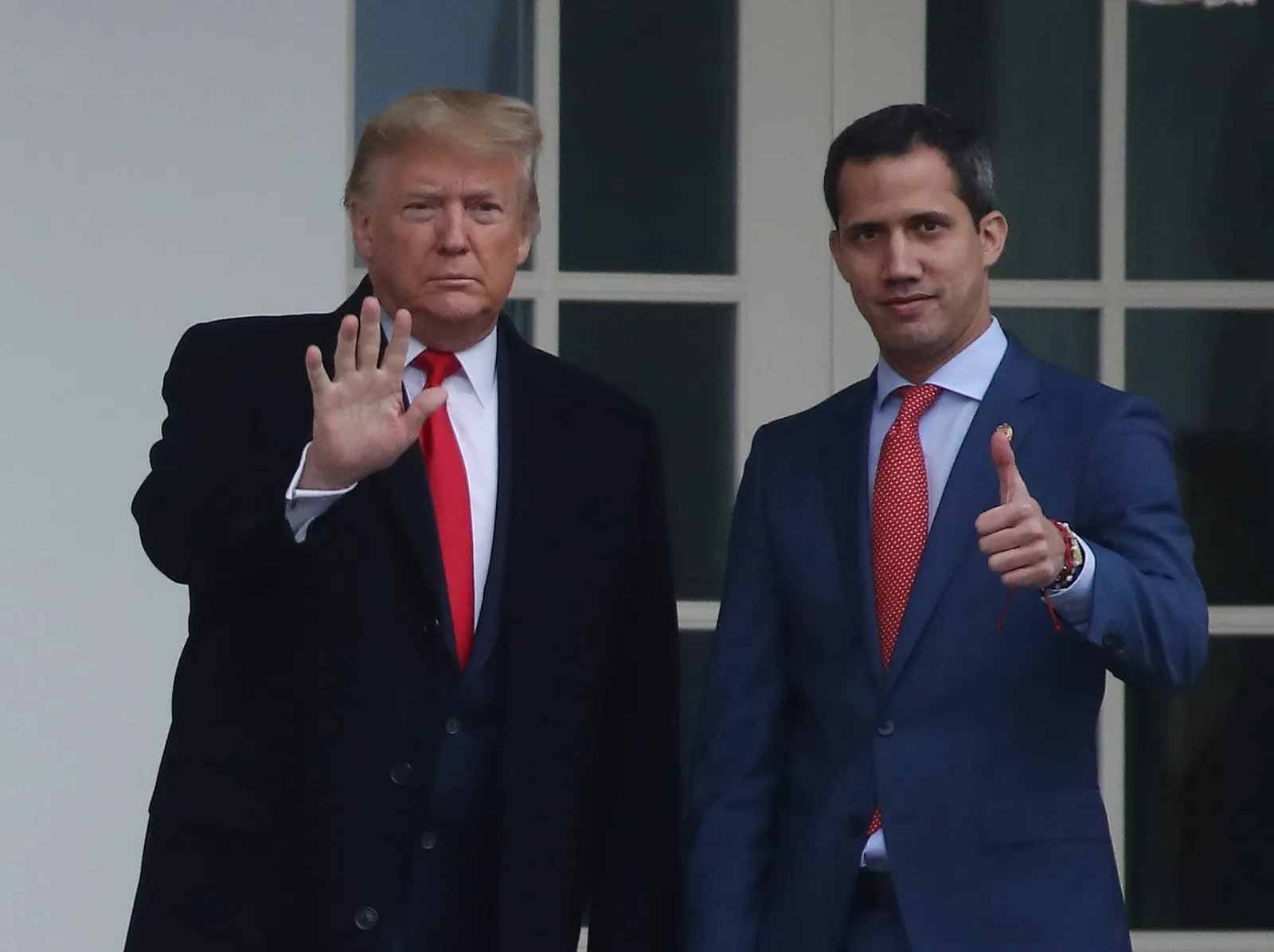
Machado was also among the first opposition leaders to distance herself from the U.S.-backed strategy that elevated Juan Guaidó, then a largely unknown National Assembly member, as Venezuela’s interim president in 2019. That approach, engineered by the first Trump administration, collapsed spectacularly. Its political fallout still lingers, even for figures like Machado who played no role in its design or execution.
“Trump doesn’t really trust this opposition anymore,” a member of the Venezuelan opposition who asked to remain anonymous told Newsweek.
“He shows a relatively high level of ignorance about Venezuela and believes it is enough to read it as a simplistic good-versus-bad story. But he also saw how that strategy failed, and he does not believe they can deliver,” echoed Ronal Rodríguez, a Venezuelan researcher at the Venezuela Observatory at Colombia’s Universidad del Rosario.
...
The Guaidó strategy, orchestrated by officials like former National Security Adviser John Bolton, former Vice President Mike Pence and Venezuelan Envoy Elliot Abrams, relied heavily on the expectation that Maduro’s inner circle would fracture and that the military would defect. That did not happen. At the same time, corruption scandals plagued the interim government, including the disappearance of tens of millions of dollars in overseas assets and allegations of self-dealing by opposition envoys responsible for managing them.
Speaking to Newsweek, former National Security Adviser John Bolton said the episode left Trump with little confidence in the opposition figures who had promised a swift victory, although he placed the ultimate blame on Washington.
“The opposition was betrayed by someone inside the Maduro regime they believed had agreed to defect,” Bolton said. “But ultimately it was the U.S. that failed. We did not apply enough pressure.”
Trump, he added, “was never willing to use military force, and that is why the regime survived.”
Even before Trump threw U.S. support behind Delcy Rodríguez — at least on an interim basis — doubts persisted within the opposition about the mistakes of previous years. Gabriela Arellano, a former Venezuelan lawmaker now coordinating Machado’s political team from exile in Bogotá, acknowledged that errors made during the interim government, particularly under Guaidó’s leadership, damaged the movement’s credibility in Washington.
“There were moments when we were not strategic,” Arellano told Newsweek. “People inside the movement used their platforms for personal benefit, and that cost us. But this is a new leadership and a different process. María Corina is not part of that old dynamic.”
Betting on Trump, Despite the Risk
Machado may be the opposition’s most visible figure today, but in 2019 the movement was led by Juan Guaidó, alongside Leopoldo López, Henrique Capriles, and Julio Borges. At the time, Machado distinguished herself by arguing that Maduro could only be forced from power through direct foreign intervention. She even pushed to revive a long-dormant intergovernmental collective security agreement dating back to 1947.
The irony is that she ultimately proved right, though at a steep personal cost. Despite having no role in the decisions that failed seven years ago, her campaign is now burdened by broken promises and by a U.S. administration that appears more focused on stability and oil flows than on democratic alignment.
“If they mainly want oil, want migrants to return, and maybe want to occasionally strike organized crime, then they might be open to Chavismo,” said Isacson. “Their ideal scenario might be that Delcy Rodríguez does what they want for a while, calls new elections, and the opposition wins.”

...
Freddy Guevara, a former National Assembly leader now living in exile in New York, said the opposition understands why Washington’s priorities may have shifted, but that the underlying stakes remain unchanged.
“I think the Americans are not betting on revolution, but on reforms,” Guevara told Newsweek. “But the one holding the gun right now is the American government. We hope these guys understand that the Americans are not playing and that there is now a credible threat if they do not comply.”
Guevara, who was jailed by the Maduro regime in 2021, described Trump’s engagement with Rodríguez as a tactical move rather than a permanent rejection of Machado or the broader opposition movement.
“It is about immediate control,” he said. “But that does not mean we have lost the transition.”
Bolton, however, warned that such trust in Trump's intentions may be misplaced. In his view, the administration’s posture signals not just tactical flexibility, but a deeper willingness to sideline the opposition altogether.
“Trump is re-legitimizing the Maduro regime,” Bolton said. “He does not understand the trust that the Venezuelan people placed in Machado, and now the opposition is being discredited by the United States itself. If the result is the same authoritarian system without the figurehead, it is going to work out very badly.”
“Delcy Rodríguez is not a guarantee for economic investment, stability or transition,” said Arellano, the former Venezuelan lawmaker. “And that for there to be a transition, for a real process of restoring democracy to begin, the whole cartel must leave [the presidential palace] Miraflores.”
Washington’s Plan and the Power Question
By midweek, the outlines of the Trump administration’s post-Maduro approach were coming into focus. Secretary of State Marco Rubio described it as a three-stage process: First, stabilization. Second, economic recovery, ensuring that the West has access to markets. Only then, Rubio said, would Venezuela move toward a political transition.
“I have tremendous admiration for María Corina Machado. I admire Edmundo González as well. We all have views about the last election—not just us, but many other countries around the world. That said, we have a mission we’re focused on right now,” Rubio said in an appearance on CBS’ "Face the Nation" on Sunday.
Within days of Maduro’s removal, U.S. officials began working on plans to move tens of millions of barrels of sanctioned Venezuelan crude to American ports, according to President Trump. The arrangement under discussion could involve between 30 and 50 million barrels sold at market prices under U.S. supervision, a step that would immediately bring Venezuelan oil back into U.S. supply chains.

...
But who actually holds power on the ground in Caracas remains the central question. While the administration has treated Rodríguez as a potential interlocutor, current and former U.S. officials caution that she does not control Venezuela’s coercive institutions.
“The key people are not Delcy and her brother,” Bolton said. “The key people are Vladimir Padrino López (defense minister) and Diosdado Cabello (interior minister and longtime Chavista power broker). They are the ones with the troops, the police, and the colectivos.”
That assessment is widely shared among analysts. Adam Isacson said Trump’s public dismissal of Machado reflects a narrow view of where power currently resides in Venezuela. “They are thinking about who controls weapons and the capacity for violence,” Isacson said. “And that is not María Corina.”
Administration officials have privately raised concerns about the risks of sidelining Venezuela’s existing security apparatus. Beyond the armed forces and intelligence agencies, the country also includes armed civilian militias, organized crime groups, and Colombian guerrillas. Any of them could destabilize a fragile post-Maduro environment if they were abruptly displaced.
Days removed from Maduro's ouster, Venezuela’s opposition remains trapped in uncertainty. The same U.S. administration that delivered the capture of their enemy is now setting clear limits on how far it is willing to go on the opposition’s behalf. The moment of rupture has passed; the harder question lies ahead. Yet lawmakers like Freddy Guevara remain confident.
"We support the United States, and we’re convinced they support us as well. But we need to see concrete actions that show this is also about Venezuelan democracy."
View 0 Comments
Submit Correction
View Editorial & AI Guidelines