
...

By Tom O'Connor
Deputy Editor, National Security and Foreign Policy
0
Share
Newsweek is a Trust Project member
See more of our trusted coverage when you search.Prefer Newsweek on Googleto see more of our trusted coverage when you search.
The assassination of popular conservative commentator Charlie Kirk last week sent shockwaves throughout the United States, sparking new discourse on a growing wave of violence that risks normalizing the use of force to achieve political aims.
While much of this debate has portrayed political violence as an emerging, even foreign trend for the country, experts point out that bloodshed has long been a feature of U.S. politics, and the spike in politically motivated attacks witnessed over the past decade has yet to rise to unprecedented levels.
Yet even for a country no stranger to vicious cycles of violence, things could get worse before they get better.
Read More on Analysis
"For some time now, we've become increasingly inured to acts of unspeakable violence, most prominently and frequently on display in the form of mass shootings, often at schools or houses of worship," Jon Michaels, professor of law at the University of California, Los Angeles, and author of the book "Vigilante Nation," told Newsweek.
"Increasingly, though, the violence has become more explicitly political—and politics have become more explicitly violent," he added.
...
How Did We Get Here?
Many observers have pointed to the January 6, 2021 riot at the U.S. Capitol as a turning point for contemporary politics. Supporters of President Donald Trump stormed the building in a bid to forcefully overturn lawmakers' confirmation of then-President-elect Joe Biden's victory at the ballot two months earlier.
The attack, however, was only the culmination of growing manifestations of political violence in the U.S. In the lead up to the 2020 presidential race, when already flaring political tempers were exacerbated by an air of uncertainty surrounding the COVID-19 pandemic and ensuing lockdowns, violence perpetrated by and against the Black Lives Matter protesters following the death of George Floyd by police officer Derek Chauvin became a central component of a politically divisive news cycle.
Meanwhile, a number of election workers and government officials were subject to intimidation, harassment and threats of violence during and after the election, a trend that would continue through to the latest vote that returned Trump to the White House last November.
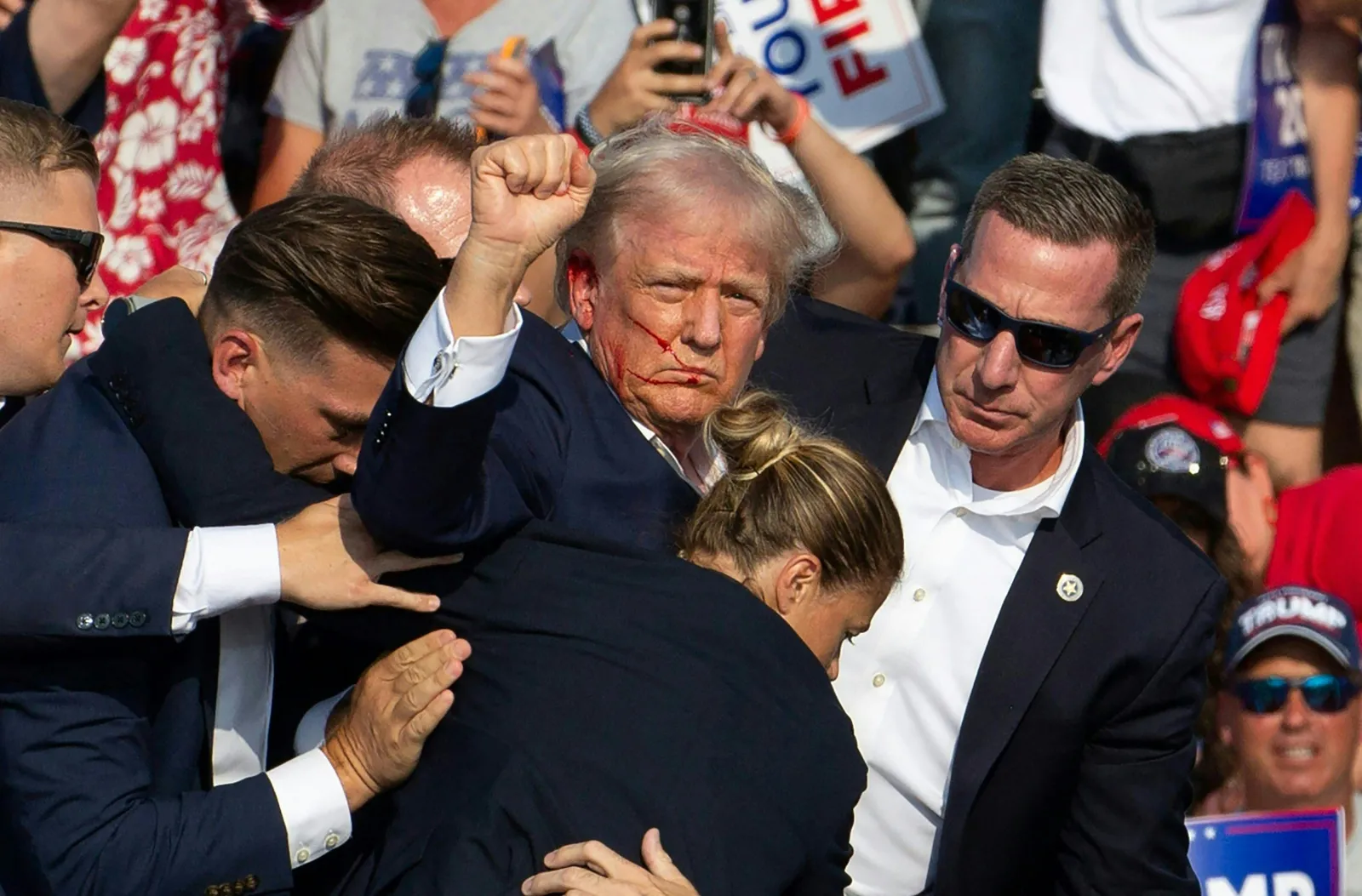
Violence would continue to manifest in other ways as well, with recent examples including the attempted assassination of Trump in the run up to the 2024 election, the assassination of Minnesota State Senator Melissa Hortman in June and a spate of other politically motivated attacks that targeted various sites such as a Jewish museum in Washington, D.C., the CDC headquarters in Georgia and a vigil for Hamas-held hostages in Colorado.
While most of these acts drew widespread condemnation, some have had a more mixed reaction from the public. The killing of United Healthcare CEO Brian Thompson in December sparked a firestorm of debate, with donations for alleged assassin Luigi Mangione nearing $1 million ahead of his first court hearing in April.
Kirk's killing last Wednesday while debating audience members on hot-button issues—including gun violence—at a Utah Valley University event has also been met with some celebration among his critics, shining a spotlight on the toxicity of the current political climate.
"What's behind all of this? Obviously, guns play a huge role but so does an ever-intensifying state of political and cultural tribalism that our political system exacerbates (thanks to gerrymandering and the partisan primary system)," Michaels said, "as does a profound disillusionment with democracy and its underlying commitments, one of which is the loss of political power is no excuse to resort to violence."
"So long as one sees the other guys are morally inferior and so long as one doesn't trust the political system to affirm his moral judgments, political violence is apt to continue apace," he added.
...
Where Did It All Begin?
The roots of violence in American politics run far deeper than the experience of the past decade. The first century of the nation born out of the Revolutionary War was marked by the systematic ethnic cleansing of Native Americans and frequent clashes among rival factions sparring over issues such as taxes, religion, race and governance, with slavery emerging as a major flashpoint that sparked the Civil War.
Immediately following that conflict, the deadliest ever bloodletting over opposing political agendas on U.S. soil, three leaders—Presidents Abraham Lincoln, James A. Garfield and William McKinley—were slain in office in the span of just 35 years. Violence in other forms would also intensify through the late 19th century and early 20th century.
"Many hundreds of Americans were lynched and murdered between 1890 and 1925 in particular," Jeff Goodwin, professor at New York University told Newsweek. "The Red Summer of 1919 was particularly violent. The Black neighborhood of Tulsa was burned to the ground soon thereafter."
"And this period also saw periodic massacres of workers, some black, some white, including the horrific Elaine, Arkansas massacre," he added.
Violence would again erupt on a nationwide scale during the civil rights era, when Goodwin noted "dozens of Southern activists were killed, followed by many more killed by police during the urban rebellions that began in 1965 and continued well into the 1970s."
"Dozens of Black Panther activists were killed, and many more thrown in prison," he added. "Five radicals were killed in the Greensboro massacre in 1979. Police would kill many more people in the rebellions that occasionally broke out afterwards, in Miami and Los Angeles and elsewhere."
This period was also marked by a presidential assassination, the 1963 killing of President John F. Kennedy, and three other attempts: one shot that wounded President Ronald Reagan in 1981, and two just weeks apart that were unsuccessfully directed toward President Gerald Ford in 1975.
Given this legacy, Goodwin argued, "yes, violence is rising, but it is nowhere nearly as severe as during the first decades of the last century or during the long civil rights era."
As to why violence has so potently reemerged in U.S. politics over the past decade, he points to both ideological and socioeconomic trends plaguing the nation.
"Inequality has not been so vast for many decades. People are pissed, working-class people especially but not just them," Goodwin said. "And the far right has not been this strong for many decades. You probably have to go back to the far right in the South during the 1950s and 1960s to find something comparable."
William Galston, senior fellow at the Brookings Institution and former White House deputy assistant on domestic policy, pointed to events since the dawn of the 21st century that have eroded the U.S. public's trusts in institutions that have otherwise moderated violent tendencies in politics.
"If you just look at what's happened since the turn of the century, in the beginning of the new millennium, we had a government asleep at the switch while terrorists were preparing to kill thousands of Americans," Galston told Newsweek. "We responded with two expensive, lengthy and mostly failed wars while we had the worst financial crisis since the Great Depression, and very few financial experts had any sense that was about to happen, either. We had a painfully slow recovery from that recession."
"I think the list goes on and on and on," he added. "The past quarter-century has not been a great period for governance in America, and there have been some patches of competence, but they've been the exception rather than rule."
The issue is compounded by a growing divide between the two parties that jockey for control of the legislative and executive branches. One University of Southern California survey released during the 2016 election that ultimately handed Trump his first victory found that political polarization was at its worst level since the Civil War. The ensuing years have done little to abate the problem.
"Many scholars—I'm one of them—have been charting the rise of political polarization in the United States over the past generation," Galston said, "and the growing sense that the differences between the parties and the partisans are harder and harder to negotiate, and that each side seems determined to dominate the other, not just beat them in the normal way, but beat them into submission."
"Each side sees the other as a mortal threat to a way of life or set of principles that it cherishes," he added, "and so the adjective existential has been much overused, but obviously it's being used for a reason."

...
Where Do We Go from Here?
While seemingly cyclical in nature, past eras of violence do not necessarily dictate the future, argued Galston.
"Here we are again now, and the fact that the fact that previous cycles of violence eventually died down, there's no guarantee that the current cycle will," Galston said. "But we shouldn't leap to the conclusion that we're in an inexorable downward spiral that can end only in mass violence, civil war—call it what you will—that conclusion is not warranted by history."
A recent report released by the Armed Conflict and Location Event Data (ACLED) monitor also noted that, while "smaller-scale, scattered incidents" in which the population was exposed to violence was up since the beginning of the year, more serious events, along with fatal incidents and those involving armed groups were down. Protests, while up since this past January, had also yet to exceed the 2020 peak.
The conclusion, according to ACLED, was that the U.S. was not currently on a "civil war trajectory," noting that the country currently "lacks systematic, organized, militarized opposition."
The greatest danger lies in unpredictable lone-actor violence — as tragically underscored by the assassination of Charlie Kirk," the report found.
But to escape the current cycle would also take key steps from political leaders, "the principal responsibility" of whom, Galston said, "is not to fight fires with fires, it's to fight fire with hope, with foam, the way they do with airlines crashes, to try to deprive the blaze of oxygen that keeps it going."
"Don't add fuel to the fury," Galston said.
Christian Davenport, the Walgreen Professor for the Study of Human Understanding and Political Science at the University of Michigan and a research professor at the Peace Research Institute Oslo, argued that the role of the state in the study of trends in political violence has been largely underrepresented.
Pointing to recent research he has conducted studying both "government" and "challenger" indicators of "relative contention" in the U.S., he concluded that "coercion and force enacted by governments generally exceeds that generated by behavioral challengers between 1950 through the 1970s."
"Between 1970 through the early 2000s, challenger behavior exceeded that of governments but by 2005 government behavior again exceeded that of challengers," Davenport told Newsweek. "By 2010, this shifted again. The takeaway here is that one cannot simply say that political violence is recently increasing without noting the broader historical shifts."
In fact, he warned, that the sole focus on the role of non-state actors, including both "lone wolf" attackers and organizations, has been a key factor undermining efforts to "curb state repression."
"Individuals in the United States must therefore be careful not to simply accept claims that non—state political violence is on the rise without evidence," Davenport said. "Individuals in the United States must also remember that governments have often facilitated/instigated violent dissent, terrorism and insurgency in their efforts to control what is taking place in their territorial domain."
"These are undertaken by 'agents provocateur,'" he added. "I mention this not to promote paranoia but to caution individuals for once we accept that governments have an incentive to help individuals engage in violence directed against them, then we become better as well as more cautious citizens—demanding evidence, taking the time to evaluate what took place and intelligently moving forward to hold everyone responsible for what took place."
View 0 Comments
Submit Correction
View Editorial & AI Guidelines