
...


By Mandy Taheri and Brendan Cole
0
Share
Newsweek is a Trust Project member
See more of our trusted coverage when you search.Prefer Newsweek on Googleto see more of our trusted coverage when you search.
About a dozen U.S. executives are joining President Donald Trump on his trip to China to meet with President Xi Jinping, the first visit by a sitting U.S. president in nearly a decade.
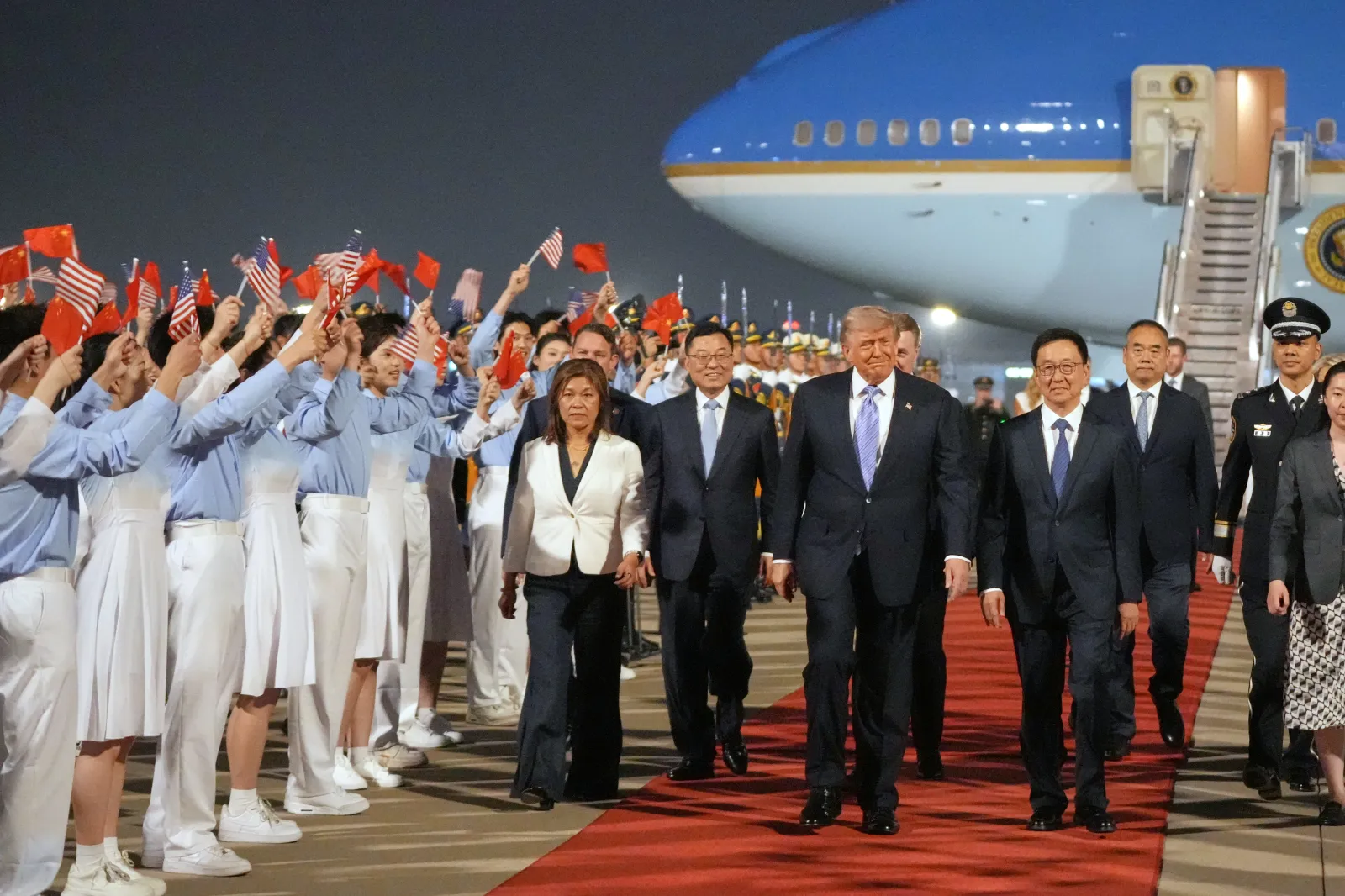
Trump arrived in Beijing on Wednesday evening, 7:50 p.m. local time, where he was greeted on the tarmac by a military guard and performers waving the Chinese and American flags and chanting "Welcome, welcome." Also welcoming Trump were China’s vice president, Han Zheng; the Chinese Ambassador to the U.S., Xie Feng; and the vice minister of foreign affairs, Ma Zhaoxu.
The U.S. president has said he is looking to strike trade deals, and there is anticipation over whether both countries will extend a tariffs truce set to end in October after a bruising trade war last year.
Read More on News
The world's two largest economies face fierce competition in emerging technologies and security, and Trump's visit comes as the U.S. has sunk significant costs into the war in Iran.
Trump said that he will be asking Xi, "a leader of extraordinary distinction", to "open up China" so that several tech and other industry business leaders accompanying him could "work their magic."
...
Who Is With Trump?
Top technology executives from the chip industry, finance, agriculture, aerospace, technology and payments are traveling with Trump, highlighting his administration’s economic and business priorities.
- Jensen Huang, Nvidia
- Tim Cook, Apple
- Elon Musk, Tesla/SpaceX
- David Solomon, Goldman Sachs
- Kelly Ortberg, Boeing
- Brian Sikes, Cargill
- Cristiano Amon, Qualcomm
- Steven Schwarzman, Blackstone
- Larry Fink, BlackRock
- Jane Fraser, Citi
- Jim Anderson, Coherent
- Henry Lawrence Culp, GE Aerospace
- Jacob Thaysen, Illumina
- Michael Miebach, Mastercard
- Dina Powell McCormick, Meta
- Sanjay Mehrotra, Micron
- Ryan McInerney, Visa
- Chuck Robbins, Cisco (was invited but will not attend because of the company’s earnings this week, Cisco said Monday)
The list of executives and representatives from certain sectors not attending is also notable, with no major oil and gas leaders amid the ongoing war with Iran, which has disrupted exports and rattled global energy markets.
Contrary to earlier reports, Huang, CEO of Nvidia, was indeed invited as the company seeks to sell AI chips to China despite ongoing restrictions. He previously said it would be a "great honor" to attend the summit.
In a post to Truth Social on Tuesday night, Trump confirmed Huang's presence aboard Air Force One, saying, "CNBC incorrectly reported that the Great Jensen Huang, of Nvidia, was not invited to the incredible gathering of the World’s Greatest Businessmen/women proudly going to China. In actuality, Jensen is currently on Air Force One and, unless I ask him to leave, which is highly unlikely, CNBC’s reporting is incorrect or, as they say in politics, FAKE NEWS!"
China's Need for US Tech
The addition to the delegation of Huang has raised hopes that there could be a breakthrough in Nvidia's effort to sell its powerful H200 AI chips to local customers. The Trump administration authorized sales of the H200 chips last year, but they have not yet been sold in China amid disagreements from both sides about shipments.
Two people familiar with the matter told Reuters that the U.S. executives are seeking an agreement, presenting a "tangible ask" or pushing for regulatory discussion.

...
“The message of Jensen Huang joining Trump on this trip is simple and clear—to persuade the Chinese to purchase Nvidia's H200 chips,” Zhiqun Zhu, director of the China Institute at Bucknell University, Lewisburg, Pennsylvania, told Newsweek on Wednesday.
"China does not want to become dependent on U.S. technologies, which could become a tool of the US government against China,” he said.
Zhiqun Zhu said that Chinese tech firms like Huawei are developing their own chips, and China is interested in more advanced ones than H200.
“For China to buy H200 chips, the Trump administration will need to give China some reassurance that this supply chain will remain stable and not be affected by ups and downs in the U.S.-China relationship,” said Zhu.
China is looking to reduce reliance on foreign technology by building its own semiconductor industry, but its homegrown chips do not match the performance of Nvidia's most advanced products.
Despite China’s push for self‑reliance, U.S. officials have touted Washington’s leverage over Beijing. Aircraft engines and parts are not easily substituted, and China depends on U.S. and European manufacturers for this technology.
Treasury Secretary Scott Bessent said last September that China depends on U.S. exports, including aircraft engines and parts, chemicals and ingredients used to make silicon for aerospace and semiconductor supply chains.
His comments point to priorities for the Trump administration in this week’s talks as the U.S. increases its production of semiconductors and encourages production among allies.
Beijing wants the U.S. to further ease high-tech export controls on China so it can buy more American technology, Zhiqun Zhu said. “In addition, China is likely to push the US to open its doors for Chinese investment, including in EVs, green technology, and infrastructure."
Rajneesh Narula, professor of international business regulation at the Henley Business School in Reading, England, told Newsweek that Beijing won’t be dictated to by Trump and has no incentive to reward pressure tactics.
“At most, we’ll see transactional gestures like promises to buy more soybeans or a handful of Boeing aircraft, but these will be headlines rather than hard concessions.”
Narula said U.S. business leaders were telling Trump, "You can't replace the Chinese prowess in high-tech manufacturing that easily." The U.S. president's slumping popularity in the U.S., which has coincided with Americans facing higher costs caused by the Iran War, means that after talks with Xi, “ it's really important for Trump to show some wins.”
“China has the upper hand. They're only six or six months behind the Americans when it comes to AI,” Narula added.
Dominic Chiu, senior analyst at Eurasia Group, told Newsweek in an email that the notably smaller size of the delegation, around half, from 2017, "reflects the administration's awareness of the tension between bringing a large business convoy to Beijing and its own rhetoric around derisking and reshoring. Showing up with a sprawling delegation eager to invest in China would undercut that message.
"The delegation is also different from the 2017 one, not just in terms of numbers but in the sectors that they belong to. The heavy representation from technology, AI, and financial sectors signals where the administration sees the real battleground for US economic leadership is going forward."
Arms to Taiwan on the Table?
Washington’s arms sales to Taiwan have been a flashpoint between the U.S. and China, and there have been fears that arms sales could see the island used as leverage over any broader deal between Washington and Beijing.
Taiwanese lawmakers last week approved a special defense budget of $25 billion to buy missiles and other weapons from the U.S. However, the Trump administration has reportedly not moved ahead with arms deliveries following a record $11 billion weapons package for Taiwan, authorized in December.
Brad Bowman, senior director from the Foundation for the Defense of Democracies (FDD), a think tank, said on X that Beijing is expected to use flattery and promises of big commercial deals and imports of American goods to persuade Trump to curtail the delivery of weapons to Taiwan.
Mark Montgomery, a senior fellow at the FDD said in a media call last week previewing the summit that it “has to be evident to the president and his economic team that Taiwan is the model ally for the United States.”
“We do have a trade deficit with Taiwan of $75 to $100 billion a year, but as the president might say, it's a big, beautiful trade deficit—it's because they're selling us $150 [billion] to $175 billion dollars worth of microelectronics and semiconductors that drive trillions of dollars of U.S. economic productivity," said Montgomery, a retired U.S. rear admiral.
Montgomery said last week that Xi is probably more willing to put Taiwan on the agenda than in his last meeting with Trump in Seoul last October.
"I think he could easily condition broader relationship with the U.S. on movement on Taiwan," Montgomery said. "Things like trade or rare earths or even Iran could be leveraged against it."
Montgomery added that Trump "needs to understand who matters in this case. And the country that matters in this case, just as much as China, is Taiwan, and he needs to be very careful here. They're a model ally, they're vibrant."

...
What Is the Meeting About?
In an exclusive interview with Newsweek, Chinese Ambassador to the United States Xie Feng discussed his hopes for improved relations between the two countries, saying, "A stable and constructive China-U. S. relationship not only serves the fundamental interests of both our peoples, but also meets the shared expectation of the international community."
The meeting also follows a trade war in which the Trump administration has levied tariffs on Chinese goods, of which Feng said, "We hope the U.S. side will move further ahead, and completely remove the unilateral tariffs and other restrictive measures."
Trump and Xi are also expected to discuss the Iran war, particularly its impact on global supply chains and energy markets with China, one of the world’s largest importers of oil. It is expected that discussions will also dip into nuclear arms, agriculture and energy. China is also expected to announce various business agreements, including one with Boeing.
The delegation reflects the Trump administration’s focus on key industries, including technology, finance and energy. Many of the companies have ongoing business with China, including Meta, which China has ordered to undo its $2 billion acquisition of AI startup Manus, and Tesla, which is seeking clearance to expand its autonomous driving system into China, as well as dissuading China from curbing solar manufacturing exports that the company needs to expand its factories.
The presence of Cargill, the only agricultural company to attend, signals that the White House may be seeking a farm deal or a broader commitment from China on soybean and other agricultural purchases.
Payment and financial firms are hoping to edge deeper into the tightly regulated country.
Chiu said that "not all companies represented have uniformly warm ties with Beijing," adding that it suggests "the Trump administration isn't looking to paper over corporate grievances for the sake of optics. If anything, it reads as a deliberate signal to the broader US business community that when firms run into trouble with China, the administration intends to have their back."
"Besides Boeing and Cargill being linked to purchase agreements, the others are mainly there to deliver demands on critical input supply," Reva Goujon, a geopolitical strategist at Rhodium Group, told Reuters.
Last month, U.S. Trade Representative Jamieson Greer said that the two countries are working to create a "Board of Investment" and "Board of Trade" to help navigate strategic investments and when to trade on issues that do not compromise national security.
"This could help the U.S. administration's messaging that to even be able to discuss a board of investment, China needs to be a reliable investment partner and not weaponize supply," Goujon added.
Who Went to China With Trump in 2017?
Trump’s 2017 visit involved a larger delegation, with 29 high-profile executives, about 10 of whom were representatives of the energy or gas industries, and others in retail, according to CNBC.
"Deals can provide a solid foundation for a stronger relationship that is more free, fair and reciprocal between the U.S. and China," then-Commerce Secretary Wilbur Ross said at the time.
- Lloyd Blankfein, Goldman Sachs
- Kevin McAllister, Boeing
- Steve Mollenkopf, Qualcomm
- Andrew Liveris, DowDuPont
- Ajay Banga, Mastercard
- John Rice, GE
- Seifollah Ghasemi, Air Products
- Keith Meyer, Alaska Gasline Development Corp.
- Former Alaska Governor Bill Walker
- Donald Chen, Archer Daniels Midland Co.
- Daniel Revers, Arclight Capital Partners
- Mitch Snyder, Bell Helicopter
- Jack Fusco, Cheniere Energy Inc.
- Timothy Tangredi, Dais Analytic Corps.
- Frederick Jones, Delfin Midstream
- Luka Erceg, Drylet
- David Messer, Freepoint Commodities
- Shane Tedjarati, Honeywell
- Vance Hum, I.M. Systems Group Inc.
- Theodore Walker, partner, Reinsurance Company of the United States
- Nick Lisi, SAS
- Kevin Smith, SolarReserve
- Li Zhao, Stine Seed Co.
- John Garrison, Terex Corp.
- Langtry Meyer, Texas LNG Brownsville LLC
- Paul Doherty, The Digit Group Inc.
- Gianluca Pettiti, Thermo Fisher Scientific China
- Jim Miller, U.S. Soybean Export Council
- Paul Koenig, Viroment
- Joe Emeterio Gutierrez Elso, Westinghouse Electric Co.
Following the visit, China reported signing $253 billion worth of deals with U.S. companies during the visit, including agreements with Boeing and Qualcomm. The Commerce Department noted that 37 deals were signed during Trump's broader Asian tour in 2017.
Update 5/13/26, 8:27 a.m. ET: This article has been updated with additional information.
View 0 Comments
Submit Correction
View Editorial & AI Guidelines