...

By Ellie Cook
Senior Defense Reporter
0
Share
Newsweek is a Trust Project member
See more of our trusted coverage when you search.Prefer Newsweek on Googleto see more of our trusted coverage when you search.
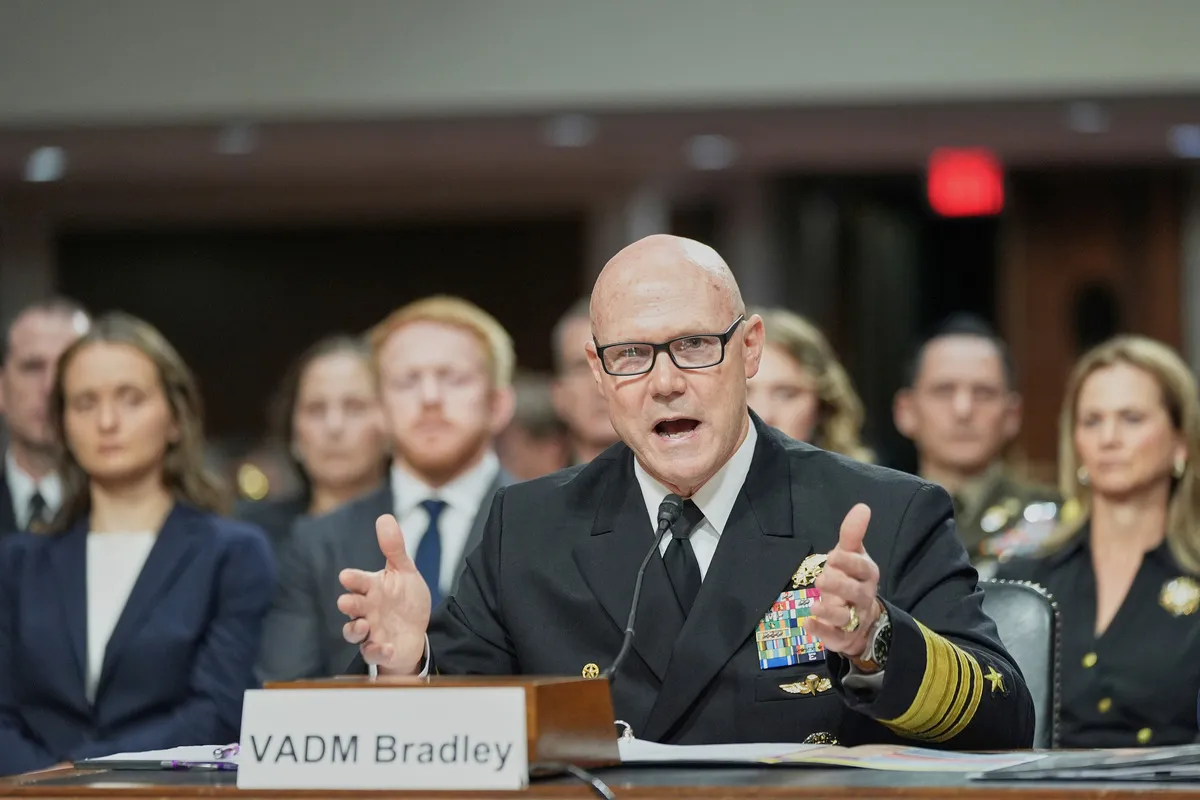
Defense Secretary Pete Hegseth hailed Admiral Frank Bradley, the head of the U.S. military's special operations command (USSOCOM), as an "American hero" after the White House confirmed the top Navy admiral ordered a second strike on a suspected drug vessel in early September.
In a social media statement on Monday, Hegseth said Bradley is "a true professional, and has my 100% support."
"I stand by him and the combat decisions he has made—on the September 2 mission and all others since," he wrote.
Read More on World
The Washington Post had reported Bradley was in charge of an attack on an alleged drug boat in the southern Caribbean on September 2 and had ordered a second strike that killed two survivors on the vessel to comply with an alleged verbal order from Hegseth to kill everyone on board. The Post cited two anonymous sources with knowledge of the operation.
Both Democrats and Republicans have expressed alarm, with the GOP-led Senate and House Armed Services committees pledging to look into the early September mission.
...
Hegseth called the report "fake news" and "fabricated, inflammatory, and derogatory."
White House Press Secretary Karoline Leavitt said on Monday that Hegseth had authorized the strikes but did not give the "kill everybody" order. Referring to this alleged order, chief Pentagon spokesperson, Sean Parnell said: "That is a dangerous & irresponsible lie."
The September 2 strikes were the opening salvo in what has become a concerted campaign against suspected drug boats in both the southern Caribbean and eastern Pacific. At least 83 people have been killed in more than 20 strikes, according to the administration's own numbers.
Officials said 11 people were killed in the September 2 mission.
"Secretary Hegseth authorized Admiral Bradley to conduct these kinetic strikes," Leavitt said on Monday. "Admiral Bradley worked well within his authority and the law, directing the engagement to ensure the boat was destroyed and the threat to the United States of America was eliminated."
President Donald Trump told reporters on Sunday he "wouldn't have wanted" a second strike. Five anonymous U.S. officials told The New York Times Hegseth had ordered a strike that would kill those aboard the boat and destroy the vessel ahead of the September 2 mission. But Hegseth did not specify what would happen if the first missile did not fulfill this.
Hegseth said in a post to social media on Friday the strikes "are lawful under both U.S. and international law, with all actions in compliance with the law of armed conflict—and approved by the best military and civilian lawyers, up and down the chain of command."
Former military lawyers and officials, as well as international observers, have raised concerns the strikes violate domestic and international law and could put U.S. soldiers at risk. The Post reported in late November a classified Justice Department memo penned in the summer indicated U.S. personnel involved in the strikes would not be prosecuted down the line.
The strikes have come alongside a growing U.S. military build up close to Venezuela, including the looming presence of the U.S.' largest aircraft carrier and other warships. The beefed up presence close to Venezuela's shores has been increasingly seen as a way to pressurize, and possibly to topple, Venezuela's authoritarian socialist leader, Nicolás Maduro.
Who Is The USSOCOM Commander?
Bradley was the chief of the Joint Special Operations Command (JSOC) at the time of the September strikes. He was promoted to the head of USSOCOM, which oversees JSOC, in October.
A Texas native, Bradley graduated from the U.S. Naval Academy in 1991 and started a career as a Navy SEAL the following year, according to the military.
Before heading up JSOC, he was the chief of Special Operations Command Central, which is responsible for planning U.S. Central Command (CENTCOM) special operations and Naval Special Warfare Development Group. The latter is colloquially known as SEAL Team Six.
SEAL Team Six, known for its elite counterterrorism operations, led the intelligence gathering and targeting for the September 2 mission, the Post reported, citing two anonymous sources.
The U.S. Navy says Bradley was "among the first to deploy into Afghanistan" in the wake of the 9/11 attacks and has served with SEAL Team Four and SEAL Delivery Vehicle Team Two, as well as Italy's SEALs as an international exchange officer.
Bradley has a master's degree in physics from the California-based Naval Postgraduate School. He is married with four children, according to publicly-available information.
View 0 Comments
Submit Correction
View Editorial & AI Guidelines