...

By Andrew Stanton
Reporter
0
Share
Newsweek is a Trust Project member
See more of our trusted coverage when you search.Prefer Newsweek on Googleto see more of our trusted coverage when you search.
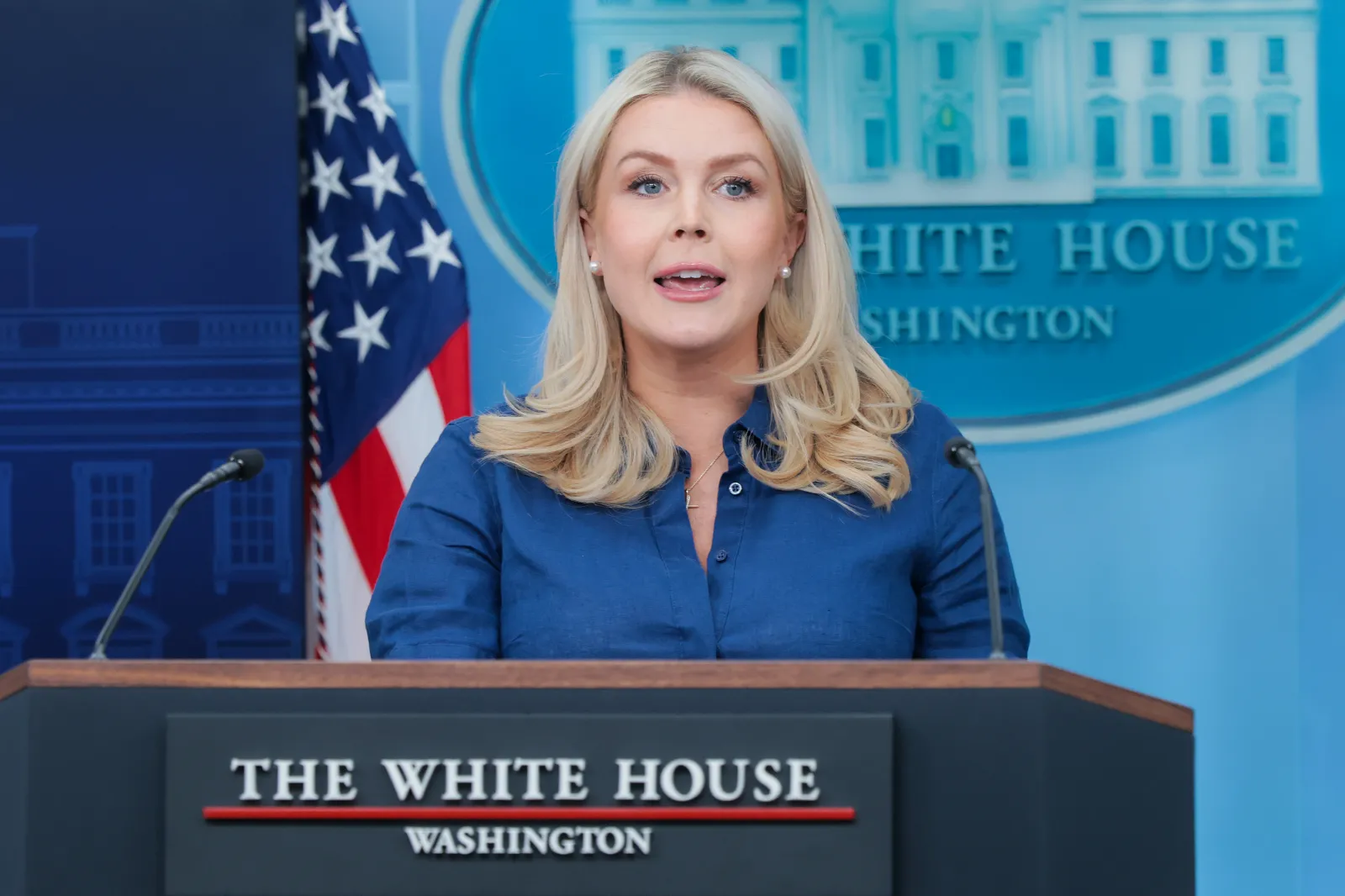
White House Press Secretary Karoline Leavitt said Iran’s navy was “obliterated” as Tehran seized two ships from the Strait of Hormuz on Wednesday.
Iran’s seizure of the ships comes one day after President Donald Trump extended a ceasefire in the Iran war while maintaining a blockade of Iranian ports. The Strait of Hormuz is a critical passageway for the global oil supply, with 20 percent of the world’s traded oil passing through it prior to the conflict.
Why It Matters
Trump announced that the U.S. would extend its fragile ceasefire with Iran this week. He wrote in a post to Truth Social on Tuesday that he “directed our Military to continue the Blockade and, in all other respects, remain ready and able, and will therefore extend the Ceasefire until such time as their proposal is submitted, and discussions are concluded, one way or the other.”
Read More on News
The attacks are an indication of Tehran's attitude toward Trump's declared extension. Iran declined to engage in peace talks this week, arguing that the blockade of Iranian ships would violate the ceasefire.
Karoline Leavitt Says Ship Seizure 'Piracy'
Iranian media said the MSC Francesca and Epaminondas were seized by its navy and are being escorted to Iran.
Leavitt criticized the “American media” for “blowing this out of proportion to discredit the president's facts, that he has completely obliterated Iran's conventional navy” during an interview with Fox News.
“These two ships were taken by speedy gunboats," she said. "Iran has gone from having the most, lethal navy in the Middle East to now acting like a bunch of pirates. They don't have control over the strait. This is piracy that we are seeing on display.”
Meanwhile, Navy Secretary John Phelan will be departing the Trump administration, Sean Parnell, assistant to the Secretary of War for Public Affairs, announced.
“On behalf of the Secretary of War and Deputy Secretary of War, we are grateful to Secretary Phelan for his service to the Department and the United States Navy. We wish him well in his future endeavors,” he wrote.
...
Iran Seizes Two Ships: What to Know
On Wednesday, the Islamic Revolutionary Guard Corps (IRGC) Navy Command said it had captured two vessels, identified as MSC Francesca, which it said was linked to Israel, and the Liberia-flagged Epaminondas, which Greek media said was owned by Technomar Shipping and operated by MSC.
Iranian media reported that the IRGC transferred the vessels to the Iranian coast for “operating without the required authorization and for manipulating navigation systems,” adding that this “jeopardized maritime security.”
Leavitt said the seizures did not violate the ceasefire because they were "international ships," not American or Israeli.
The IRGC-affiliated Fars News Agency named a third vessel—Euphoria—as also being among its targets on Wednesday, although further details were not immediately available.
An IRGC statement reported by Tasnim News Agency stated the vessels were “reportedly linked to the Zionist regime” and were operating “without authorization." The ships were allegedly trying to exit the Strait of Hormuz, according to the statement.
“Disturbing the order and safety of the Strait of Hormuz is our red line,” the statement added, according to a translation.
Technomar said it was “approached and fired upon by a manned gunboat” off the coast of Oman and that its ship was damaged. The second ship came under fire hours later. No injuries to the crew of either vessel were reported.
There have been more than 30 attacks on ships in the region since the war began on February 28.
IRGC warns of ‘Crushing Response’ in Statement
The IRGC wrote in a separate statement reported by Tasnim News Agency that it was prepared to deliver “‘surprises’ beyond the enemy’s understanding.” It said Iran takes pride in its abilities. The statement marked its founding anniversary.
It said the IRGC remains at its “highest level of readiness and determination to continue the fight.” It warned that any “aggression” would be met with “immediate, decisive, and crushing responses.”
When Will Peace Talks Begin?
Iranian Foreign Minister Abbas Araqchi wrote in a post on X on Tuesday that blockading Iranian ports is an "act of war" that violates the ceasefire.
"Striking a commercial vessel and taking its crew hostage is an even greater violation. Iran knows how to neutralize restrictions, how to defend its interests, and how to resist bullying," he wrote.
Iranian Foreign Ministry spokesperson Esmail Baghaei told state TV that Iran has not decided whether to take part in new negotiations with the U.S. and has accused Washington of a "disregard and lack of good faith" during negotiations.
Leavitt told reporters that Trump hasn't set a deadline to receive a proposal from Iran.
"Ultimately, the timeline would be dictated by the commander in chief in the United States,” she said.
What Is the Strait of Hormuz and Why Is it Important?
Roughly 20 million barrels of oil per day, about one‑fifth of global petroleum consumption, normally pass through the strait, according to U.S. Energy Information Administration data. Its closure amid the Iran war has put new pressure on global oil markets, leading to higher prices both globally and in the United States.
The strait lies between Iran to the north and Oman to the south, with shipping lanes passing through the territorial waters of both countries, but the strait is governed by international maritime law. Iran exerts significant influence because of its long northern coastline and control of nearby islands overlooking the narrow lanes, while Oman oversees the southern side.
The waterway is also a critical route for liquefied natural gas (LNG), carrying about 20 percent of global LNG trade, largely from Qatar. Most of the oil shipped through the strait is bound for Asian markets, making disruptions especially significant for global energy prices.
This article includes reporting by the Associated Press.
View 0 Comments
Submit Correction
View Editorial & AI Guidelines