
...

By David Averre
0
Share
Newsweek is a Trust Project member
See more of our trusted coverage when you search.Prefer Newsweek on Googleto see more of our trusted coverage when you search.
As America heads to the polls for one of the most closely scrutinized midterm elections in recent memory, it seems obvious who Russia and Ukraine want to win.
Republican President Donald Trump’s willingness to negotiate with Vladimir Putin has offered Moscow opportunities for sanctions relief and closer economic ties. Volodymyr Zelensky, meanwhile, has watched the administration ease pressure on Russia while restricting support for Ukraine.
But is it really that simple? Look more closely at what the people running Russia and Ukraine are actually saying, and the neat division between red and blue gets blurry.
Read More on Analysis
Now, as Russian, Ukrainian, and American delegations prepare for peace negotiations in Abu Dhabi next week—and a potential meeting at the White House thanks to Melania Trump—what do Moscow and Kyiv really want from the midterms?
How Red Is Russia?
There’s no doubt that influential figures in Moscow see advantages in Republicans retaining control of Congress, particularly when it comes to turning Trump’s willingness to negotiate into sanctions relief.
“If Trump loses control of Congress, it will certainly be difficult for him to make decisions, even under a law giving him powers to impose and lift sanctions,” Alexander Shokhin, head of Russia’s powerful Union of Industrialists and Entrepreneurs, warned on Monday, adding that a Democratic-controlled Congress could oppose "virtually any initiative in this area."

...
Shokhin hopes Trump will lift sanctions on the Russian Direct Investment Fund, headed by Putin’s economic envoy Kirill Dmitriev, opening the door to relief for his own organization. Senior Kremlin aide Yuri Ushakov confirmed last week that discussions over the fund’s restrictions were already underway.
Dmitriev made his own sympathies clear on Monday too, accusing Zelensky of attempting to “undermine the standing of Republicans” ahead of the midterms after the Ukrainian president suggested Trump should call for an energy ceasefire.
The Kremlin’s official position is much less partisan, however.
Putin’s spokesman Dmitry Peskov said on Monday that Moscow was watching the election “very closely” but stressed that whatever the result, Trump would remain president and “conduct his foreign policy” until the end of his term.
Deputy Foreign Minister Sergei Ryabkov was also restrained, saying on October 28 that Moscow had “no illusions” that the vote would dramatically improve relations, given Washington’s “entrenched bipartisan anti-Russian consensus.”
That helps explain why Putin’s strategy has focused less on winning over Congress than on cultivating a direct relationship with Trump and the men he trusts. Receiving the president’s envoys Steve Witkoff and Jared Kushner in September, Putin told them, “We find it comfortable to work with you, and the level of trust in this work on our side is quite high.” Witkoff returned in October and praised Putin as a “humanitarian” following the release of an American detainee, while economic envoy Dmitriev continued pursuing economic agreements through direct contacts with Washington.
Alexander Morozov, a Russian political analyst, recently told Newsweek that Moscow aimed to “manipulate Trump’s negotiating initiative until Ukraine is weakened.” A Democratic Congress could make sanctions relief harder, but it can’t replace presidential diplomacy.
Trump has already demonstrated the discretion he retains, authorizing transactions involving Russian diesel on October 9 and waiving provisions of Congress’s new Russia sanctions law on October 16.
So, Russia may prefer Republicans to win, but Congress is not the main target of its courtship. Moscow is betting that a lame-duck Trump might become more determined to secure a legacy-making peace deal, despite resistance on Capitol Hill.
How Blue Is Ukraine?
After months of friction with Trump over military assistance, intelligence-sharing and Washington’s economic overtures to Moscow, a Democratic Congress could offer Kyiv some much-needed leverage.
But Zelensky himself has been reluctant to frame Ukraine’s fortunes in partisan terms.
“Bipartisan support is stronger than it has been for the past year and a half,” the Ukrainian president told broadcaster TSN on October 25, thanking lawmakers from both parties even as he criticized Washington’s easing of sanctions on Russia and restrictions affecting Ukraine’s access to Starlink and American intelligence.
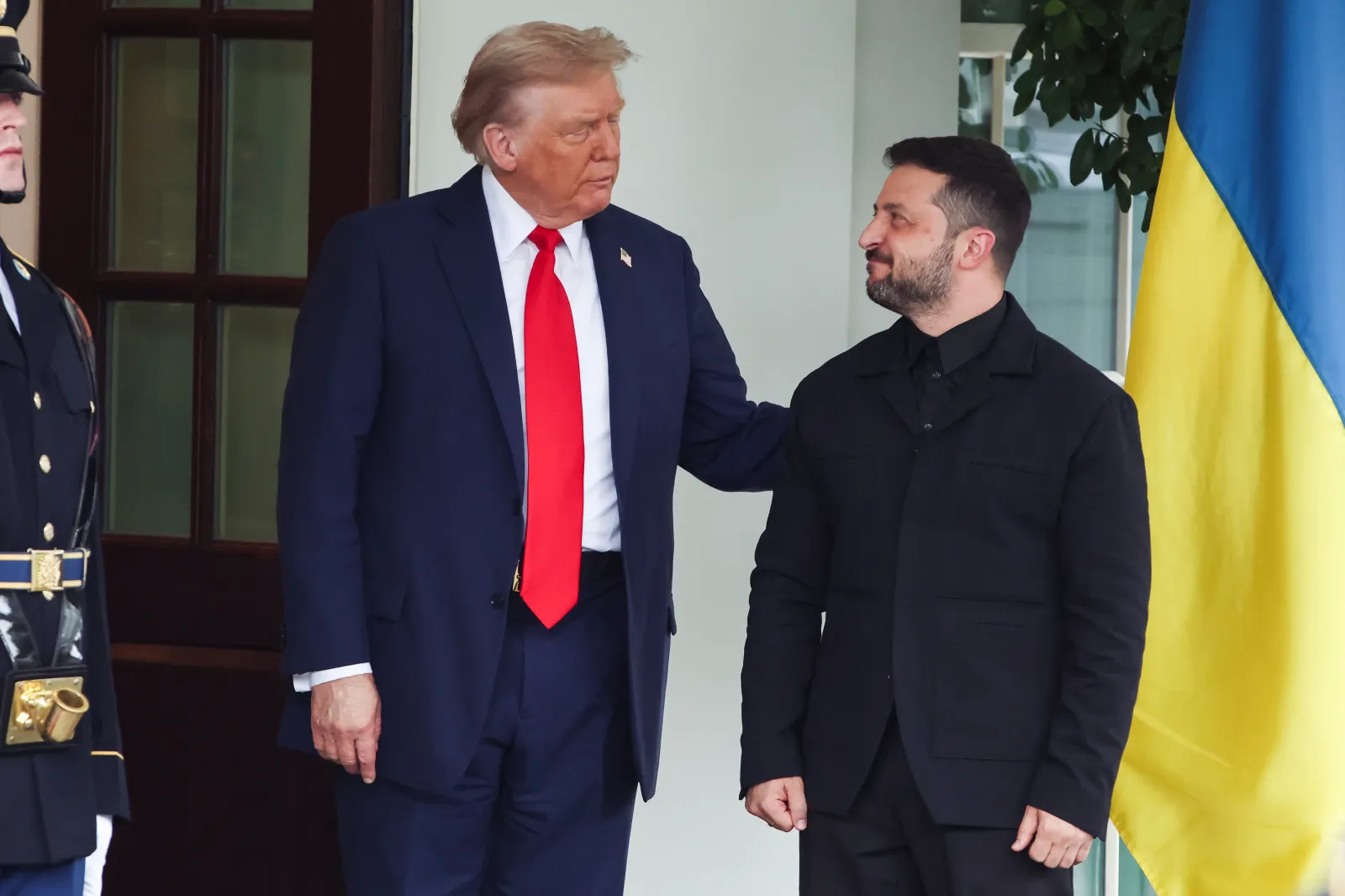
Zelensky has also actively courted Republican representatives rather than treating them as obstacles to greater support. Meeting a bipartisan congressional delegation in Kyiv on October 9—including Republican Senators Roger Wicker and Kevin Cramer—Zelensky pressed for greater air-defense support and told lawmakers, “We are grateful for your support, and, of course, we count on unanimity. We need your unanimity.”
...
Oleksandr Merezhko, chairman of the Ukrainian parliament’s foreign affairs committee, openly acknowledged Kyiv’s careful calculations on Monday.
“I do not divide the American Congress into Republican and Democratic parties,” he told Spanish news agency EFE, adding that Kyiv wanted to see a bipartisan “party of supporters of Ukraine” emerge from the vote. Ukraine’s senior diplomat in Washington, chargé d’affaires Denys Sienik, was even more blunt.
“It’s not so much about who wins. What matters to us is that support for Ukraine is preserved,” he told Ukrainian press on Monday, describing bipartisan backing in both chambers as an “absolute priority.” He also said Kyiv would work to develop relationships with newly elected lawmakers before they take office in January, including expanding the bipartisan congressional groups that advance Ukrainian interests.
Zelensky and his staff will need all the friends they can get, because several of the Republicans most willing to challenge Trump over Ukraine will be gone in January.
Former Senate Republican Leader Mitch McConnell, Senator Thom Tillis and Representatives Don Bacon and Michael McCaul are all leaving Congress. Kyiv also lost Lindsey Graham, often described as one of the few pro-Ukraine lawmakers able to effectively communicate with Trump, when he died in July.
The kind of leverage such experienced Republicans wield will not be easily replaced by Democratic newcomers, however sympathetic they may be to Kyiv’s cause.
So, Ukraine may prefer Democratic gains, but a bluer Congress is not necessarily a more useful one. Kyiv has plenty of lawmakers who sympathize with its plight; it needs lawmakers who can make, or force, Trump to listen.
View 0 Comments
Submit Correction
View Editorial & AI Guidelines