...

By Jenni Fink
Senior Editor
0
Share
Newsweek is a Trust Project member
See more of our trusted coverage when you search.Prefer Newsweek on Googleto see more of our trusted coverage when you search.
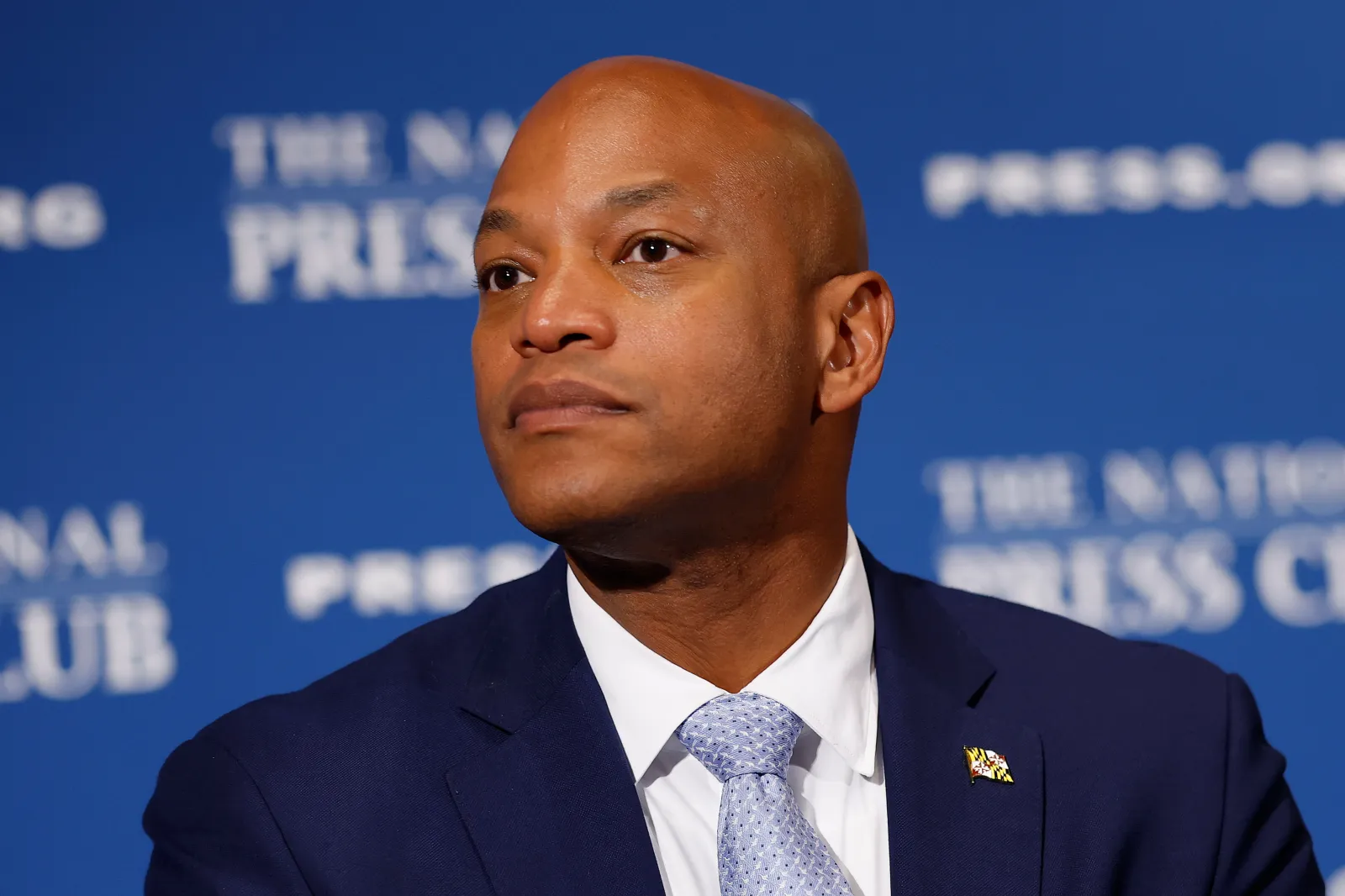
Maryland Governor Wes Moore handily won his election in 2022 and enters the 2026 election cycle as the clear favorite for reelection, but a recent dip in his approval ratings and growing voter concerns about taxes and affordability have given Republicans hope that the race could become competitive.
Republicans will now have to coalesce their base around a single candidate, Dan Cox—after a crowded GOP primary—with hopes of the GOP ousting an incumbent governor in Maryland for the first time in nearly 80 years.
On Tuesday, Cox won the Republican primary with roughly 44.7 percent of the vote when the race was called, defeating Ed Hale, who came in second, with 36.3 percent of the vote.
Read More on Politics
Wes Moore's Chances of Losing to Republicans in Maryland Governor's Race
Moore, a Democrat who took office in January 2023 after a landslide victory over Cox in 2022, remains relatively popular by historical standards. A January 2026 Gonzales poll found that 51.7 percent of Maryland voters approved of his job performance, while 41 percent disapproved. The same survey showed that roughly half of voters said they would reelect Moore if the election were held immediately, compared with 28 percent who said they would vote for a Republican challenger.
In April, Moore's approval rating fell below 50 percent for the first time. A UMBC Institute of Politics poll found 48 percent of voters approved of the job Moore is doing, and nearly six in 10 said the state is moving in the wrong direction.
“That’s the thing about being the governor, you get the credit when things are going great,” Mileah Kromer, director of the poll, said in a statement at the time. “He can’t as an individual fix grocery prices. But people tend to hold the chief executive of the state accountable.”
Those numbers indicate that Moore remains in a strong position. Yet they also reflect a notable decline from earlier surveys that placed his approval in the mid-60s. The narrowing gap between approval and disapproval ratings is a trend, Kromer said, adding that it coincides with the drop in the way people think about the economic conditions in Maryland.
Polymarket gives Democrats a 94 percent chance of winning the election, compared with Republicans' 6 percent odds, indicating people are expecting Moore to win.
...
Who Is Dan Cox? Republican Candidate for Governor
Cox is a former Maryland state delegate and was the Republican nominee for governor in 2022. He has gained a November rematch against Moore after losing the previous general election by more than 30 percentage points. Cox is well known among Maryland Republicans for his strong support of President Donald Trump and his alignment with the MAGA movement.
Despite criticism from rivals, Cox retains support among many conservative voters and remains one of the most recognizable Republicans in the race. He has denounced Democratic efforts to influence the primary, calling them inappropriate interference in the GOP nomination contest.
In the 2022 race, Trump endorsed Cox, calling him "MAGA all the way" and a "True Patriot." Trump didn't endorse anyone in the Maryland Republican primary this year.
Democrat Influence on Republican Primary
In recent election cycles across the country, Democratic organizations have spent money highlighting or elevating far-right Republican candidates during primary contests, calculating that those candidates would be easier to defeat in a general election than more moderate Republicans.
Maryland Democrats are once again attempting to shape the Republican primary electorate, reviving a strategy that helped Moore in 2022. According to The New York Times, Moore's campaign has aired advertisements on Fox News that prominently highlight Republican candidate Dan Cox's ties to Trump and the MAGA movement, effectively raising Cox's profile among GOP primary voters. The move mirrors Democratic efforts four years ago, when outside Democratic groups promoted Cox as a staunch conservative ahead of the Republican primary.
The strategy is based on the belief that Cox, who lost to Moore by a wide margin in the 2022 general election, would be a weaker opponent than a more moderate Republican. Several Republicans have accused Moore and state Democrats of interfering in their primary by drawing attention to Cox while attacking rival Republican Ed Hale as a former Democrat who cannot be trusted.
"[Moore] wants to run against Dan Cox again," Tyrone Keys, who is running with Hale, told CBS News. "Wes Moore beat Dan Cox like a rented mule in 2022, and he'd do it again. He is afraid of Ed Hale. He doesn't want to run against him, so Republicans across the state must be saying that strategy cannot work again. We can't let Wes Moore define who the Republican nominee will be."
Ultimately, voters decided to go with Cox once again, pitting him against Moore for the general election.
How Many Republicans vs. Democrats Are There in Maryland?
Moore has an advantage over Republicans even without polling, just because there are more Democrats than Republicans in the state of Maryland.
Voter registration data reviewed by Newsweek found there are 2.2 million registered Democrats, compared to 1.02 million registered Republicans. That means Democrats enjoy roughly a two-to-one registration advantage over Republicans. As a result, GOP candidates face a steep mathematical challenge in statewide elections.
However, Republicans are seeing their voter base grow compared to Moore's 2022 election, while Democrats have lost voters. Since the 2022 election, Republicans have increased their registered voters by 1.5 percent. Democrats, however, saw their voter registration drop by 1.9 percent.
Maryland's partisan makeup helps explain why Democrats have dominated statewide offices for decades. In recent years, Republicans have struggled to win federal races even when running well-known candidates. Former Governor Larry Hogan, one of the state's most popular Republicans, lost a 2024 Senate race despite his reputation as a moderate who had previously won two gubernatorial elections.
For Republicans hoping to defeat Moore, success would likely require overwhelming support from GOP voters, strong performance among independents and enough crossover votes from Democrats dissatisfied with the state's direction. Polling suggests economic concerns could help Republicans make that argument. In the January Gonzales survey, 58 percent of voters said they pay too much in taxes. Among those voters, a hypothetical Republican candidate actually led Moore by double digits.
When Was the Last Time a Republican Was Governor in Maryland?
Hogan, who served from January 2015 until January 2023, was the last Republican to hold the office. He won the election in 2014 and later secured reelection in 2018, making him one of the most successful Republicans in modern Maryland politics.
Campaigning as a moderate Republican focused on taxes, fiscal management and bipartisan governance, Hogan was able to attract support from independents and many Democrats. He defeated Democratic Lieutenant Governor Anthony Brown in 2014 during a period of voter dissatisfaction with tax increases under the outgoing Democratic administration. Four years later, he won reelection by a wide margin against Democrat Ben Jealous.
But Hogan won his first gubernatorial race in an open race, which made for an easier time for Republicans. Defeating incumbents has historically been much harder for both Republicans and Democrats. The last time Republicans ousted an incumbent governor in Maryland was in 1950. In that election, former Governor William Preston Lane, Jr., was defeated by Republican Theodore McKeldin.
Republicans seeking to replicate Hogan's success face several challenges. Hogan cultivated a moderate image that often put him at odds with the national Republican Party. The broader political environment has also become more polarized in recent years, making it harder for candidates to win substantial crossover support.
For Moore, the comparison to Hogan offers both a warning and a road map. It suggests that Maryland voters are willing to elect Republicans when they become dissatisfied with Democratic leadership. But it also underscores how rare such victories are, typically requiring uniquely popular candidates who can appeal well beyond the GOP base.
As the 2026 campaign develops, Moore's reelection prospects will likely depend on whether voters remain comfortable with the state's direction and economic policies. Recent polling shows some warning signs for the governor, including concerns about taxes and a decline in his approval rating. Yet those same polls also show him maintaining a commanding lead over a generic Republican opponent.
View 0 Comments
Submit Correction
View Editorial & AI Guidelines