...

By Alex J. Rouhandeh
National Political Correspondent
0
Share
Newsweek is a Trust Project member
See more of our trusted coverage when you search.Prefer Newsweek on Googleto see more of our trusted coverage when you search.
Residents of Virginia face a crucial decision in an off-year trip to the ballot box on Tuesday: Hand power from the state’s independent redistricting commission over to the Democratic-controlled legislature, which could potentially gain four blue congressional seats from the move, or reject the move and give Republicans a better chance at maintaining control of the U.S. House in November.
Despite Virginia voting Democrat at the presidential level in every contest since 2008 and not electing a Republican U.S. senator since 2002, the state has not turned fully blue. It has routinely held competitive gubernatorial races, and of its 11 U.S. House seats, five are held by Republicans. In 2020, the state voted by a nearly 2-1 margin to hand congressional map drawing to a bipartisan commission.
Recently elected Democratic Governor Abigail Spanberger, who rose to prominence as a centrist Democratic congresswoman, became the state’s top executive in 2025 after running a campaign that shied away from partisanship and focused on affordability. When Texas decided to redraw its maps in a move to try and net Republicans five additional House seats at President Donald Trump’s urging, Spanberger found herself forced to reckon with new partisan terrain.
Read More on Politics
The state’s Democratic majority House of Delegates began drafting an amendment to take to the ballot box that, in its current form, reads: "Should the Constitution of Virginia be amended to allow the General Assembly to temporarily adopt new congressional districts to restore fairness in the upcoming elections, while ensuring Virginia's standard redistricting process resumes for all future redistricting after the 2030 census?" It passed the state House, then the Democratic majority state Senate, and Spanberger signed it into law.
After legal challenges and the state Supreme Court allowing the referendum to proceed, voters will head to the ballot box to deliver a decision that carries high stakes for each party and its leaders heading toward the 2026 midterms.
“Virginia is a blue-leaning state, but a lot of that has to do with people who used to be Republicans moving over to the Democratic camp because of Donald Trump,” Kyle Kondik, managing editor of the election predictor Sabato’s Crystal Ball at the University of Virginia Center for Politics, told Newsweek. “But for some of those voters, this gerrymander may just be a bridge too far.”
Polling on the issue is somewhat mixed but appears to point in the direction of the measure passing. Of the six polls on the issue collected by The New York Times, four show the measure passing by at least a 4-point margin, but two showed the measure failing; one by a 1-point margin and the other by 8 points.
Spanberger replaced Republican Governor Glenn Youngkin, who left office with an over 50 percent approval rating. Kondik said that there certainly will be some voters who backed Spanberger last fall who will vote against this measure, despite her support for it.
...
Youngkin has hit the trail to rally against the measure, calling it, “The most ridiculous usurping of the voice of the people that you could possibly imagine.” He’s stated he believes the measure to be illegal and called on the Supreme Court of Virginia to strike it down earlier this month.
The court has weighed in, however, ruling in February that the measure can go up for a vote. Republicans have brought additional legal challenges, but the court has allowed the election to continue, with those challenges to remain ongoing after the special election.
Amid the GOP pushback, Democrats have been hard at work rallying support on the ground.
Dan Gottlieb, a Democratic campaign veteran serving as communications director for the YES Campaign (Virginians for Fair Elections) told Newsweek: "The YES Campaign has been doing the work—knocking over 600,000 doors, communicating directly with Virginians, organizing in every corner of the state, and driving historic early vote turnout—to make sure Virginians know the truth: a YES vote stops Trump’s power grab and levels the playing field.”
As far as special elections goes, the stakes could not be much higher than this one.
Democrats have seen significant momentum as of late. According to a POLITICO analysis, Democratic candidates outperformed Vice President Kamala Harris’ 2024 campaign totals in 193 of 229 state and federal elections since Trump’s inauguration by an average of 5 points. If Virginia votes “yes” on this measure, it will be a further stinging indictment of Trump in the state that once voted for the Republican presidential hopeful in 10 straight elections from 1968 to 2004.
“If the gerrymander passes, there will have been enough Democrats and Democratic-leaning voters who will have been motivated by their dislike of Donald Trump and Republicans to get it over the finish line,” Kondik said.
If Republicans are able to stave off the measure, however, it could reveal a centrist voter base limiting Democratic electoral power in the state during Trump's second act. It would also deliver a major blow to Spanberger, who some believe could have presidential ambitions.

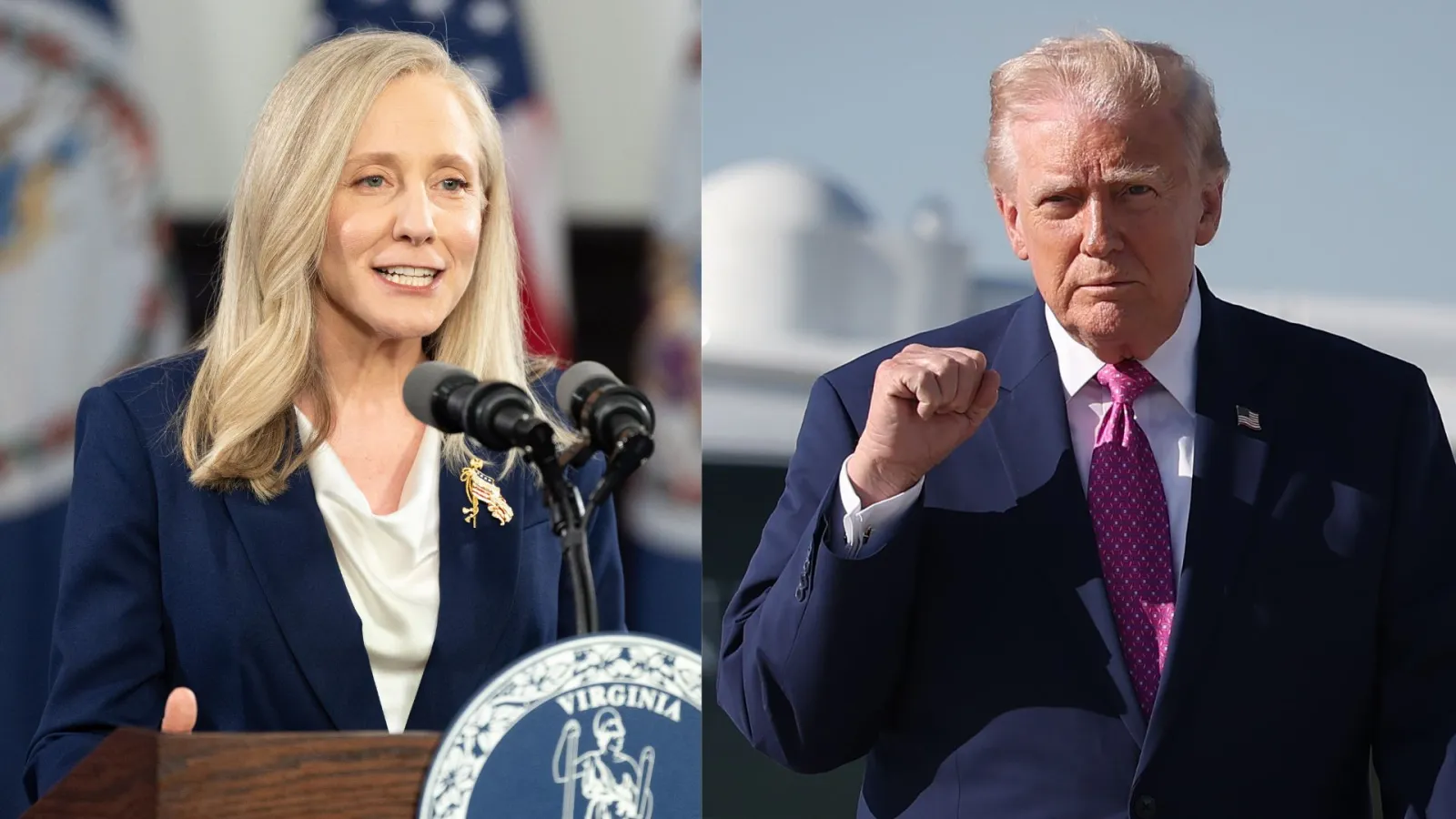
Photo-Illustration by Newsweek
Kondik said this move has already harmed her political brand and expects that no matter the results, she’ll likely “try to move back to the middle and regain whatever ground she has lost.”
Beyond the political effects the elections will have on Trump, Spanberger, and Democrats, the results will also carry ripple effects across the country as other states weigh potential map adjustments. Florida’s Republican Governor Ron DeSantis has called a special session set to start April 28 that could attempt to redraw the Sunshine State's maps in a move aimed at targeting some of the eight Democrats who serve as part of its 28-person congressional delegation.
Anytime districts are gerrymandered, however, incumbents risk their seats being made less safe. With the left coming off a series of victories, Virginia Democrats are betting the 2026 climate favors them, a safe bet as traditionally the party that holds the White House underperforms in midterm elections. That reality could put Florida Republicans in newly drawn districts in a precarious position, and the Virginia results Tuesday night could send a loud message on whether that’s a risk they should be willing to take.
View 0 Comments
Submit Correction
View Editorial & AI Guidelines