...

By Sam Stevenson
Associate News Editor
0
Share
Newsweek is a Trust Project member
See more of our trusted coverage when you search.Prefer Newsweek on Googleto see more of our trusted coverage when you search.
Hungarian Prime Minister Viktor Orbán’s party is trailing in a new parliamentary election poll from AtlasIntel, a firm with a track record of calling major elections with striking accuracy.
Newsweek has contacted Orbán’s office and his opponent Péter Magyar via email for comment.
Why It Matters
Orbán heads into election day under growing pressure as a former ally threatens to end his 16‑year hold on power, according to a nationwide poll of Hungarian adults.
Read More on Politics
The poll comes days after renewed international attention, including a recent JD Vance rally in Hungary that highlighted Orbán’s ties to U.S. conservative politics.
...
What To Know
A new survey from AtlasIntel suggests a major shift in Hungary’s political landscape ahead of the 2026 parliamentary election, which will be held tomorrow.
The poll shows the opposition Tisza party, led by Magyar, well ahead of Orbán’s ruling Fidesz party.
According to the results, Tisza commands 52.1 percent of the vote, compared with 39.3 percent for Fidesz.
Magyar also leads Orbán on personal ratings.
When respondents were asked who they believed was most suitable to serve as Hungary’s prime minister, 48.7 percent chose Magyar. Orbán was selected by 40.8 percent.
The findings come from a nationwide survey of Hungary’s adult population conducted between April 5 and April 10, 2026, with 1,587 respondents and using AtlasIntel’s Random Digital Recruitment methodology.
It carried a margin of error of plus or minus 2 percentage points, with a confidence level of 95 percent.
AtlasIntel has built a reputation as one of the most reliable polling firms in recent elections, particularly in the United States.
The company provided the most precise estimates during the 2024 U.S. presidential election, accurately capturing the national popular vote and outcomes across key swing states.
It was also the only web‑based pollster to receive an A‑rating in Nate Silver’s FiveThirtyEight rankings evaluating both historical accuracy and methodological quality.
Following the 2024 election, AtlasIntel ranked as the highest‑rated pollster in the United States according to Silver’s updated 2025 pollster rankings.
The firm has also demonstrated accuracy outside the U.S. AtlasIntel was the only pollster to correctly anticipate the deadlock in Spain’s 2023 legislative election, estimating the slim margin between major parties with an error of less than a tenth of a percentage point.
Given that track record, the latest Hungarian numbers are likely to draw attention well beyond Budapest.
Orbán has remained a polarizing figure internationally, often praised by U.S. conservatives and criticized within the European Union.
That profile was amplified again this month when Vice President Vance appeared at a pro‑government rally in Hungary, framing Orbán as a key figure in a broader conservative movement.
Since then, prediction markets suggest Orbán’s prospects have slipped slightly, though there is no indication that the change has been driven by Vance’s intervention.
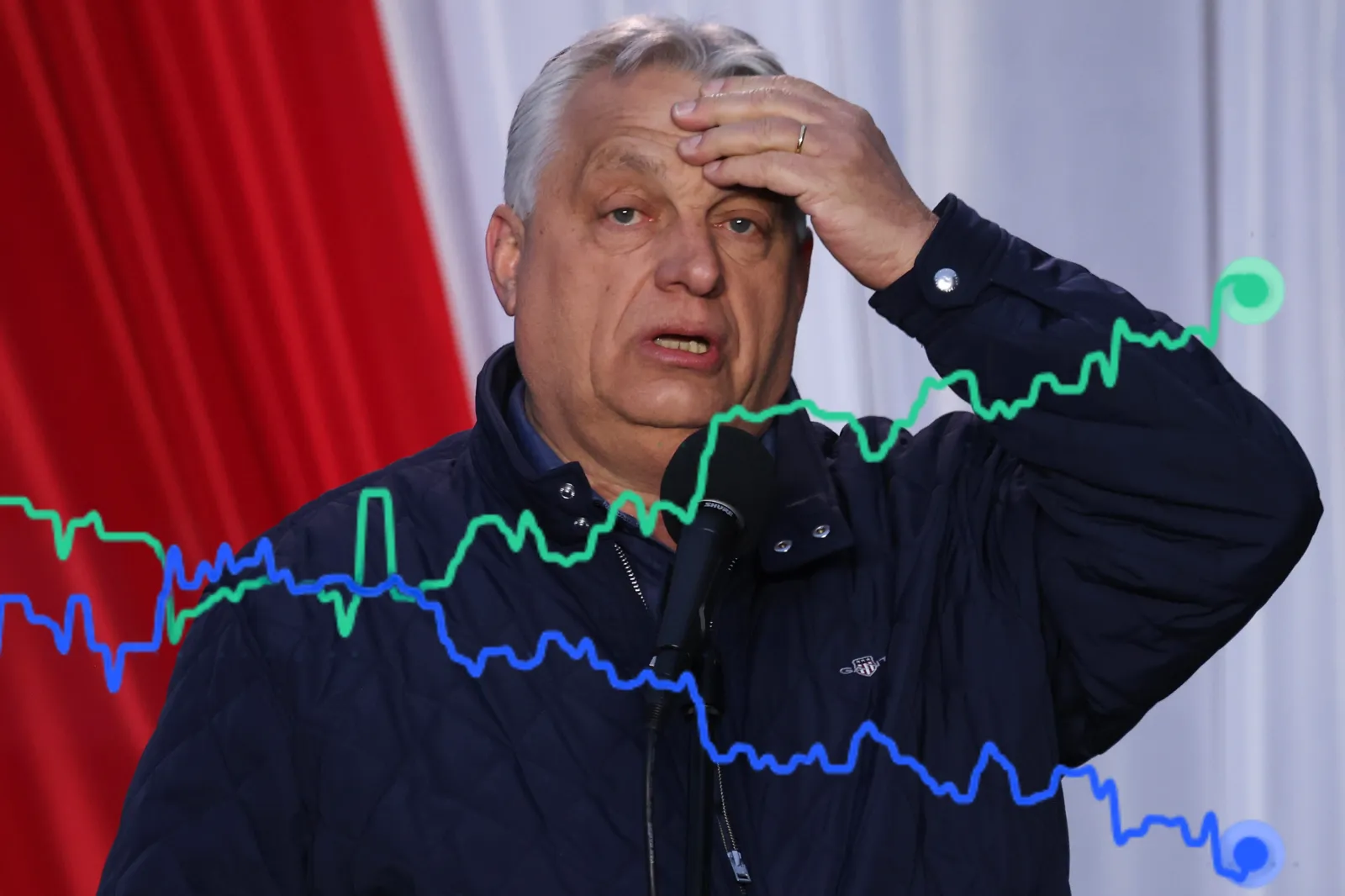
According to Polymarket, Orbán had a 28 percent chance of winning the upcoming election at the time of writing, down from 35 percent on April 5.
Kalshi shows a similar trend. At the time of writing, the prediction market platform places the incumbent prime minister’s chances at roughly 29 percent, compared with 33.3 percent six days earlier, marking a drop of roughly three percentage points in less than a week.
The Guardian has reported that Magyar has used his insider credentials to challenge the prime minister’s dominance, presenting himself as a cleaner alternative while accusing the government of corruption and abuse of power.
What People Are Saying
Magyar said on the campaign trail: "We're at the gates of a two-thirds majority victory. Let's gear up and push for the last 100m!"
Orbán accused his rival of conspiring with outside forces, saying Magyar and his party were "colluding" with foreign intelligence, adding: "This is an organized attempt to use chaos, pressure, and international vilification to call into question the decision of the Hungarian people."
Gerolf Annemans, treasurer of the "Patriots for Europe" group in the European Parliament, wrote in an op‑ed for Euro News: "It may sound paradoxical in Brussels top-floor circles, but an Orbán victory would rather be good news for Europe."
First-time voter Fanni told the BBC: "I feel it in my bones something's going to change. I don't believe I'd vote for [Magyar] in an ideal situation, but this is our only chance."
What Happens Next
Hungarian voters are due to cast their ballots in the parliamentary election on Sunday, April 12, 2026, when polling stations open nationwide in the morning and close in the early evening.
Preliminary results are expected late on election night, with most votes counted within hours of polls closing.
However, the final official outcome may take several days to confirm, particularly if the race is close, due to the counting of mail‑in and overseas ballots.
View 0 Comments
Submit Correction
View Editorial & AI Guidelines