...

By Amanda Castro
Associate News Editor
0
Share
Newsweek is a Trust Project member
See more of our trusted coverage when you search.Prefer Newsweek on Googleto see more of our trusted coverage when you search.
Two powerful earthquakes—magnitudes 7.2 and 7.5—struck northern Venezuela within seconds of each other on Wednesday evening, collapsing buildings across Caracas and coastal communities. The twin quakes are among the strongest to hit Venezuela in more than a century, triggering a national emergency and a massive regional aid response.
Thousands of families have been displaced, communications are down in parts of the country, and officials warn the death toll—already climbing—will likely rise as rescuers reach devastated areas.
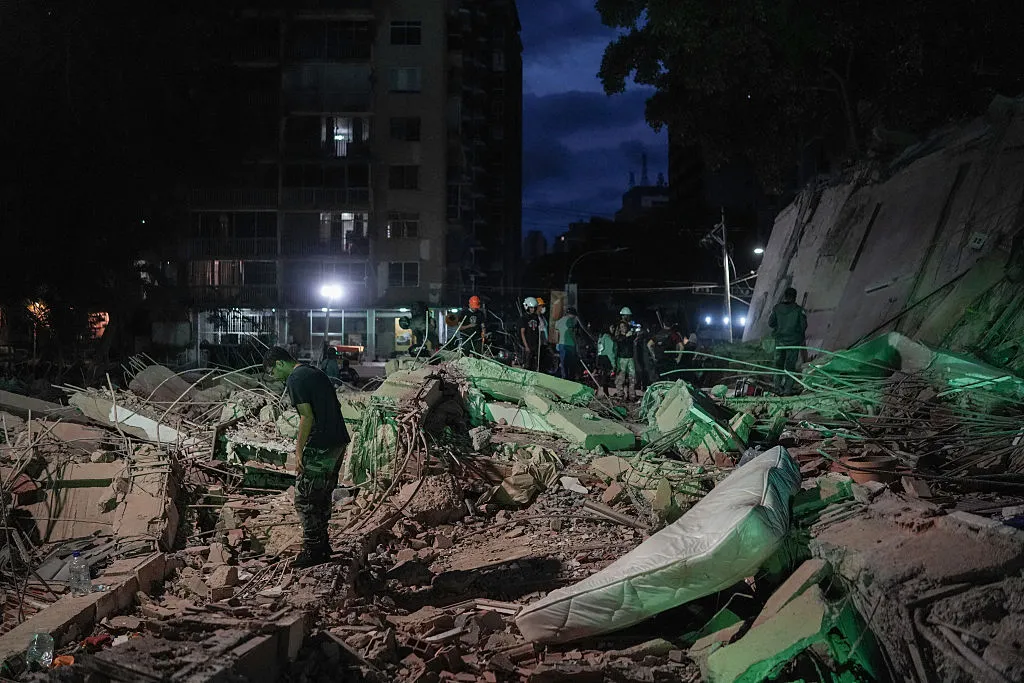
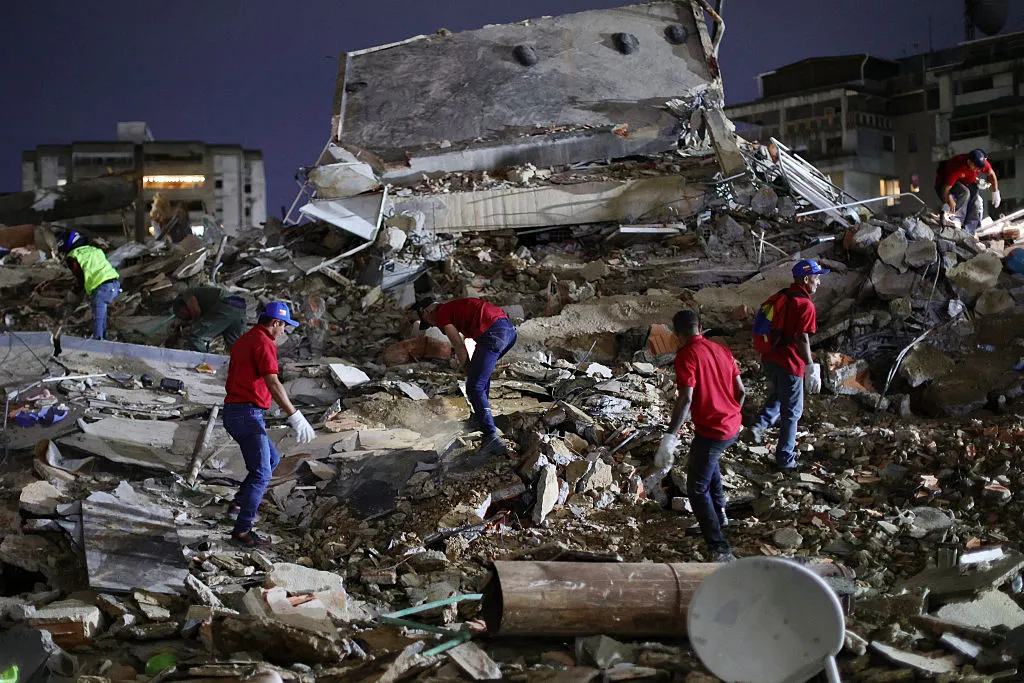
Acting President Delcy Rodríguez said at least 164 people were killed, more than 900 were injured, and tens of thousands remain missing as emergency crews dig through collapsed structures in La Guaira and the capital.
Read More on News
The U.S. Geological Survey described the event as a rare “doublet”—two major quakes striking just 39 seconds apart—an occurrence that dramatically increases structural damage and complicates rescue operations.
Venezuela Earthquake: Damage and Deaths Thus Far
...
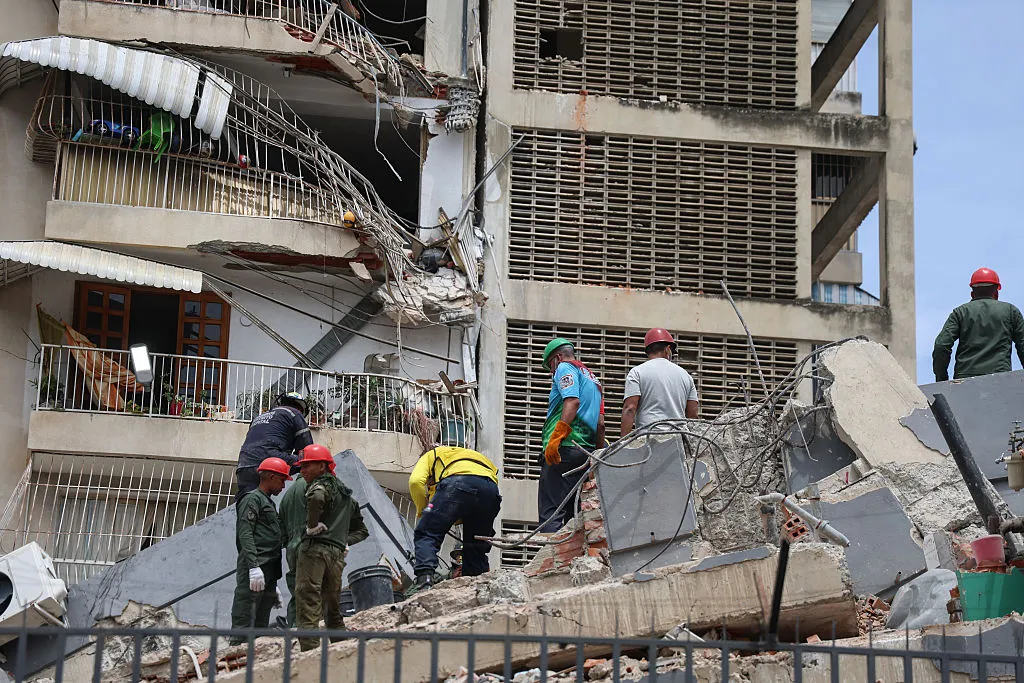
Across Caracas, residents fled into the streets as buildings swayed violently, facades crumbled, and dust clouds rose from collapsed structures. Photos show entire walls peeled away, revealing living rooms hanging open above debris‑filled streets.
The destruction stretches across a 150‑kilometer corridor east of the epicenters—an early clue to how the rupture unfolded.
Seismologist Jochen Braunmiller of the University of South Florida told Newsweek that preliminary data suggest “at least one of the earthquakes started rupturing at the west and propagated eastward,” which would explain why Caracas, roughly 100 miles from the epicenters, suffered such intense shaking.
Infrastructure failures are compounding the crisis. Gas, water, and electricity systems—already strained by years of underinvestment—sustained new damage. Schools are being converted into shelters, the country’s main airport remains closed, and emergency crews are struggling to reach isolated neighborhoods where buildings have collapsed.
...
How Venezuela Earthquakes Compare to Latest Quakes
The Venezuela doublet joins a devastating roster of major global earthquakes over the past 15 years. While its magnitudes are lower than those of some megathrust events, its shallow depth, strike‑slip mechanics, and proximity to urban areas make its impact unusually severe.
Dr. Thomas Krom of Seequent explained that Venezuela’s quakes fall into the same category as the 2023 Turkey–Syria and 2010 Haiti events: “Venezuela, 2023 Turkey-Syria, and 2010 Haiti were all 'strike-slip' faults, which means these will have predominantly lateral displacement," he told Newsweek. "This is sort of like holding a thin, brittle piece [of] wafer and pushing in opposite directions on two different sides until it breaks
By contrast, the 2011 Tohoku and 2010 Chile quakes were subduction megathrust quakes, in which one tectonic plate suddenly thrusts beneath another. “This is like pushing two heavy blocks over each other with a lot of resistance until they suddenly move,” Krom said.
2023 Turkey–Syria earthquakes

...
The Turkey–Syria disaster involved 7.8 and 7.7 magnitude quakes—also a doublet—causing more than 59,000 deaths and catastrophic damage across two countries.
Braunmiller noted that while Venezuela’s quakes were smaller, “impact depends on size, event depth, proximity to population centers, local geology, and landscape.”
In Venezuela, the first shock was followed hours later by a second major rupture, and both occurred along complex fault systems capable of producing extreme lateral shaking.
However, the Turkey–Syria quakes had a far greater geographic impact, triggering over 30,000 aftershocks and causing more than $157 billion in estimated damage.
2011 Tohoku, Japan Earthquake

...
Japan’s 9.0–9.1 Tohoku earthquake released 200 times more energy than Venezuela’s 7.5 shock, Braunmiller said. Its tsunami—not the shaking—caused most of the nearly 20,000 deaths and triggered the Fukushima nuclear disaster.
Dr. Christie Rowe, who has studied Tohoku extensively, noted to Newsweek that subduction quakes “can be much, much larger” and often affect wider regions even when they occur offshore.
Unlike Venezuela’s strike‑slip quakes, Tohoku was a megathrust event, where one tectonic plate suddenly thrust upward beneath another, releasing exponentially more energy.
2010 Haiti Earthquake

...
Haiti’s 7.0 quake remains one of the deadliest of the century, killing an estimated 100,000–160,000 people.
Political economist Usha Haley said Venezuela faces similar structural vulnerabilities: “Fragility can turn a seismic event into a deeper social and economic crisis,” she told Newsweek.
Weak institutions, she added, “determine whether a quake becomes a contained disaster or a national crisis.”
2010 Chile Earthquake

...
Chile’s 8.8 quake triggered a destructive tsunami and caused 525 deaths, but the country’s strict building codes and dense seismic monitoring network prevented far greater losses.
Rowe noted that Chile and Japan maintain “thousands of seismic stations,” while Venezuela’s national network includes fewer than 40, limiting early warning and hazard mapping.
Will There Be Aftershocks in Venezuela?
Experts agree that Venezuela should brace for a long and potentially dangerous aftershock sequence.
Braunmiller said shallow strike‑slip earthquakes “tend to have significant aftershock activity,” adding that the largest aftershocks are typically 1 to 1.5 magnitudes smaller than the main event. That means a magnitude‑6 aftershock is likely—and could be damaging given weakened buildings.
Rowe warned that “aftershocks will last months,” and historical records show the same fault system produced a similar 7.4–7.1 doublet in 1812.
Dr. Ravindra Jayaratne, a reader in coastal engineering at the University of East London, said the Venezuela doublet underscores how complex modern earthquakes can be: “Rather than a single fault slipping in isolation, we increasingly see cascading ruptures involving multiple fault segments,” he said.
He added that aftershocks “can still be powerful enough to cause further damage and place already weakened buildings at risk of collapse.”
Haley emphasized that Venezuela’s recovery will hinge on governance: “Degraded infrastructure raises the risk of cascading failures…electricity, water, hospitals, ports, airports, fuel systems.” Without strong institutions, she warned, “a major earthquake can become a long‑term development shock.”
Historical records show the same fault system produced a similar doublet in 1812, suggesting the region is capable of repeated large ruptures.
The U.S. Geological Survey estimates a 94 percent chance of at least one aftershock of magnitude 5.0 or greater in the coming week. With communications disrupted and thousands displaced, emergency officials are urging residents to stay away from damaged structures and prepare for continued shaking.
...
View 0 Comments
Submit Correction
View Editorial & AI Guidelines