...

By Jasmine Laws
Reporter
0
Share
Newsweek is a Trust Project member
See more of our trusted coverage when you search.Prefer Newsweek on Googleto see more of our trusted coverage when you search.
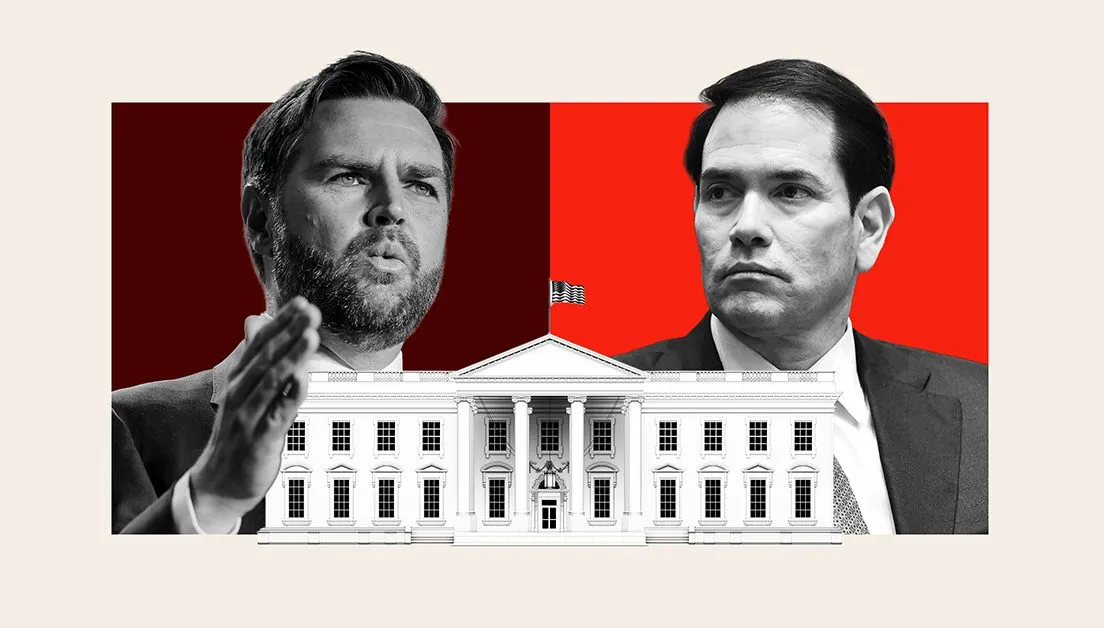
Speculation has been continuing to build over what will happen to the Republican Party in 2028, as Vice President JD Vance and Secretary of State Marco Rubio seem the GOP's most likely rivals in a fight for the White House.
President Donald Trump has repeatedly named Vance and Rubio as likely successors for the GOP. Neither has officially confirmed plans for a 2028 White House run, though presidential candidates typically wait until after the midterms to announce their plans.
Trump has said the two should run on the same ticket and both have previously insisted that there is no rivalry between them.
Read More on News
While Rubio has ruled out a run if Vance enters the race in a Vanity Fair interview, Vance joked with a photographer during a White House photo shoot: "I’ll give you $100 for every person you make look really s***** compared to me. And $1,000 if it’s Marco."
Vance has been the favorite across various polls as the GOP's next leader, but his support appears to be dwindling, while Rubio simultaneously looks as though he is gaining support as time goes on.
White House Communications Director Steven Cheung told Newsweek: "The President has assembled an all-star team that has achieved unprecedented success in just over one year. No amount of crazed media speculation about Vice President Vance and Secretary Rubio will deter this Administration’s mission of fighting for the American people."
Newsweek has contacted Rubio via the State Department press team outside regular working hours via email for comment.
...
Competing Future for Republican Party
Given the difference between the vice president and the secretary of state's support bases and policy priorities, they would likely steer the Republican Party in different directions, meaning the outcome of the succession fight might influence the party's future.
Harnessing his support among Trump-aligned Make American Great Again (MAGA) supporters, Vance has come out as the succession front-runner for the base, posing as the heir to the movement. Various polls have underscored his favor in the group and his endorsement from Erika Kirk, the widow of activist Charlie Kirk, who founded Turning Point USA, a MAGA-aligned, conservative student movement, further confirmed Vance's support from the MAGA movement.
Vance is a graduate of Yale Law School, a New York Times best-selling author and a former United States senator, yet he has been able to position himself as a critic of the elite, given his difficult upbringing and Appalachian roots, which has made him popular among supporters of the "New Right" conversative movement as well.
According to Vance advisers who spoke with Newsweek, there was no specific policy portfolio designed for him when he became vice president, as his strategy team wanted to avoid "pigeonholing" him, positioning him instead as a political Swiss Army knife and a leading defender of Trump's agenda.
He has established himself as a proponent of using government policies to boost industries across the Midwest, such as through the use of tariffs and trade barriers, a possible advocate for tax hikes, particularly on certain universities, as well as an opposer of abortion and his affiliation with a number of other key policy areas.
Meanwhile, Rubio and White House Chief of Staff Susie Wiles have come to represent their own institutional wing in the White House.
Though Vance appears to be the front-runner for 2028, Rubio has been slowly gaining ground in a number of polls. A group of Republican donors supporting a potential Rubio run have also begun to figure out plans to boost his political future, according to multiple sources who spoke with ABC News, and an emerging effort being described as "draft Rubio" is being discussed.
Rubio's image has been building over the past year as he has become a leading voice for the Trump administration, tasked with a number of influence roles. In a show of loyalty to the president, he also seems to have shifted from a number of his previous views in his adoption of Trump's agenda, an example being that he ditched his former advocacy of aid programs to shut down the U.S. Agency for International Development (USAID) under the president's direction.
Following the start of the U.S. conflict with Iran at the end of February, Rubio has been gaining additional influence, working by Trump's side as military operations unfold, though having his profile elevated by the conflict could enhance or hinder his chances of a White House run.

...
Impact Of An Early Succession Battle
Strategists and experts who spoke to Newsweek about the potential Vance-Rubio rivalry suggested that an early succession fight might not be an entirely bad thing, though it could have consequences if any competition takes away from policies.
Competition in a political party as it looks ahead to its next generation of leadership is "inevitable," Brittany Martinez, a Republican political strategist and the executive director of Principles First, a grassroots conservative movement, told Newsweek, though she added that "it’s still early to frame this as a true succession battle."
The potential problem isn't "multiple strong contenders emerging," she said, but if "internal jockeying starts to overshadow the issues voters care about most, particularly the economy."
"If the conversation becomes personality-driven or factional, as we’ve seen happen over the last decade, it can have real electoral consequences—especially in moments when there isn’t a candidate at the top of the ticket capable of capturing broad interest from voters," she said.
When it comes to voter turnout, a "hot nomination fight" can lead to an uptick in interest, Larry Sabato, the founder and director of the University of Virginia Center for Politics, told Newsweek. He added that it can even "strengthen a party by bringing in new people. Most of the time, the contenders reconcile, maybe via the vice president nomination."
Though not an impact of an early succession battle, another factor to consider more broadly is historical patterns.
"There is a long and distinguished list of candidates that were unable to balance both the need to be politically independent while continuing to depend on the outgoing president: Richard Nixon in 1960, Hubert Humphrey in 1968, Al Gore in 2000, Hillary Clinton in 2016, and Kamala Harris in 2024," Luke Nichter, the chair in Presidential Studies and director of the Presidential Studies Program at Chapman University, told Newsweek.
He added that only George H.W. Bush "pulled it off" in 1988 and said that "the challenge of running on change and continuity simultaneously is almost always fatal in politics. Bush pulled it off arguably because he ran more on continuity–Reagan’s popularity–than change."
What This Means for GOP's White House Chances in 2028
Whether or not the potential rivalry between Vance and Rubio could hinder the Republican Party's chances of a White House victory in 2028 is up for debate.
Allan Litchman, a political analyst and professor of history at American University, told Newsweek that he thought "a succession fight between Vance and Rubio would likely diminish Republicans' prospects of winning the 2028 presidential election."
He said that one of the keys to victory for the incumbent party is to "avoid a battle for the nomination," as he said "if the rivalry between these two figures leads to a contested nomination, it would undermine public faith in the party governing the White House."
Though this contest would likely not impact the loyalty of Republicans, it could "dampen their turnout," he said, adding that it could also "turn independent voters away from the party in power."
"Contested nominations have almost always presaged the incumbent party's defeat," he said. "Examples include the battle between President Gerald Ford and Ronald Reagan for the 1976 Republican Party nomination, the fight between President Jimmy Carter and Ted Kennedy for the 1980 Democratic Party nomination, and the battle between Hillary Clinton and Bernie Sanders for the 2016 Democratic Party nomination."
However, others are less certain that brewing tension between the two men will end badly for the party. Sabato said it's important to remember that this "may not even be a fight" and that it is worth waiting to "see what Trump does."
If it does result in a succession battle, he said: "I doubt it leaves lasting scars for the GOP. Both have signed on to Trump’s platform. The differences can’t be too great. And neither Vance nor Rubio is the sort to take the fight too far."
With plenty of time before the 2028 election, the midterms will likely be the next major development in this potential battle, as it is likely that presidential candidates will then begin to announce their plans to run.
In a polarized era, the center is dismissed as bland. At Newsweek, ours is different: The Courageous Center—it's not "both sides," it's sharp, challenging and alive with ideas. We follow facts, not factions. If that sounds like the kind of journalism you want to see thrive, we need you.
When you become a Newsweek Member, you support a mission to keep the center strong and vibrant. Members enjoy: Ad-free browsing, exclusive content and editor conversations. Help keep the center courageous. Join today.


View 0 Comments
Submit Correction
View Editorial & AI Guidelines