...

By Andrew Stanton
Reporter
0
Share
Newsweek is a Trust Project member
See more of our trusted coverage when you search.Prefer Newsweek on Googleto see more of our trusted coverage when you search.
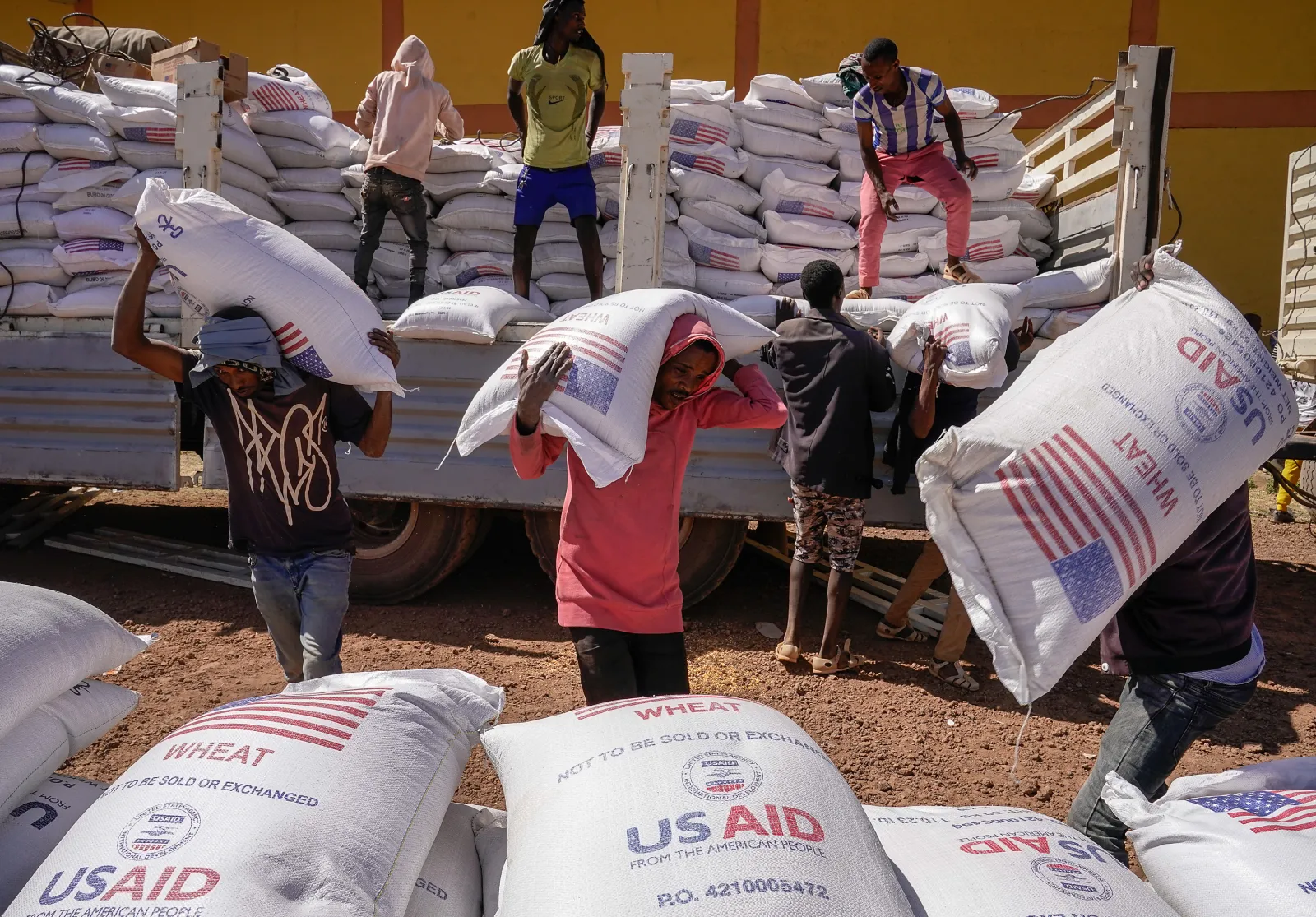
President Donald Trump and Department of Government Efficiency head Elon Musk are gutting the United States Agency for International Development (USAID)—but foreign aid represents only a tiny fraction of the federal budget.
Newsweek reached out to the White House via email for comment.
Why It Matters
The Trump administration announced on Tuesday that nearly all USAID workers would be withdrawn from the field amid efforts to dismantle the agency.
Read More on Politics
The U.S. pays more in foreign aid than any other country, and dismantling USAID emerged as a key priority for the president in the early days of his current term. Many programs are viewed at risk of being ended amid the restructuring and due to his executive order ending diversity, equity and inclusion (DEI) programs in the federal government.
Critics view these programs as a misuse of taxpayer dollars, arguing these funds should be spent at home to tackle priorities such as border security. Others see these humanitarian projects as necessary not only to improve living standards for millions but also to have key national security implications.
Maryam Z. Deloffre, a professor of international affairs at The George Washington University, told Newsweek that interruptions to these programs funded by USAID will lead to "an unimaginable amount of human suffering across the globe."
"Beyond the operational and technical, humanitarian assistance is about helping others. It's the impulse to deliver a meal to your friend who has cancer or donate to a food drive for victims of a hurricane. It's the belief that every life is worth saving and every human has a right to life with dignity," she said.
...
What To Know
The White House on Wednesday touted a list of foreign aid programs Trump views as wasteful that are likely to be cut at the end of the 90-day freeze in a form on their rapid response X account.
Among the projects the White House takes issue with, they listed $20 million for a "new Sesame Street show in Iraq" to $1.5 million and $5.5 million to promote LGBTQ+ advocacy in Jamaica and Uganda, two countries where members of the LGBTQ+ community have few legal rights. Uganda has one of the world's strictest antigay laws, including the death penalty.
The administration also pointed to programs to fund $6 million for tourists in Egypt, more than $19 million to promote "inclusion" in Vietnam and $5 million to EcoHealthAlliance, described as "one of the key NGOs funding bat virus research at the Wuhan lab."
"For decades, USAID bureaucrats believed they were accountable to no one — but that era is over," the White House wrote. "President Trump is STOPPING the waste, fraud, and abuse."
On Tuesday, White House press secretary Karoline Leavitt criticized USAID for sending $1.5 million to advance DEI in Serbia workplaces, $70,000 for a "DEI musical" in Ireland and $32,000 for a "transgender comic book in Peru."
While Republicans view many of these programs as a waste of taxpayer dollars, they represent a small percentage of spending from the federal government. Congress appropriated $43.4 billion to USAID in fiscal year 2023, according to a report from the Congressional Research Service. Total expenditures were $6.134 trillion, according to a press release from former Treasury Secretary Janet Yellen.
This means that only about 0.7 percent of the federal budget goes to USAID.
The sorts of programs Republicans have zeroed in on aren't necessarily indicative of most foreign aid. Much of USAID funding goes toward agencies like the World Food Program, UNICEF and nongovernmental agencies like Save the Children, Deloffre said.
The most expensive grants issued by USAID deal with issues like improving health care and economic development rather than advancing diversity programs, according to a review of contracts issued by the agency in FY2024.
These programs stand to be disrupted by the foreign aid freeze but could continue after the 90-day review period ends—they would instead operate under the State Department.
USAID handed out more than 6,000 contracts in FY2024. The largest was a $6 billion grant to development firm Chemonics International to work on combating HIV/AIDS. It also received $2.5 billion related to malaria. Pfizer was also a top recipient, receiving $4 billion for international COVID-19 vaccine development.
How U.S. Benefits From Foreign Aid
In addition to the ethical and humanitarian concerns around dismantling USAID, Americans also benefit from the country's leadership in foreign aid, Deloffre said. For instance, the agency procures $1.5 billion in U.S.-produced agricultural products shipped overseas.
Furthermore, cutting these programs will "absolutely" cause more expensive challenges down the road, she said.
"The disruption to health, food, and educational programs will roll back decades worth of progress in strengthening health systems, in improving educational attainment, and increasing economic development and will exacerbate migration as people try to flee violence, instability, and democratic backsliding in their home countries," Deloffre said.
While the future of USAID programs remains unclear, Secretary of State Marco Rubio said parts of the agency will continue to run under the watch of Pete Marocco, the State Department's director of foreign assistance. Not all foreign aid will be cut, he said.
Rubio wrote on X, formerly Twitter, in February 2017 that foreign aid is "critical to our national security" but must be well spent.
What People Are Saying
Secretary of State Marco Rubio told Fox News on February 3: "This is not about getting rid of foreign aid. There are things that we do through USAID that we should continue to do that make sense. And we'll have to decide, is that better through the State Department, or is that better through something, a reformed USAID? That's the process we're working through."
Senator Brian Schatz, a Hawaii Democrat, on X: "There's an outbreak of Ebola in Uganda. There's an outbreak of Marburg's disease in Tanzania. Thousand of American diplomats leaving their posts abruptly. We just look so weak and a bit nuts. Foreign policy is hard, but this is just a very big early blunder."
White House press secretary Karoline Leavitt told reporters: "I don't know about you. But as an American taxpayer, I don't want my dollars going toward this crap. And I know the American people don't either. And that's exactly what Elon Musk has been tasked by President Trump to do. To get the fraud, waste and abuse out of the federal government."
What Happens Next
Decisions about which programs are being cut are expected to be made within 90 days of January 20. Reimbursement for approved programs will resume at the end of the review period, but many programs are expected to be halted.
View 0 Comments
Submit Correction
View Editorial & AI Guidelines