...


By Kate Plummer and John Feng
0
Share
Newsweek is a Trust Project member
See more of our trusted coverage when you search.Prefer Newsweek on Googleto see more of our trusted coverage when you search.
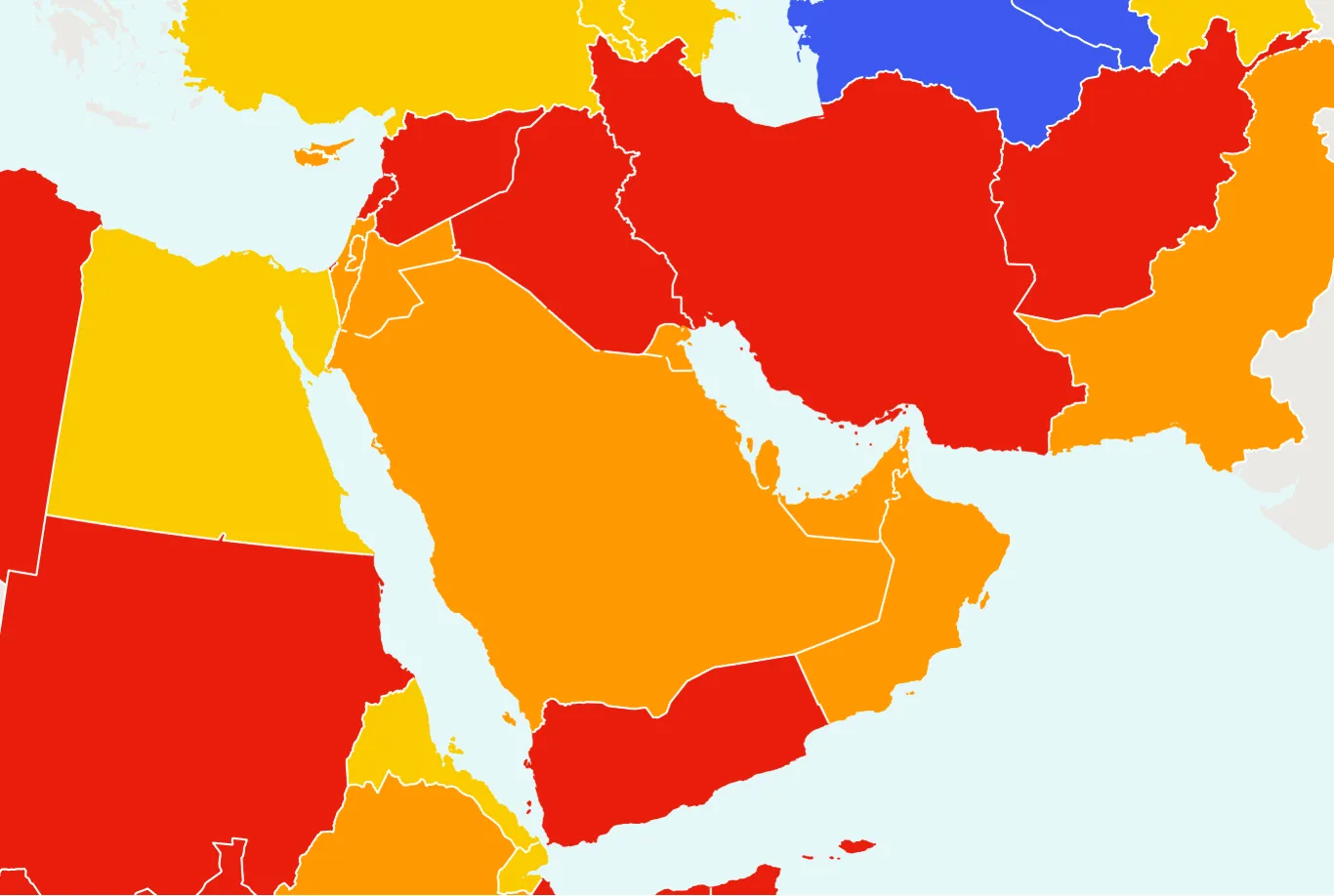
The U.S. State Department has issued travel advisories to American citizens around the world amid the ongoing conflict between the United States and Iran.
The U.S. and Israel has been carrying out coordinated attacks on Iranian military and strategic targets, with officials describing the action as a preemptive operation targeting the country's nuclear capabilities. Iran's Supreme Leader Ayatollah Ali Khamenei was killed in the strikes. Mojtaba Khamenei, his son, was named his successor Sunday.
The Islamic Republic launched retaliatory strikes across U.S. bases in the Middle East and Iran has repeatedly denied pursuing a nuclear weapon.
Read More on News
Oil prices shot up past $100 a barrel for the first time since 2022 as strikes across the Middle East entered their 10th day.
Newsweek has rounded up the U.S. government's travel warnings below.
Qatar
The U.S. has issued a Level 3 warning for travel in Qatar, the second most serious travel advisory. The warning suggested people should "reconsider travel" to the country "due to the threat of armed conflict."
It said: "Following the onset of hostilities between the United States and Iran on February 28, there has been an ongoing threat of drone and missile attacks from Iran and significant disruptions to commercial flights."
It also said Americans in Qatar were advised to sign up to receive emergency alerts and monitor local media to inform plans.
The guidance was updated to reflect the departure of non-emergency U.S. government personnel.
Kuwait
A Level 3 warning has also been issued for Kuwait.
The State Department said it had on March 2 "ordered [the] departure of non-emergency U.S. government personnel and family members of government personnel."
"There were no changes to the risk indicators," it added.
A previous warning said that people should "exercise increased caution in the Jleeb Al-Shuyoukh area in Kuwait City because of crime." The district in the capital is adjacent to the international airport.
"Do not travel to the desert area near the border with Iraq because of bombs, shells, and landmines left over from the 1990 Gulf War," the advisory also warned.
Meanwhile, writing on X, the department's bureau of consular affairs said there was "a continuing threat of missile and UAV [unmanned aerial vehicle] attacks over Kuwait."
It said U.S. citizens should stay indoors and "shelter in place."
...
Bahrain
Bahrain has also been issued a Level 3 travel advisory "due to terrorism and armed conflict" arising from the conflict between the U.S. and Iran.
"Terrorist groups continue plotting possible attacks in Bahrain," the warning said. "Terrorists may attack with little or no warning. Targets may include tourist sites, transportation hubs, markets, shopping malls, and religious sites as well as government and military facilities."
The guidance was similarly updated to reflect the departure of non-emergency U.S. government personnel.
Bahrain's Health Ministry said 32 people were injured in a drone attack on the Gulf state Monday.
United Arab Emirates
A Level 3 advisory has also been issued for the United Arab Emirates "due to the threat of armed conflict and terrorism."
The advisory warned about "a risk of terrorist violence" and said: "Terrorists may attack with little or no warning and may target tourist locations, transportation hubs, shopping areas, government facilities, places of worship, and in particular locations associated with the Jewish and Israeli communities."
As with Bahrain, Kuwait and Qatar, the guidance was similarly updated to reflect the departure of non-emergency U.S. government personnel.
Saudi Arabia
A Level 3 advisory in Saudi Arabia cautioned about the "risk of armed conflict, terrorism, exit bans, and local laws regarding social media activity."
The guidance, issued on March 3, said Americans should "not travel to the Yemen border due to the threat of terrorism" and said there had previously been "missile and drone attacks" in the country."
"Armed groups in Yemen have attacked Saudi border towns and other sites in Saudi Arabia with armed drones, missiles, and rockets," the warning said. "People near the border with Yemen are at increased risk."
On March 8 the guidance was updated to reflect the departure of non-emergency U.S. government personnel. "There were no changes to the advisory level or risk indicators," the advisory says.
Pakistan
A Level 3 warning urges American to "reconsider travel to Pakistan."
It told Americans not to travel to "Balochistan Province and Khyber Pakhtunkhwa (KP) Province, including the former Federally Administered Tribal Areas (FATA), due to terrorism and kidnapping and the immediate vicinity of the Line of Control due to terrorism and the potential for armed conflict."
Oman
A Level 3 warning was issued because of limited U.S. Embassy operations.
"Terrorism is a concern in Oman," the warning said. "Attacks can occur with little or no warning, especially around holidays. They can involve knives, firearms, and vehicles."
The advisory warned against traveling to the Yemen border.
Cyprus
A Level 3 warning has been issued to reflect "limited U.S. Embassy assistance for Americans in the Turkish Cypriot administered area."
Turkey
Americans are advised to "exercise increased caution" in Turkey, where there is a Level 2 warning. And there is a Level 4 warning in the southeast "due to risk of terrorism and armed conflict" following the Iran war.
"There are heightened risks of anti-Western, specifically anti-U.S. or anti-Israel, sentiment," the warning said. "There is continued threat of attacks by terrorist groups.
Iraq
Iraq was hit with a Level 4 warning meaning Americans should not travel to the country. "Do not travel to Iraq due to terrorism, kidnapping, armed conflict, civil unrest, and the U.S. government’s limited ability to provide emergency services to U.S. citizens in Iraq," the warning, which was updated to reflect U.S. employees leaving the country said. "Do not travel to Iraq for any reason. Leave now if you are there."
Jordan
A Level 3 warning suggests Americans do not travel to the country "due to terrorism and armed conflict" after non-emergency U.S. government employees left the country. It warned against travel to the border with Syria and Iraq and other regions where the risk of crime is higher.
View 0 Comments
Submit Correction
View Editorial & AI Guidelines