...



By Gabe Whisnant, John Feng, and Tom O'Connor
0
Share
Newsweek is a Trust Project member
See more of our trusted coverage when you search.Prefer Newsweek on Googleto see more of our trusted coverage when you search.
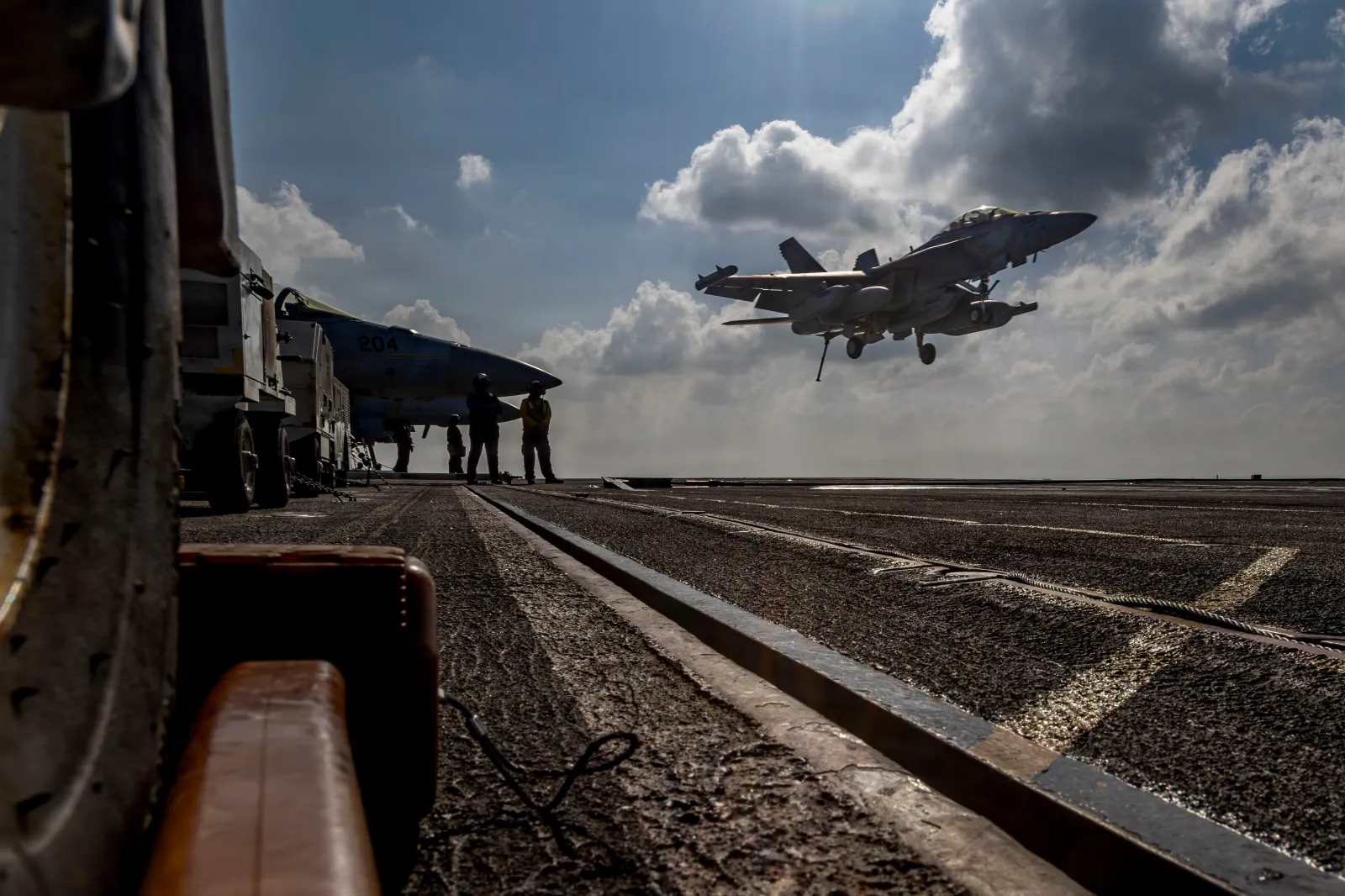
U.S. Central Command said a U.S. Navy fighter jet shot down an Iranian drone that was approaching the aircraft carrier USS Abraham Lincoln in the Arabian Sea, marking the latest confrontation between U.S. and Iranian forces in the region.
In an emailed statement Tuesday to Newsweek, Central Command spokesperson Navy Captain Tim Hawkins said the drone “aggressively approached” the carrier with “unclear intent” and continued flying toward the ship despite de‑escalatory measures taken by U.S. forces operating in international waters. The military said the shootdown occurred within hours of a separate incident involving Iranian forces and a commercial vessel in the Strait of Hormuz.
The drone, identified as a Shahed‑139, was destroyed by an F‑35C fighter jet launched from the Abraham Lincoln, which Central Command said was operating about 500 miles from Iran’s southern coast. No U.S. personnel were injured, and no equipment was damaged in the incident, the military said.
Read More on News
The incident was also reported on by Iran's semi-official Tasnim News Agency, which cited an unnamed source as stating that a drone identified as a Shahed-129 had "been engaged in identification, monitoring and imaging in its regular and legal mission in the open waters, and this is considered a routine and legal action."
"The drone successfully sent its surveillance and reconnaissance images to the center, but then lost contact," the source said, according to Tasnim. "However, the reason for this loss of contact is being investigated and details will be announced once it is confirmed."
Newsweek reached out to the Iranian Mission to the United Nations for comment.

...
Later the same day, Iran’s Islamic Revolutionary Guard Corps harassed the U.S.-flagged, U.S.-crewed merchant vessel Stena Imperative, according to Central Command. The military said two Iranian boats and an Iranian Mohajer drone approached the ship at high speed and threatened to board and seize the tanker.
Central Command told Newsweek, "During a separate incident hours later in the Strait of Hormuz, Iran’s Islamic Revolutionary Guard Corps (IRGC) forces harassed a U.S.-flagged, U.S.-crewed merchant vessel lawfully transiting the international sea passage. Two IRGC boats and an Iranian Mohajer drone approached M/V Stena Imperative at high speeds and threatened to board and seize the tanker."
The statement continued, "Guided-missile destroyer USS McFaul (DDG 74) was operating in the area and immediately responded to the scene to escort M/V Stena Imperative with defensive air support from the U.S. Air Force. The situation de-escalated as a result, and the U.S.-flagged tanker is proceeding safely."
Turkey had been working behind the scenes to host the talks later this week as U.S. Middle East envoy Steve Witkoff traveled through the region. A Turkish official later said the location of the discussions had not been finalized but that Turkey stood ready to support the diplomatic effort.
White House press secretary Karoline Leavitt told reporters Tuesday that those talks are still on.
“President Trump is always wanting to pursue diplomacy first, but obviously it takes two to tango,” Leavitt said after the incidents. She added, “As always, though, of course, the president has a range of options on the table with respect to Iran.”
Iranian Foreign Ministry spokesperson Esmail Baghaei earlier told the state-run Islamic Republic News Agency that "the place and time of the talks are not a complicated issue and should not be used as a pretext for the media game both," noting Turkey, Oman and other regional countries had offered to host talks and played a "valuable" role in supporting the diplomatic process.
Iranian Foreign Minister Abbas Araghchi also held separate calls Tuesday with his counterparts from Oman, Qatar and Turkey.
What are Shahed Drones?
Shahed drones are Iranian‑made unmanned aerial vehicles developed by Shahed Aviation Industries and used by Iran for surveillance and attack missions. The Shahed‑129 and Shahed-139 are part of a broader family of drones that includes loitering munitions capable of flying long distances and striking targets at low cost.
U.S. officials and allies have raised concerns about the drones’ growing role in regional tensions, noting their widespread use by Iran and Iranian‑aligned forces and, separately, by Russia in its war in Ukraine. Analysts say the drones’ relatively simple construction and range make them a persistent threat in congested airspace, particularly near naval and commercial shipping routes.
Where is the USS Abraham Lincoln Stationed?
The Nimitz-class aircraft carrier USS Abraham Lincoln was operating in the Arabian Sea at the time of the drone incident, according to U.S. Central Command. The Abraham Lincoln carrier strike group had been redirected from the Indo‑Pacific earlier in its deployment and entered the U.S. Central Command area of responsibility weeks before the incident. U.S. officials say the carrier’s presence is intended to bolster deterrence and protect regional security.
Iran Supreme Leader Warns US Attack Would Spark 'Regional War'
Iran’s Supreme Leader Ayatollah Ali Khamenei warned last week that any attack by the United States would trigger a “regional war,” escalating tensions as Washington increased its military presence near Iran. In remarks reported by Iranian state media and Reuters, Khamenei said Iran does not seek conflict but would respond forcefully to any aggression.
President Donald Trump has teased the prospect of a regional conflict if a deal isn't reached on the Islamic Republic’s nuclear program.
"We don’t make a deal, then we’ll find out whether or not he was right," Trump said Sunday.
Update: 2/3/26, 3:11 p.m. ET: This article was updated with new information and remarks.
Update: 2/3/26 6:31 p.m. ET: This article was updated with additional information and comments.
This article includes reporting by the Associated Press.
In a polarized era, the center is dismissed as bland. At Newsweek, ours is different: The Courageous Center—it's not "both sides," it's sharp, challenging and alive with ideas. We follow facts, not factions. If that sounds like the kind of journalism you want to see thrive, we need you.
When you become a Newsweek Member, you support a mission to keep the center strong and vibrant. Members enjoy: Ad-free browsing, exclusive content and editor conversations. Help keep the center courageous. Join today.


View 0 Comments
Submit Correction
View Editorial & AI Guidelines