...

By Micah McCartney
Reporter
0
Share
Newsweek is a Trust Project member
See more of our trusted coverage when you search.Prefer Newsweek on Googleto see more of our trusted coverage when you search.
A senior United States official on Tuesday disclosed further details about a covert nuclear-related test allegedly carried out by China while stressing the U.S. cannot afford not to resume testing to some degree, to avert an "intolerable disadvantage" in an era of two nuclear peer rivals.
Why It Matters
China, like the U.S. and Russia, signed the 1996 Comprehensive Nuclear-Test-Ban Treaty (CTBT), which prohibits nuclear weapons test explosions in any environment, including space.
Read More on World
While none of the three has ratified the pact, the countries have for decades observed voluntary moratoriums on explosive testing for decades. Ahead of talks with Chinese counterpart Xi Jinping in October, Trump called for the Pentagon to resume tests "on an equal basis," citing "other countries testing programs."
The issue lands amid deepening uncertainty in the global nuclear order, with New Start, the last remaining U.S.-arms control agreement between the U.S. and Russia, expiring on February 5, 2026.
Newsweek reached out to the White House via email with a request for comment.
What To Know
Speaking at the Hudson Institute on Tuesday, Christopher Yeaw, assistant secretary of state for arms control and nonproliferation, elaborated on a February 6 claim by Under Secretary of State for Arms Control and International Security Thomas DiNanno at a disarmament conference in Geneva that China carried out a nuclear test in 2020.
"We are aware of nuclear-yield-producing nuclear explosive testing in China," Yeaw said. "We are aware that they are using decoupling, which is essentially a method to reduce the effectiveness of seismic apparatus to detect this. We’ve been paying very close attention to this—obviously, a very important issue."
A magnitude-2.75 seismic event believed to have occurred near China’s traditional nuclear testing site at Lop Nur in the Xinjiang region of northwestern China was detected on June 22, 2020, at 9:18 a.m. local time, Yeaw said. The signal was recorded by a key International Monitoring System (IMS) seismic station in Makanchi, Kazakhstan, part of the global network established to detect nuclear explosions.
"Looking at the data—and I’ve looked at additional data since then—there is very little possibility, I would say, that it is anything but an explosion, a singular explosion," Yeaw said. "It is not consistent with the ripple-fire explosions you get in mining. It is also entirely not consistent with an earthquake. It is quite consistent with what you would expect from a nuclear explosive test of some certain yield—one that would be supercritical and not subcritical, as the United States tests currently."
Turning to Trump’s comments about a possible resumption of U.S. testing, Yeaw said: "Now, as far as ‘equal basis’ goes—what I can say is that the basis, at least, is that we know they were preparing tests with designated yields in the hundreds of tons. So that’s a basis. And what the president decides to do with that is up to him.
"If the United States’ adversaries were able to test at some yield that we couldn’t detect, while we maintained a strict zero-means-zero policy, then the United States would be living at an intolerable disadvantage." Yeaw added, echoing the words of Linton Brooks, a former head of the National Nuclear Security Administration.
"Equal basis" doesn’t mean returning to "Ivy Mike-style atmospheric testing in the multimegaton region," he said.
A satellite analysis of Lop Nur's northern tunnel test area "did not provide any conclusive findings to support or disprove the recent U.S. allegations," the Center for Strategic and International Studies wrote in a report last week.
...
"However, Lop Nur is a large facility. It is possible that China conducted an underground nuclear test at another area. It is also possible that the testing did indeed take place at this tunnel, and there are no optical indicators in these two images," the authors said.
Beijing has repeatedly rebuffed calls to join negotiations on a new arms control treaty, arguing that the United States and Russia, as the countries with the two largest arsenals, have the primary responsibility to take the lead.
“The U.S. accusation of Chinese nuclear explosive tests is completely groundless," Liu Pengyu, spokesperson for China's embassy in the U.S., told Newsweek.
"China opposes the U.S.’s fabrication of pretexts for its own resumption of nuclear tests. China urges the U.S. to renew the commitment of the five nuclear-weapons states to a moratorium on nuclear testing, uphold the global consensus on the ban on nuclear testing, and take concrete actions to safeguard the international nuclear disarmament and nuclear non-proliferation regime."
The U.S. allegations also follow earlier concerns raised by then-Director of the Defense Intelligence Agency Robert Ashley Jr., who said Russia was "probably not adhering" to the zero-yield standard of the CTBT while developing new nuclear systems.
What People Are Saying
Jeffrey Lewis, director of the East Asia Nonproliferation Project at the Middlebury Institute of International Studies, on X: "A magnitude of Mb=2.7 corresponds to about 18 tons of yield at China's Lop Nor test site. If the explosion was fully decoupled that would correspond to about 400-700 tons of TNT. Again, these are very small events, relatively speaking. (Nagasaki was ~20,000 tons.)"
Dmitry Peskov, Kremlin spokesperson, told reporters Wednesday: "Neither the Russian Federation nor China has conducted any nuclear tests. We also know that these claims were firmly rejected by representatives of the People’s Republic of China, so that is the situation," Peskov told journalists, responding to a question about whether Russia has its own data on the matter.
What Happens Next
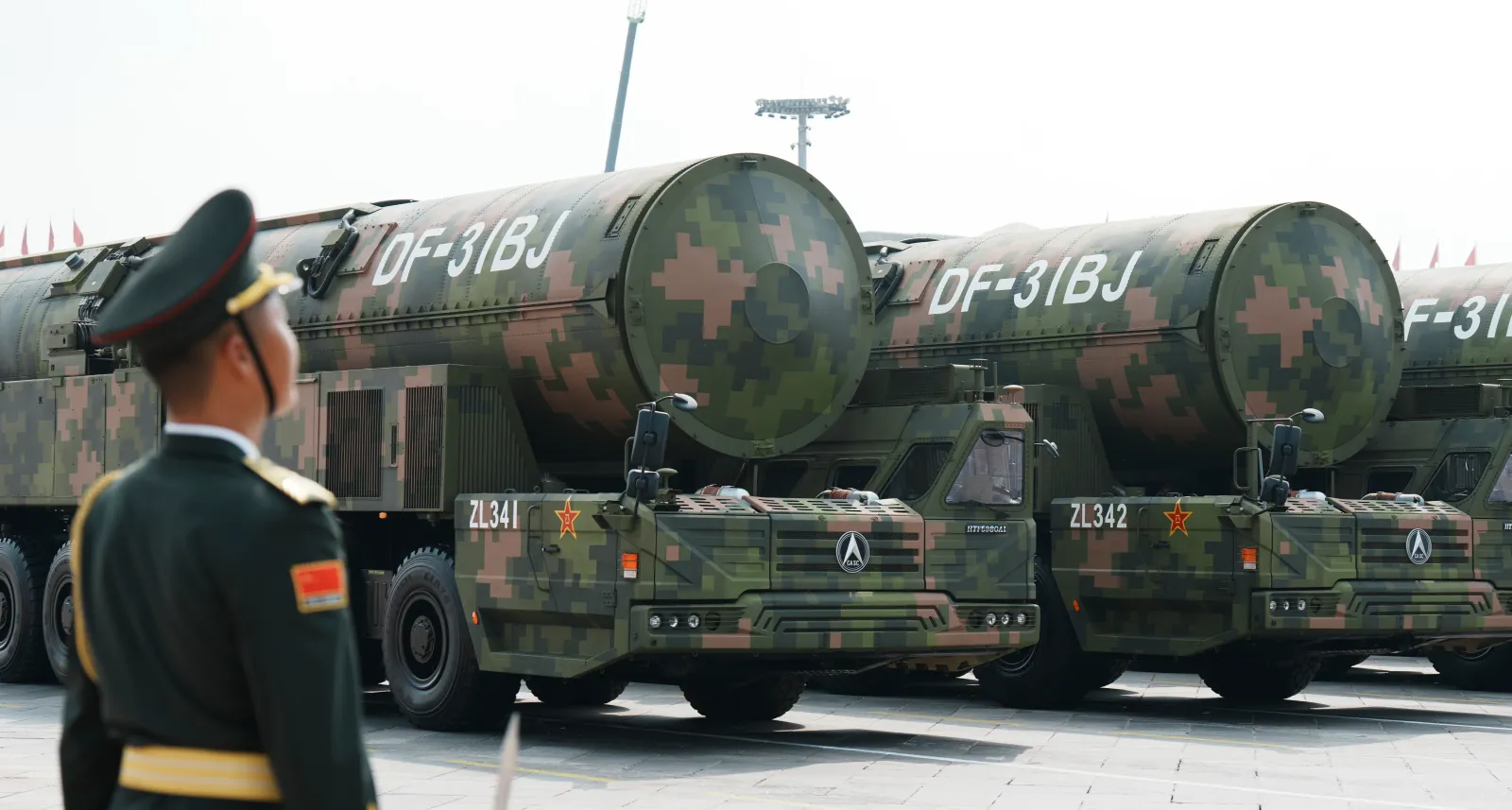
China’s nuclear arsenal exceeded 600 warheads and projected to exceed 1,000 by 2030, according to Pentagon estimates. It remains unclear under what conditions the country would consider entering into multilateral negotiations on nuclear arms control.
Update 2/20/26, 9:58 p.m. ET. This article has been updated with comment from China's embassy in the U.S.
In a polarized era, the center is dismissed as bland. At Newsweek, ours is different: The Courageous Center—it's not "both sides," it's sharp, challenging and alive with ideas. We follow facts, not factions. If that sounds like the kind of journalism you want to see thrive, we need you.
When you become a Newsweek Member, you support a mission to keep the center strong and vibrant. Members enjoy: Ad-free browsing, exclusive content and editor conversations. Help keep the center courageous. Join today.


View 0 Comments
Submit Correction
View Editorial & AI Guidelines