...

By Dan Gooding
Associate News Editor
0
Share
Newsweek is a Trust Project member
See more of our trusted coverage when you search.Prefer Newsweek on Googleto see more of our trusted coverage when you search.
The foreign-born population in 26 U.S. states grew by more than 300 percent over the past 45 years, while American-born populations lagged far behind.
New analysis of U.S. Census Bureau data by the Center for Immigration Studies (CIS) – a right-leaning think tank – found it was Texas and Florida where the biggest increases occurred.
The findings have been backed up by the non-partisan Brookings Institution, which found that immigrant populations continue to drive the country's population growth.
Read More on U.S.
"The story of immigration is a national one, but it's an uneven one as well," Steven Camarota, director of research at the Center for Immigration Studies, told Newsweek. "Which means that in many states the impact is so much larger, so much bigger, than it is nationally.
"Whatever the impact, whether you think it's positive or negative, or even more if you're thinking about the impact on housing or culture or politics or the labor market, it's a very uneven story."
Census data gives regular glimpses into the changing makeup of the U.S. population. Such hard data is crucial for policymakers, and the various groups across the political spectrum discussing how immigration should be managed, especially in the face of a declining American fertility rate.
Historic Highs of Foreign-Born Residents
After a five-year decline in the U.S. population, a pandemic-era surge began in 2020. CIS has pointed to the explosion of new arrivals from the southwest border, be they legal immigrants or those crossing illegally.
Camarota and Karen Zeigler, who authored the CIS report, said that the changes were "all the more striking" because babies born to immigrants counted among the U.S.-born population figures – highlighting the ongoing tension around birthright citizenship the Trump administration is seeking to address via executive order.
Much of the data available allows a look at the changes at state level, with 14 states seeing historic highs of their foreign-born population share in the first quarter of 2025. These were: Alabama, Delaware, Florida, Georgia, Indiana, Maryland, Mississippi, New Mexico, North Carolina, Oklahoma, South Carolina, Tennessee, Texas and Virginia.
State Populations Becoming More Diverse
The Brookings analysis of the data also highlighted how young Hispanic and Asian American residents were driving the most new births, while white Americans were seeing greater numbers of deaths.
All states experienced growth in their Hispanic, Asian American and two-or-more-races populations in 2023-24. Brookings found that without those groups, California, New Jersey, and New York would have all seen their population gains drop into the negative at a time when births have fallen.
"We have a decline of white children in the U.S., which is the big engine of the fact that we have an overall decline in in children," William Frey, demographer at the Brookings Institution, told Newsweek. "But that's being countered by the growth in a lot of these racial minorities, and especially Latinos in a big way."
Since 2021, when the last surge at the U.S.-Mexico border began in earnest, there have been steady changes in population make-up in states generally associated with immigrant communities: those in the northeast, along the southwest border, and in Florida.
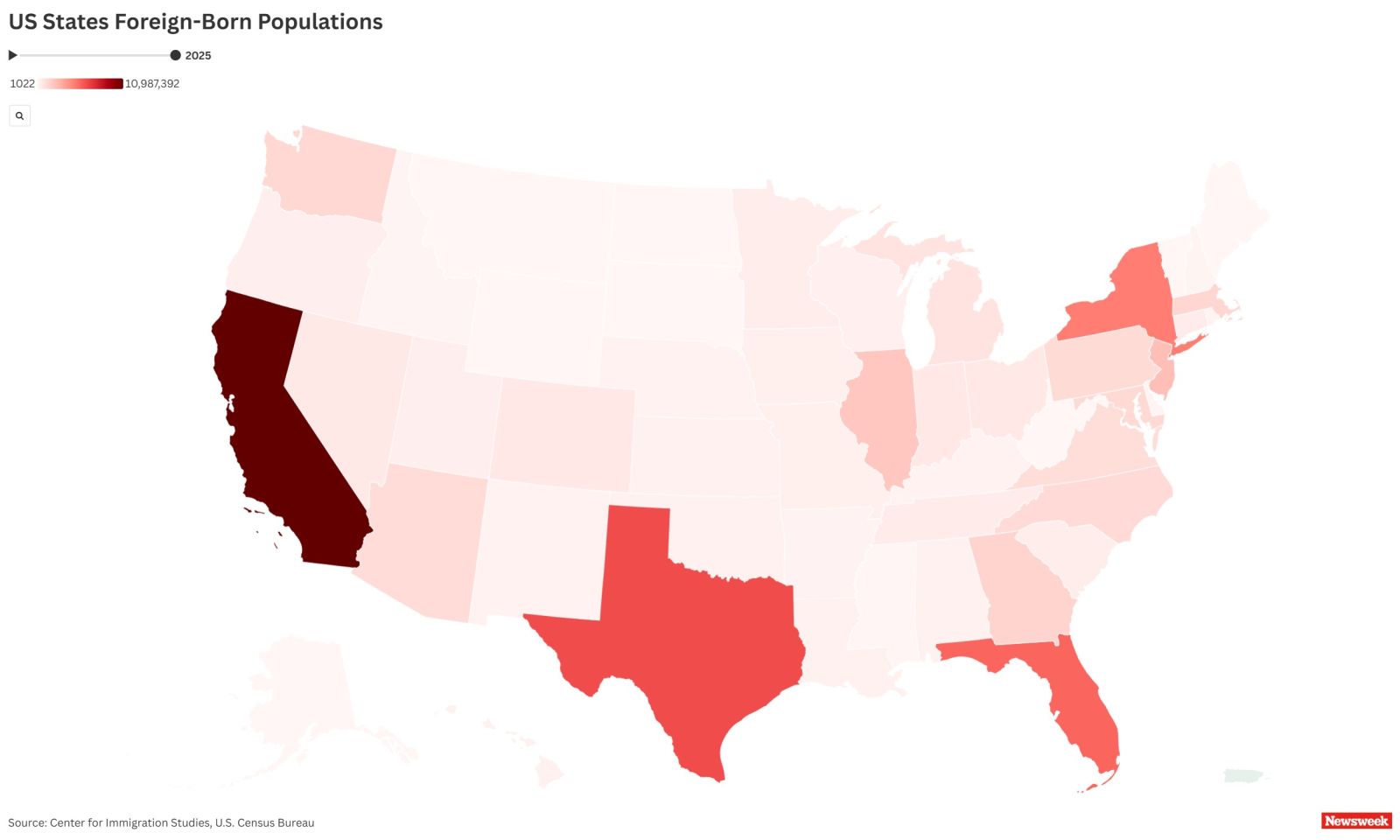
However, as the chart below shows, the foreign-born population has noticeably grown across the board, even in states with relatively low numbers like Alabama.
California continues to dominate, with over 10 million estimated residents born outside the U.S. Texas follows with 6.2 million, then Florida with 5.5 million, and New York with 4.7 million.
Frey noted that it isn't just traditional immigrant-heavy states like New York and California that are seeing a rise in younger foreign-born and minority populations.
"Not only are whites becoming smaller, but these new minorities are a bigger part of it than they've ever been before, which means we're going to be much more dependent on them as those groups move into their younger labor force ages and newer groups of young people move into those groups," Frey said.
"The fact that that's spreading across the country is something that's important, not only because of the nature of the racial composition of that group, but because those states are going to dependent on those kids to keep that younger population not declining as much and, in some cases, growing."
Camarota said that there may be a shift that becomes apparent in the coming years, due to President Donald Trump's immigration policies that have led to a drop in new arrivals at the southwest border, as well as efforts to deport thousands of immigrants without legal status.
Camarota said that, often, the focus of the immigration debate and discussion is on alleged illegal immigrant criminals, or the long-term resident swept up in enforcement actions under the Trump administration.
"What I do think gets lost in the model of compelling anecdote is the overall question of the numbers," he said. "And I would say one of the big questions that this kind of report raises, but it doesn't answer is: is this too much [immigration]?
"You could argue it's not enough, but what is the absorption capacity of Texas? What is the absorption capacity of Florida? I don't mean just narrowly with schools and hospitals, though that's a big deal. I mean, politically, socially, culturally, economically, what is the absorption capacity? Have they reached it? Is public dissatisfaction with immigration related to the sense that it's just too much?"
Frey told Newsweek that data illustrates how, the U.S. wants to continue to grow its population, then it needs immigrants in order to do so.
View 0 Comments
Submit Correction
View Editorial & AI Guidelines