...

By Ryan Chan
China News Reporter
0
Share
Newsweek is a Trust Project member
See more of our trusted coverage when you search.Prefer Newsweek on Googleto see more of our trusted coverage when you search.
A United States military command aircraft, capable of communicating with nuclear-armed submarines, was tracked on an "unusual" flight near Greenland, according to an expert.
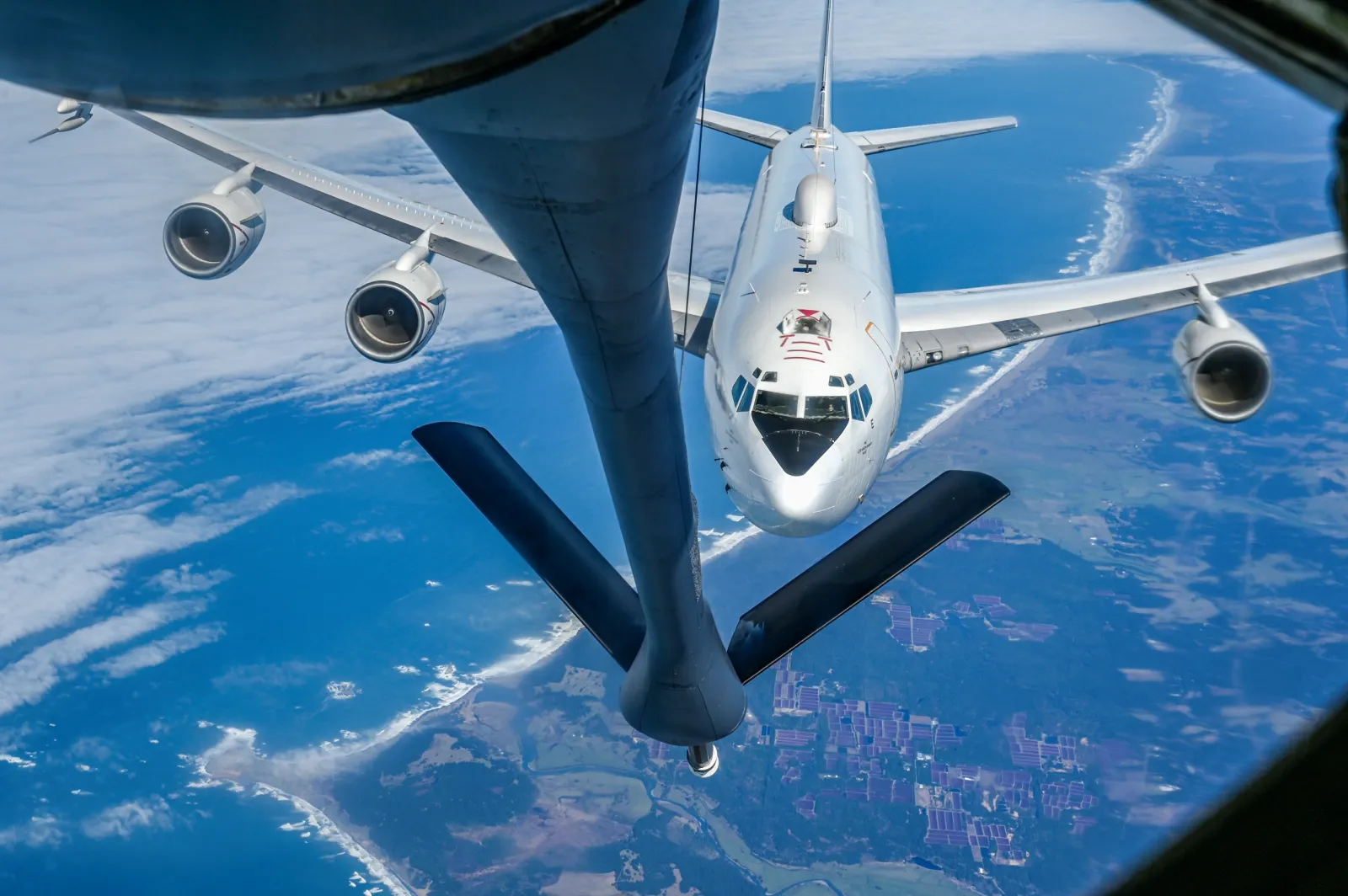
The U.S. Navy confirmed on Thursday the deployment of the E-6B airborne command post, also known as Mercury, at Pituffik Space Base in Greenland for what it described as "routine operations" and exercises with nuclear submarines in the Pacific and Atlantic Oceans.
"Naval Strategic Forces conduct global operations in coordination with combatant commands, services, and allies and partner nations, even in the High North," Commander Jason Fischer, U.S. Submarine Force spokesperson, said in a statement to Newsweek.
Read More on World
Why It Matters
Facing the growing presence of Russia and China in the Arctic, President Donald Trump has repeatedly voiced interest in acquiring Greenland, a self-governing territory of NATO ally Denmark, citing "national and international security."
The deployment of the E-6B aircraft in Greenland follows Trump's claim earlier this month that two nuclear submarines were positioned in the "appropriate regions" amid "provocative statements" made by Dmitry Medvedev, deputy chairman of Russia's Security Council.
...
Last month, an E-6B aircraft and the nuclear ballistic missile submarine USS Maryland were spotted operating in the North Atlantic Ocean, whose presence the Navy confirmed, noting that it coordinates closely with allies and partners to address "shared security concerns."
What Is The E-6B?
According to the U.S. Navy, the E-6B provides "survivable, reliable, and endurable" command, control, and communications between the National Command Authority and strategic forces. The E-6B fleet is assigned to the Strategic Communications Wing 1 at Tinker Air Force Base in Oklahoma.
The aircraft can transmit messages to nuclear-armed submarines beneath the ocean surface using a very low frequency communication system with dual trailing wire antennas. The primary antenna can be deployed for five miles, according to defense outlet The War Zone.
In addition to serving as a communications relay between the National Command Authority and submarines under the Take Charge and Move Out (TACAMO) mission, the aircraft are tasked with the Looking Glass mission using the Airborne Launch Control System (ALCS).

...
The ALCS is designed to transmit launch codes to intercontinental ballistic missiles in their underground silos in the event that ground-based control centers are disabled. In April, an E-6B aircraft simulated the launch of an intercontinental ballistic missile using the ALCS.
What To Know
@thenewarea51, an aviation enthusiast on the social media platform X, told Newsweek that open-source flight tracking data showed an E-6B aircraft deployed to Pituffik Space Base—the northernmost installation of the Pentagon—from Tinker Air Force Base on Monday.
Two days later, the aircraft was tracked for several hours over the Labrador Sea off Greenland's western coast. @thenewarea51 confirmed to Newsweek that this was the first mission since the aircraft's arrival at Pituffik Space Base, located north of the Labrador Sea.
Pituffik Space Base is critical to missile warning and the defense of the U.S. homeland, operating the Upgraded Early Warning Radar (UEWR) to detect and track intercontinental and submarine-launched ballistic missiles. Vice President JD Vance visited the base in March.
Hans Kristensen, director of the Nuclear Information Project at the Federation of American Scientists, described the E-6B aircraft's flight near Greenland as unusual.
"Communicating with [ballistic missile submarine] or part of other exercise?" he commented in a post on X.
While the E-6B fleet uses Tinker Air Force Base as its main base, it has been deployed to forward bases in the U.S. and other locations. E-6Bs are often tracked—using open-source methods—operating over the northeastern Pacific and northwestern Atlantic.
@thenewarea51 told Newsweek that E-6B aircraft had been deployed to Guam—a U.S. territory in the Western Pacific—Norway, Germany, Spain, and the United Kingdom in the last couple years. "But I couldn't find any mention of a TACAMO going to Greenland before."
What People Are Saying
The U.S. Naval Air Systems Command says: "The Navy accepted the first E-6B aircraft in December 1997 and the E-6B assumed its dual operational mission in October 1998. The E-6 fleet was completely modified [from the E-6A] to the E-6B configuration in 2003."
The War Zone website comments on the E-6B aircraft: "Their primary job is an incredibly dark one. If called upon, they would directly facilitate the end of the world. But the fact that they are so capable of suddenly carrying out that mission ensures that they won't ever actually have to."
What Happens Next
The successor to the E-6B aircraft, the E-130J Phoenix II, is under development and will relieve the latter—which has served for over three decades—of the TACAMO mission.
View 0 Comments
Submit Correction
View Editorial & AI Guidelines