...

By Ryan Chan
China News Reporter
0
Share
Newsweek is a Trust Project member
See more of our trusted coverage when you search.Prefer Newsweek on Googleto see more of our trusted coverage when you search.
Facing the Chinese missile threats to its air bases in the Western Pacific Ocean, the United States recently tested its fighter jets on enhancing their survivability while on the ground.
The Chinese Defense Ministry did not immediately respond to a Newsweek request for comment.
Why It Matters
According to the Pentagon's assessment report on Chinese military power, the number of China's medium-range ballistic missiles has increased by 300 to 1,300 in just over a year. With a range of 621 miles to 1,864 miles, they can target U.S. military bases in Japan.
Read More on World
The Hudson Institute, a U.S. think tank, warned in a report that China has been building the capabilities to destroy and paralyze an opponent's aircraft on the ground to seize air dominance; the unhardened U.S. military airfields are highly vulnerable to attacks.
What To Know
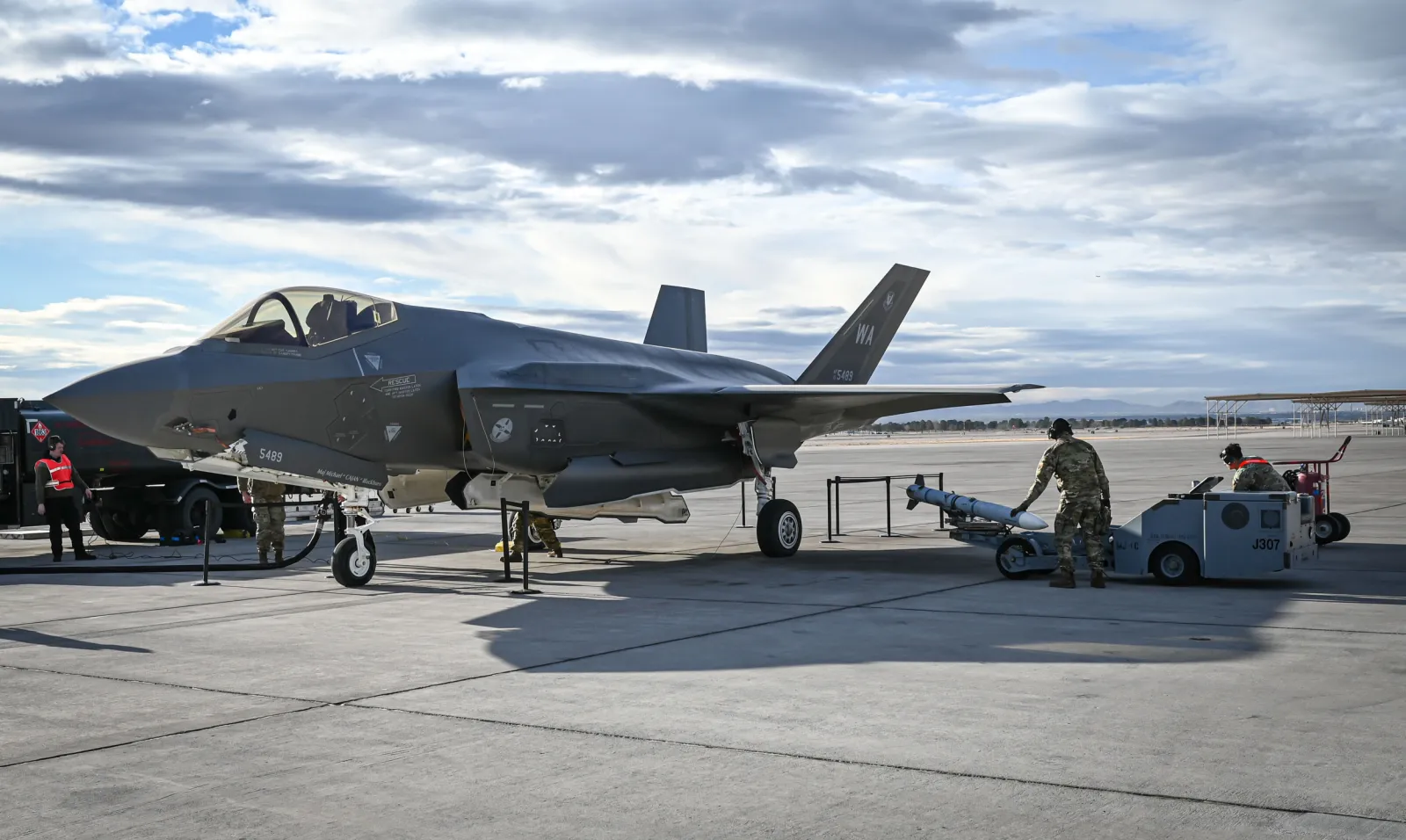
A U.S. Air Force press release on Tuesday said an F-35A fighter aircraft took part in a test known as "integrated combat turn" (ICT) at Nellis Air Force Base in Nevada, where ground crews exercised "rapid aircraft regeneration and employment procedures."
During an ICT, an aircraft conducts the simultaneous fueling, arming, reconfiguration, and inspections, reducing the time of aircraft recovery and relaunch to the minimum. A quick turnaround of an aircraft is critical for survival on the battlefield, the press release said.
The F-35A jet was refueled and loaded with four AIM-120 advanced medium-range air-to-air missiles simultaneously while keeping its engine running during the test at Nellis. Meanwhile, other legacy military aircraft have employed similar turnaround procedures.
...
During a normal procedure where an aircraft's engines were shut down, it took about three hours to complete the process, from refueling to rearming, leaving the aircraft vulnerable on the ground to attacks. The ICT is capable of relaunching aircraft in under half the time.
"We are developing capabilities to make us more lethal," according to U.S. Air Force Lieutenant Colonel Kevin Hand at the Air Force Reserve Test Center. "We are constantly doing new things, trying new tactics, techniques and procedures to meet the pacing threat."
Leaders at the Pentagon have viewed China as its "pacing threat" and "pacing challenge" since 2020. The former means a direct, consequential, and near-term peril to U.S. security and values, while the latter poses a long-term risk to U.S. influence, position, and power.
What People Are Saying
U.S. Air Force Master Sergeant Sharlyn Smith at the 59th Test and Evaluation Squadron said in the press release: "An aircraft is its most vulnerable when it's on the deck. If it's flying, it is a threat to everything around it. If it's on the ground, it's less of a threat and it's more of a target."
U.S. Air Force Master Sergeant Oliver Gutierrez at the 59th Test and Evaluation Squadron said in the press release: "The goal [of the test] is to standardize these procedures to ensure maintainers are trained and confident when performing them in combat. This will save lives and significantly enhance the lethality of our aircraft."
What Happens Next
It remains to be seen how the U.S. Air Force will further enhance its aircraft's survivability on the ground. The Hudson Institute's report recommended the Pentagon should enhance the resilience of its military infrastructure in the contested Western Pacific region.
View 0 Comments
Submit Correction
View Editorial & AI Guidelines