...

By Ryan Chan
China News Reporter
0
Share
Newsweek is a Trust Project member
See more of our trusted coverage when you search.Prefer Newsweek on Googleto see more of our trusted coverage when you search.
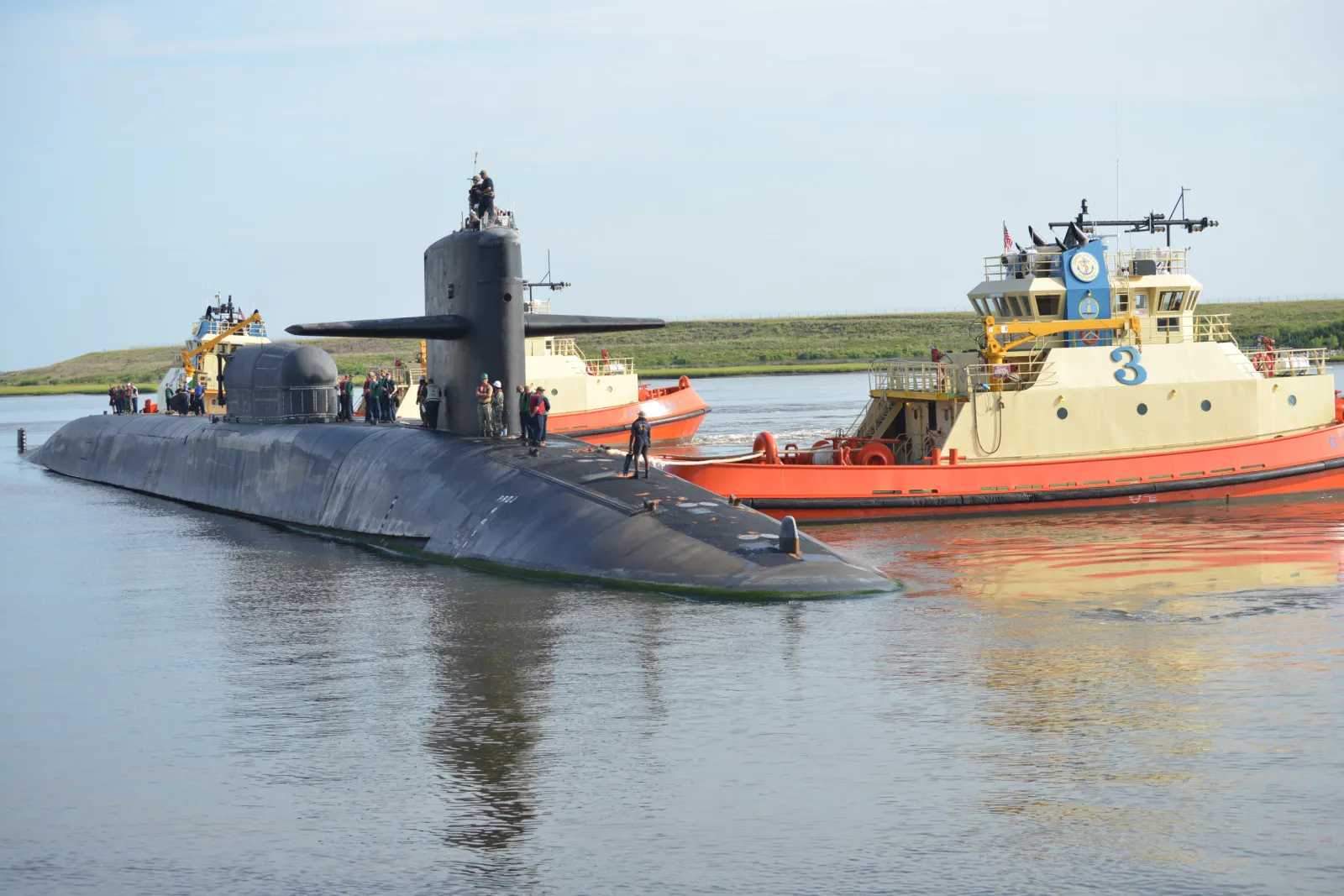
A powerful United States Navy nuclear submarine, armed with conventional long-range missiles, returned home on Wednesday following a 727-day round-the-world deployment during which it conducted missions countering threats posed by Russia, China and Iran.
USS Florida, a 18,750-ton nuclear-powered Ohio-class guided missile submarine, entered the Naval Submarine Base Kings Bay in Georgia following a deployment that commenced in August 2022. It had traveled more than 60,000 nautical miles for the past two years.
The conventionally armed boat is one of the four Ohio-class submarines in the Navy's fleet that were converted from nuclear-armed ballistic missile submarines. The Florida underwent a refueling and conversion in July 2003 and it was completed in April 2006.
Read More on News
...
The main firepower of the "denuclearized" Florida and its three sister ships, USS Ohio, USS Michigan and USS Georgia, is the Tomahawk land-attack cruise missile. Each can carry up to 154 missiles, which can strike targets on land 1,000 miles away.
Another feature of this type of submarine is that it supports special operation forces, capable of hosting up to 66 personnel and accommodating their equipment. Two of the 24 missile tubes were converted to chambers that allow insertion and retrieval of combat personnel.
During this deployment, which began in the Atlantic Ocean and wrapped up in the Pacific Ocean, the Florida deployed in the 5th, 6th and 7th Fleet's areas of operations, which are in the Middle East, Europe and Western Pacific Ocean, respectively.
"We have demonstrated the versatility of SSGN [guided missile submarine] platform to operate anywhere at any time," said the Florida's Blue crew commanding officer, Captain Peter French. The submarine has Blue and Gold crews which alternate operating the boat.

...
The Navy said the two-crew system maximizes submarine's availability, reduces number of submarines required to meet operational requirements, and allows for crew training, readiness and morale. The Florida had swapped its crew five times during deployment.
It is very uncommon for an East Coast-based submarine to deploy to the West Coast, the commanding officer added, "but we managed to do an exceptional job completing the mission." The crews conducted vital missions crucial to national security, the Navy said.
"All submariners go through extensive screening and training to ensure that they can handle the psychological effects of extended deployments and long periods of isolation," former Navy submariner of Bryan Herrin, who served aboard the Ohio, told Newsweek.
This was not the longest deployment for the Florida, which was commissioned 41 years ago. In 2020, it concluded an 800-plus-day overseas deployment that covered almost 100,000 miles, according to defense news website The War Zone.
During the initial stage of the recent deployment, the Florida mainly operated in Europe, including Greece, the Ionian Sea, and the Mediterranean Sea, photos published by the Navy showed.
The Navy rarely publicized the movement of its submarine force, also known as the "Silent Service," unless it wanted to send a message of deterrence to adversaries. This was the case of the Florida's deployment in Europe during Russia's all-out invasion of Ukraine.
In April last year, the Florida conducted a show of force mission in the Middle East as Iran-backed armed groups continued to attack the U.S. military in the region. It entered the Red Sea via the Suez Canal, a move publicized by the Navy at that time.
After a brief return to Europe, where the Florida visited Tromsø, a Norwegian city north of the Arctic Circle, the submarine headed back to the Middle East after the outbreak of war between Israel and Hamas. It passed through the Suez Canal in November.

...
In January, the submarine launched Tomahawk missiles against the Iranian-backed Houthi rebels in Yemen in response to their attacks on commercial shipping in the Red Sea.
The Florida moored in Guam in April for maintenance after visiting Diego Garcia, a British Indian Ocean Territory. It reloaded Tomahawk missiles with submarine tender USS Frank Cable on the U.S. island territory in the Western Pacific Ocean last month.
Guam is a strategic military hub for the U.S. projecting power in the region, where China expanded air and naval operations further from its territory. Rearmament of the Florida on the island can send a signal to regional adversaries like China, Russia and North Korea.
For the last leg of the circumnavigation after a stop in Guam, the Florida returned to the Atlantic Ocean via the Panama Canal, the Navy told Newsweek.
The crews now can enjoy much-needed time off, said Christopher L. Martell, Gold crew chief of the boat.
View 0 Comments
Submit Correction
View Editorial & AI Guidelines