...


By John Feng and Jasmine Laws
0
Share
Newsweek is a Trust Project member
See more of our trusted coverage when you search.Prefer Newsweek on Googleto see more of our trusted coverage when you search.
The U.S. military has a vast number of military bases across Europe, but after a suggestion that President Donald Trump's administration could withdraw troops from the continent, there has been speculation of what implications that would have on NATO and the Russia-Ukraine war, which is nearing the 3-year mark.
Newsweek has contacted the White House via email for comment.
Why It Matters
After Christoph Heusgen, head of the Munich Security Conference, suggested on Friday that the U.S. could pull its troops out of Europe, fear of what the move would mean for NATO added to concerns that had been brewing for some time.
Read More on News
Trump, a longtime critic of NATO, has said that NATO allies should increase their defense spending to 5 percent of GDP, rather than relying on American protection.
Defense Secretary Pete Hegseth also recently made the comment that Ukraine's hope of re-claiming its pre-2014 borders was an "unrealistic objective," increasing the tension between U.S. and Ukraine, particularly as Trump has been pushing relations with Russian President Vladimir Putin.
What To Know
There were at least 65,754 active-duty troops across the United States European Command (EUCOM) area of responsibility as of June 30 last year, according to the Department of Defense's most recent location report.
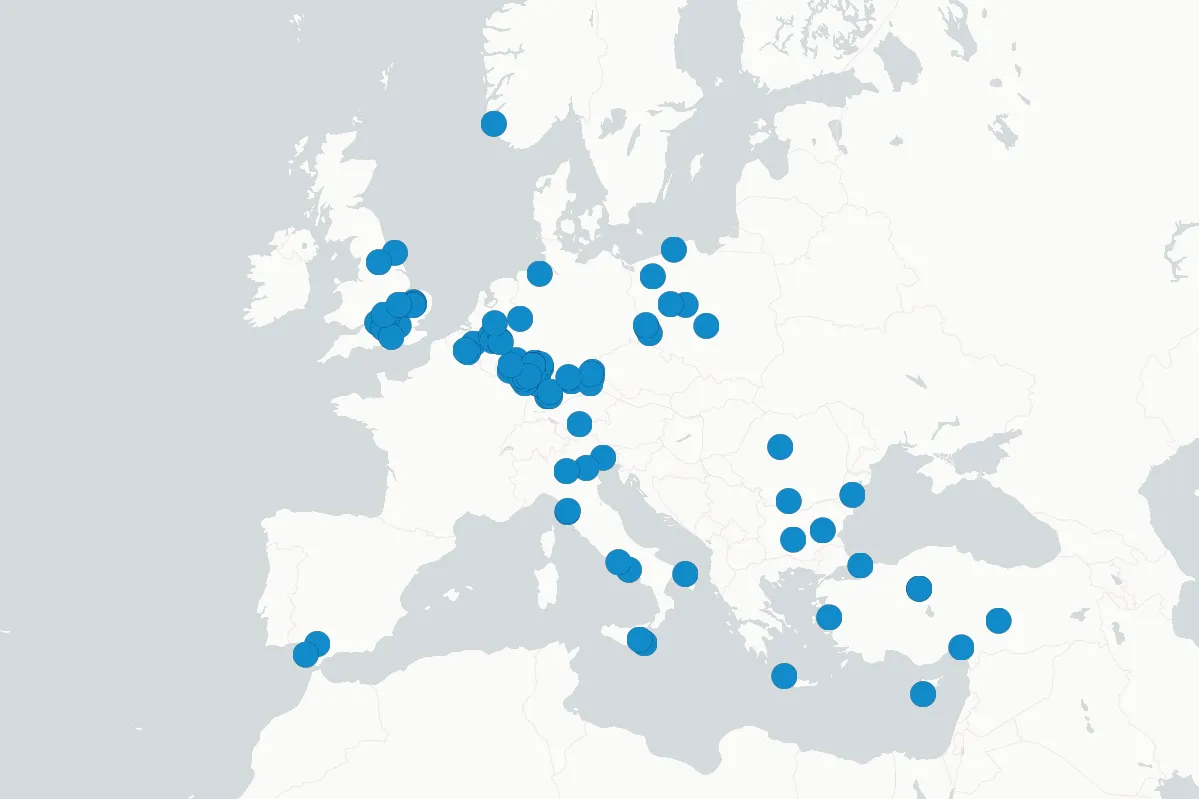
Troops are in more than 38 U.S. military bases across Europe. The map below shows the locations of U.S. military bases in the continent but includes only those that are at least 10 acres or have a value of at least $10 million.
Military bases overseas are considered important to U.S. power beyond its territorial bounds, allowing it to maintain presence in areas that "the U.S. government determines are important to the national interest," according to a congressional research service report from July 2024.
The report adds that military bases can also "signal U.S. intentions to other international actors, which may support a variety of strategic aims."
The installation of military bases, or the closure of them, can enable the U.S. to "communicate to allies," per the report, suggesting that the potential move to withdraw troops from bases across Europe would have geostrategic and political intentions.
Below is a list of some of the main U.S. military installations in Europe, according to the approved list of bases on the official U.S. Defense Department website Military Installations.
The website notes that it does not include every U.S. installation, only those locations approved by the individual service branch.
Germany
- Ansbach, U.S. Army Garrison
- Buechel Air Base
- Geilenkirchen NATO Air Base
- Kalkar, U.S. Air Force Element
- Ramstein AB
- Spangdahlem AB
- USAG Bavaria
- USAG Bavaria, Garmisch
- USAG Bavaria, Hohenfels
- USAG Rheinland-Pfalz Kaiserslautern Military Community
- USAG Rheinland-Pfalz, Baumholder
- USAG Stuttgart
- USAG Wiesbaden
Italy
- Aviano Air Base
- Ghedi Air Base
- Naval Air Station Sigonella
- Naval Support Activity Naples
- Naval Support Activity Naples Department Gaeta
- USAG Italy
- USAG Italy-Darby Military Community
Hungary
- Papa Air Base
Greece
- Naval Support Activity Souda Bay
Portugal
- Lajes Field
Spain
- Moron AB
- Naval Station Rota
U.K.
- RAF Alconbury, RAF Molesworth
- RAF Croughton, RAF Fairford
- RAF Lakenheath
- RAF Mildenhall
Turkey
- Incirlik AB
- Izmir AS
Netherlands
- USAG BENELUX Brunssum
- Volkel Air Base
Norway
- Stavanger
Belgium
- Kleine Brogel Air Base
- USAG BENELUX-Brussels
- USAG BENELUX-SHAPE/Chievres
What People Are Saying
Graham Allison, professor of government at the Harvard Kennedy School, told Newsweek: "Claims by individuals like Trumps former National Security Adviser John Bolton strike me as false. While the Trump team is trying to shock Europeans out of their security coma—in which they believed they could subcontract their security to the U.S. without paying for it—I suspect to hear many rumors. But I'm expecting the numbers of U.S. forces in Europe this time next year to be within the bounds of the highs and lows of that number over the past decade."
What Happens Next
While it is uncertain whether the U.S. will withdraw troops from Europe, Hegseth has made it clear that the U.S. aims to "prioritize empowering Europe to own responsibility for its security."
View 0 Comments
Submit Correction
View Editorial & AI Guidelines