
By Peter Aitken
Politics Weekend Editor
0
Share
Newsweek is a Trust Project member
See more of our trusted coverage when you search.Prefer Newsweek on Googleto see more of our trusted coverage when you search.
U.S. Central Command (CENTCOM) on Saturday announced that its forces had intercepted one of the 19 "shadow fleet" vessels identified as part of Operation Economic Fury.
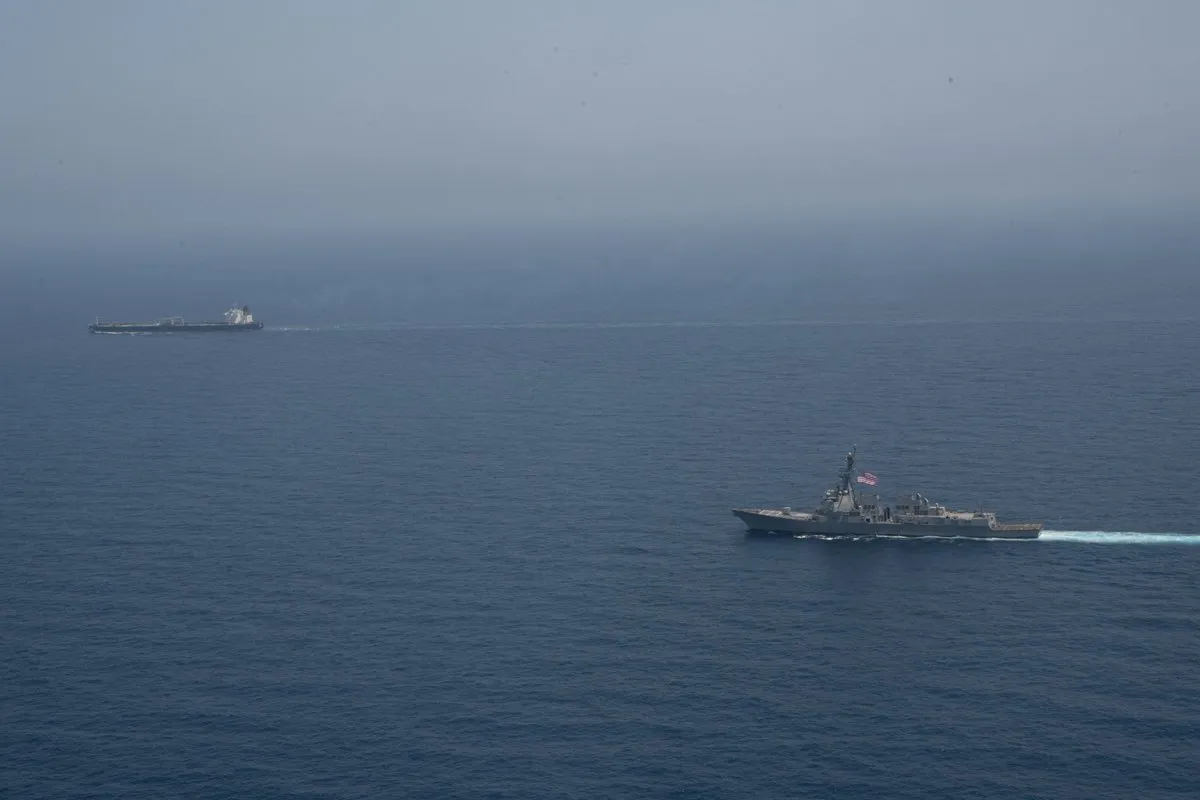
In a post on X, CENTCOM named the vessel as M/V Sevan, which was among vessels sanctioned by the Treasury Department as part of the U.S. effort to strengthen its blockade of Iranian ports as the Trump administration tries to use economic pressure to force a peace deal with Tehran.
"Earlier today, Sevan was intercepted in the Arabian Sea by a U.S. Navy helicopter from guided-missile destroyer USS Pinckney (DDG 91), and the merchant vessel is currently complying with U.S. military direction to turn back to Iran under escort," CENTCOM wrote in its post. "U.S. forces continue to enforce U.S. sanctions and fully implement the blockade against ships entering or departing Iranian ports. 37 vessels have been redirected since the start of the blockade."
Read More on World
Why It Matters
Iran’s so‑called “shadow fleet” refers to a network of aging oil tankers and front companies that Tehran has reportedly used to move crude while evading U.S. sanctions. These vessels frequently operate with transponders turned off, falsified locations, or rapid name and flag changes, allowing Iranian oil to reach buyers—primarily in Asia—despite mounting enforcement pressure.
The shadow fleet is central to Iran’s ability to sustain oil exports under sanctions, even as U.S. naval interdictions and Treasury blacklists expand beyond the Persian Gulf into global shipping lanes.
Operation Economic Fury is the Trump administration’s economic pressure campaign aimed at choking off those same revenue streams without relying solely on direct military force: It combines aggressive sanctions with maritime enforcement and financial targeting to squeeze Iran’s oil trade and broader economy as part of a renewed “maximum pressure” strategy.
...
What To Know
The Treasury Department on Friday escalated Operation Economic Fury by announcing sanctions on a range of Iranian companies and resources, including Hengli Petrochemical (Dalian) Refinery Co., a large China‑based independent “teapot” refinery identified as one of Iran’s biggest oil customers, alongside roughly 40 shipping firms and vessels linked to Iran’s so‑called shadow fleet.
Treasury officials emphasize that these tankers and intermediaries form the logistical backbone of Iran’s sanctions‑evasion system, moving oil through covert maritime practices that the new designations are meant to expose and shut down.
The initiative marks a shift toward more aggressive and cumulative financial pressure, noting that the measures build on hundreds of prior Iran‑related sanctions issued since early 2025.
Stopping Ships in the Indian Ocean
On Wednesday, a day after U.S. troops seized the stateless Iranian-linked tanker the Tifani in the Bay of Bengal, CENTCOM said it had also in the past days turned back the Iranian tankers Hero II and Hedy and interdicted the Dorena, an Iranian-flagged crude carrier last seen off the west coast of India one week ago.
The trio of vessels was previously reported as having evaded the U.S. blockade by reaching the Indian Ocean.
On Thursday, Reuters reported the U.S. had also intercepted the Iranian tankers Deep Sea and Sevin, both of which were last seen returning from Asian waters in mid-March, according to Newsweek’s review of publicly available AIS data.
There have been reports, including from Reuters, the U.S is letting Iranian-linked ships bypass the blockade in order to catch and isolate them in open waters using faster Navy destroyers, away from the risk of sea mines and the missiles of Iran’s Revolutionary Guard.
View 0 Comments
Submit Correction
View Editorial & AI Guidelines