10
Loading video...

By Tom O'Connor
Deputy Editor, National Security and Foreign Policy
0
Share
Newsweek is a Trust Project member
See more of our trusted coverage when you search.Prefer Newsweek on Googleto see more of our trusted coverage when you search.
The U.S. indictment of former Cuban President Raúl Castro has raised speculation that the White House was looking to pursue similar action against the communist leader as it did Venezuelan President Nicolás Maduro earlier this year.
Maduro, who was seized in a brazen Delta Force raid in January that led to the deaths of dozens of 32 Cuban personnel tasked with guarding him, was charged with "narco-terrorism" during the first Trump administration in 2020. He faces trial in New York City.
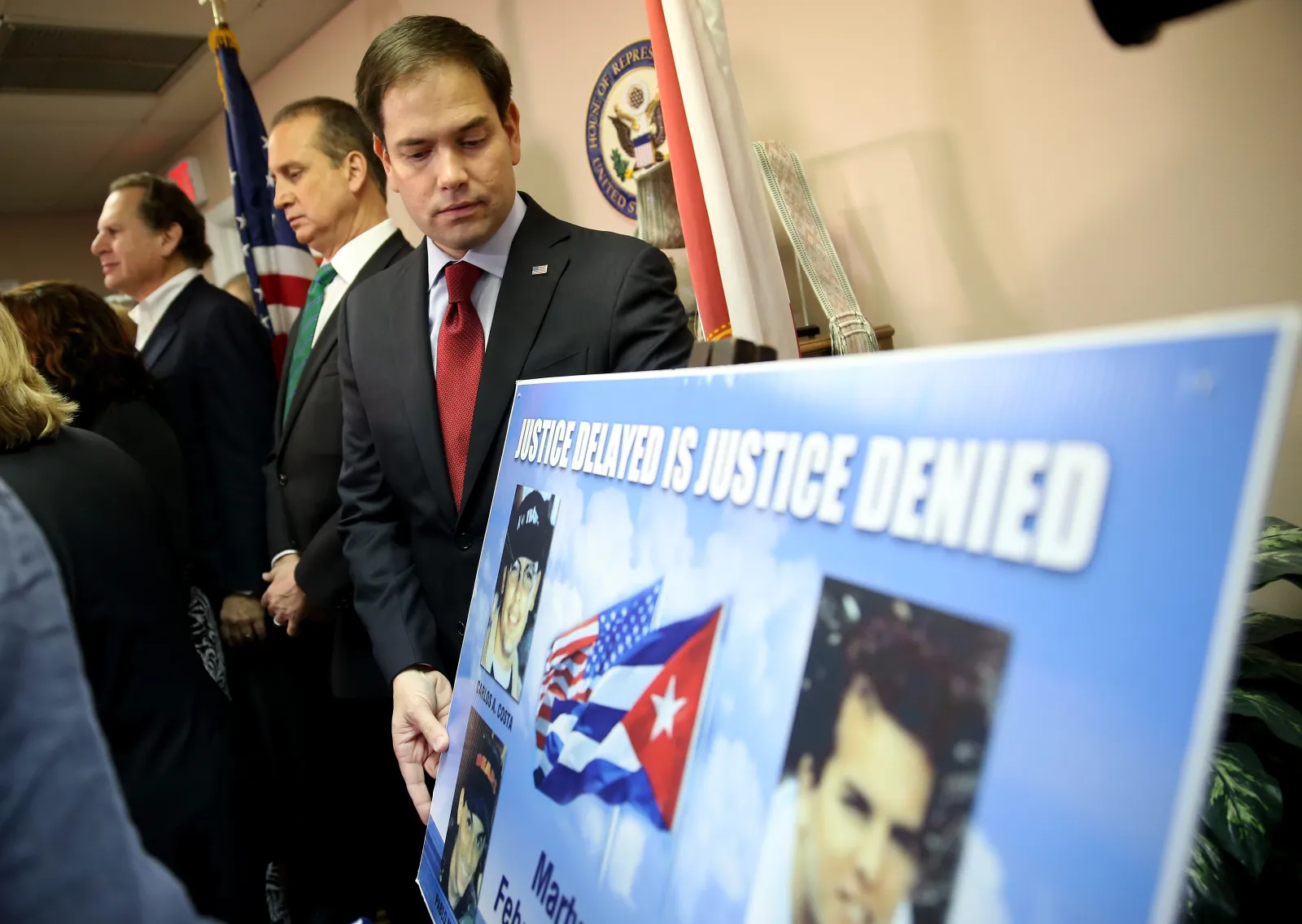
The 94-year-old Castro, who succeeded his brother, Fidel, in 2008 and led for a decade, is facing U.S. charges over his alleged involvement in the Cuban military's 1996 shootdown of two civilian planes operated by an activist group tied to exiled opposition forces. The indictment was revealed on Wednesday by the Department of Justice.
Read More
U.S. Indicts Raúl Castro, as Trump Eyes Military Intervention in Cuba7 min read

What Could US Military Action Against Cuba Look Like?8 min read

Cuba Envoy Slams Rubio’s ‘Obsession’ With Regime Change Amid Trump Threats8 min read

The decision to pursue legal action against Castro comes at a time of heightened tensions between the U.S. and Cuba. Weeks after the abduction of Maduro, a key energy ally for Havana, the Trump administration announced an effective oil blockade of Cuba and began warning of a potential military takeover if the island nation did not strike a deal.
Dealing With Iran & Venezuela (and now Cuba)
Meanwhile, Trump in February made good on military threats against another foreign foe, Iran, launching a joint war alongside Israel that killed the nation's supreme leader, Ayatollah Ali Khamenei. But the ongoing conflict, now at a stalemate amid negotiation attempts, does not appear to have averted the White House's focus on Cuba, which Trump has openly teased as the "next" target.
"In all of these cases, there was the escalation of the threat of use of force, and the escalation of military assets, and the escalation of rhetoric intended to intimidate, coerce, threaten, and even try to encourage defections within the government, and the hope was always that that would be enough," Christopher Sabatini, senior fellow for Latin America at Chatham House, told Newsweek. "It wasn't even so much of a negotiating strategy, it was a hope that they could promote change simply by raising the stakes."
As with Venezuela and Iran, however, Cuba has remained steadfast in its approach, expressing openness to talks while rejecting any U.S. attempt to impose changes on the nation's government. Sabatini said a continued impasse could only lead to escalation.
"There is an inevitability of some form of action if the threats and the saber rattling don't work," Sabatini said.

...
What Trump Could Do In Cuba
Even before its announcement on Wednesday, analysts had expressed to Newsweek earlier this week that Castro's highly anticipated indictment could serve as a prelude to military action.
The charges ultimately came the same day as a five-minute video address by Secretary of State Marco Rubio, who appealed directly in Spanish to the Cuban people. Rubio, a Cuban American and longtime critic of the island's communist leadership, blamed the Cuban government for the country's economic woes and promised a "new relationship."
Trump signaled no immediate action in a separate encounter with reporters at the White House on Wednesday. Asked if he expected any escalation in regard to Cuba, the president said, "No, there won't be escalation. I don't think there need to be."
"Look, the place is falling apart. It's a mess. And they've sort of lost control," Trump said. "They've really lost control of Cuba."
Should Trump move forward, however, he has several options available, including but not limited to:
- A Venezuela-style targeted Special Operations Forces raid
- A similar sweeping air war, as was launched against Iran.
- Cuba's far weaker, outdated military capabilities also leave open the possibility of a full-scale invasion, though costly and likely to face asymmetric threats in the form of Cuba's "war of all the people" guerrilla doctrine.
Nearly every kinetic scenario, however, would demand significant resources, much of which is currently devoted to the Middle East theater.
Cuba's Vow to 'Fight Back'
During an interview with Newsweek last month, Cuban President Miguel Díaz-Canel declared that Cuba would "fight back" if the U.S. initiated a military conflict and said he did not fear for his own life or freedom.
He also argued that his country's collective leadership and adherence to "monolithic unity, an ideological cohesion, and a revolutionary discipline" would serve to thwart any decapitation or collaboration attempts.
Sabatini was skeptical that Washington would easily find someone similar to Venezuelan Vice President Delcy Rodríguez, who swiftly replaced Maduro and initiated a more conciliatory relationship with the U.S.
"First of all, it's impossible to find any single person that you can extract, that then everyone else will fall in line behind. It's a much more cohesive elite structure," Sabatini said. "The second is it's going to be very difficult to even then find if you were to find that person to ensure that they were compliant enough that you could drive later. It's a deeply indoctrinated government."
"And the third issue is, you really don't have a business sector in Cuba, you don't have really much of an independent civil society in a broad sense," Sabatini said. "It exists, but so it also doesn't have even the social base for a process of exchange."
Removing Castro may also do little to shake the system, in large part due to the military-led GAESA (Grupo de Administración Empresarial S.A.) conglomerate he helped expand and now at the center of Rubio's rhetoric against Havana.
"There are a lot of military officers who live very well by running that. There's a certain amount of embedded autonomy in these institutions, because of the way they've been built up," Sabatini said. "So, I think beyond Raúl Castro—he's old, he's a historico— but for many people, what he created, especially as defense minister, will hold many of them in check."

...
Legal Scrutiny Over Actions in Venezuela (and Cuba?)
Trump's strategy of using criminal indictments to pursue military means against a foreign nation has also come under legal scrutiny.
"Under international law, the Venezuela operations (and any similar operations the administration might attempt in Cuba) clearly violate the bedrock rule binding on all countries that the use of force is prohibited except in legitimate self defense or with UN Security Council authorization," Tess Bridgeman, co-editor of Just Security, who previously served in several senior White House legal positions, told Newsweek.
"UN involvement is clearly off the table here. And Cuba has not attacked the United States, nor is there any imminent threat of Cuba doing so, which means the United States has no claim of self-defense," Bridgeman said. "Any use of force against Cuba—including sending U.S. forces into Cuba to forcibly abduct any of its leaders—would be an act of aggression."
She argued that the issue was central to the norms protecting smaller states from hostile acts carried out by more powerful countries, and "having an indictment pending in your domestic criminal justice system does nothing to change that."
"Reliance on an indictment of a current or former Cuban official to invade the country—to arrest someone who had been indicted or otherwise—would likewise merely be a smokescreen intended to mask the blatant illegality of a use of force against Cuba," Bridgeman said.
"Even if the operation were lawful under international law (it is not), under domestic law, the President does not have authority to go to war without congressional authorization," she added. "His invasions of Iran (last summer), Venezuela, and Iran again in February have all been blatant violations of the U.S. Constitution."
Benjamin Gedan, director of the Stimson Center Latin America program who previously handled Latin America policy at both the National Security Council and State Department, also took issue with the legality of any operation on the grounds of Castro's indictment, while that may not prove an obstacle for the administration.
"Delta Force commandos are not bounty hunters and an indictment does not give Trump permission to invade Cuba, under domestic or international law, to hunt down a fugitive," Gedan told Newsweek. "But that did not stop Trump from ordering U.S. troops into combat in Caracas to seize Venezuela's ruler."
What Cuba Says About The 1996 Incident
The Cuban government, for its part, has condemned the U.S. move and challenged the narrative surrounding the 1996 incident at its center.
"The United States government lacks the legitimacy and jurisdiction to carry out this action," the Cuban government said in a statement referred to Newsweek by the Cuban Mission to the United Nations.
"It constitutes a despicable and infamous act of political provocation, resting upon the dishonest manipulation of the incident that led to the downing over Cuban airspace in February 1996 of two aircraft operated by the terrorist organization 'Brothers to the Rescue,' based in Miami, whose repeated violation of Cuban airspace for hostile purposes was a matter of obvious public knowledge," the statement said.
Brothers to the Rescue is led by Cuban dissident José Basulto, who has claimed to be a CIA operative involved in various acts of sabotage against the Cuban government. The Justice Department alleges that the Cuban government had infiltrated the organization and deliberately trained to bring down the two aircraft, leading to the deaths of four individuals.
The Cuban government also reaffirmed the nation's "commitment to peace and its unwavering determination to exercise the inalienable right to self-defense, as recognized by the United Nations Charter," in the statement responding to the U.S. legal action.
"The Cuban people reaffirm their unshakable resolve to defend their Homeland and their Socialist Revolution, and, with the utmost strength and steadfastness, express their unrestricted and unwavering support for Army General Raúl Castro Ruz, Leader of the Cuban Revolution," the statement said.
...
Symbolic Weight
While U.S. reconnaissance flights have intensified over Cuba, much of the escalation has been limited to economic, legal and political salvos, with hard power not yet in place.
Gedan argued that the indictment could prove more potent as a pressure tactic to push Cuba toward a more amenable negotiating position.
"Raúl's retirement has become considerably less comfortable," Gedan said. "That does not mean an invasion is imminent. Trump has his hands full in the Middle East, and his supporters are not exactly pining for more military adventures."
"But the threat is credible," he added, "and it could give U.S. negotiators more leverage as they push for economic reforms to open the island to greater U.S. investment."
And if that is the ultimate goal, then pursuing Castro alone would do little to advance it, argued Richard Feinberg, professor of international political economy at the University of California, San Diego, who formerly held multiple roles at the White House, State Department and Treasury Department.
"There is no Venezuela playbook for Cuba," Feinberg told Newsweek. "Even if the U.S. military could kidnap Raúl Castro, which would be extremely difficult, that would not significantly advance resolution of the deepening crisis. Contrary to the myth that Cuba is ruled by one family, in fact it is the institution of the Cuban Communist Party and the associated military and security apparatus, that rule Cuba."
"I read the indictment of Raúl Castro as primarily pitched to the exile Cuban American community, which has been seeking vengeance against the Castro family for over 60 years."
View 0 Comments
Submit Correction
View Editorial & AI Guidelines