
...

By Dan Gooding
Associate News Editor
0
Share
Newsweek is a Trust Project member
See more of our trusted coverage when you search.Prefer Newsweek on Googleto see more of our trusted coverage when you search.
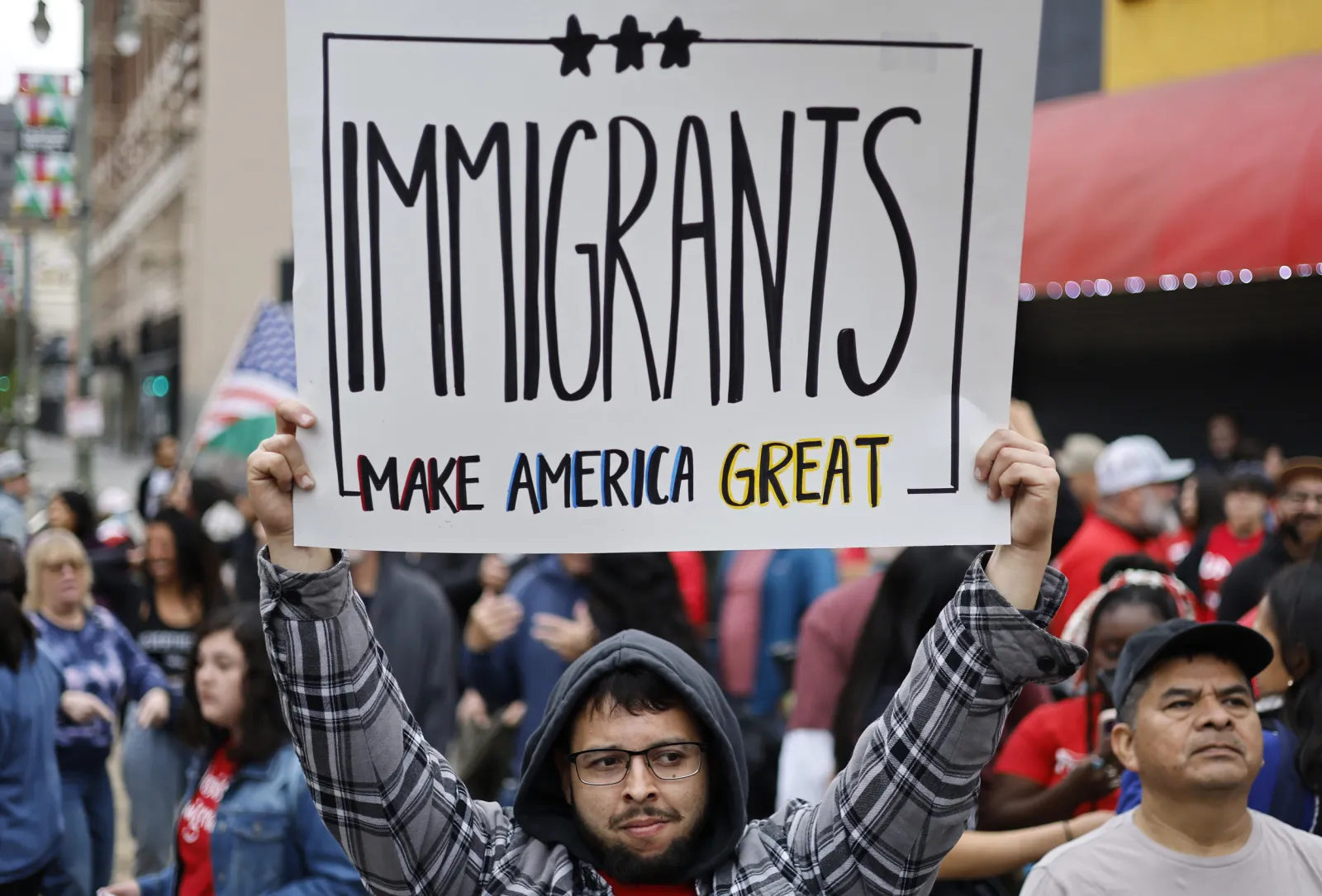
Immigration was the sole driver of the United States' population growth in a single year for the first time since records began, a new study released Wednesday said.
The nonpartisan Migration Policy Institute (MPI) looked at U.S. Census Bureau data for 2022-2023, the latest available, finding that falling American birthrates factored into the change.
Why It Matters
The findings come at a time when immigration, particularly illegal immigration, is a key focus of the current White House administration. While plans for mass deportations are being carried out, the other obstacle — a collapsing fertility rate — has been far more vexing for officials, both in the U.S. and other developed nations suffering from the same dynamic.
Read More on U.S.
...
What To Know
The U.S. immigrant population grew by 1.6 million between 2022 and 2023 to 47.8 million, according to the MPI analysis, with immigrants now representing a 14.3 percent share of the overall population—the highest ever.
The Census Bureau started collecting data in 1850 and has tracked immigrant arrivals through the boom in the early 1900s, the bust in middle of the century, and then a steady rise from the 1970s onward.
In 2023, birth rates among American women reached a record low for those aged between 20 and 24, while the rate also dropped overall for the larger group of 20-39 year olds, according to the Centers for Disease Control and Prevention (CDC).
The shift has been noted in other reporting in recent months, including from the National Foundation for American Policy (NFAP), which found that more immigrants were entering the workforce than American-born workers because of an aging population and the declining birthrate. Immigrants made up around 18 percent of the total workforce in 2023, the last year for which complete data is available.
In a separate study, the nonpartisan Center for Immigration Studies (CIS) looked at estimates from January 2025, finding an even larger rise in the immigrant population. It now stands at around 15.8 percent, according to the CIS analysis.
...
How Has The Immigrant Population Changed?
Among the largest nationalities represented in the U.S. immigrant population in 2023 were Mexicans at 23 percent, followed by Indians (6 percent) and Chinese (5 percent).
The nationalities driving the most growth were those from Central and Southern America, as well as the Philippines, Nigeria and Afghanistan. While some will have crossed the southwest border illegally during that period, many arrived on newly created or expanded legal pathways, such as humanitarian parole.
Nearly three quarters have legal status of some kind. Around 27 percent of the immigrant population in 2023 had no legal status, but 19 percent had green cards, while 49 percent had become U.S. citizens.
The number of children living with at least one immigrant parent has also grown drastically since 1990, when the proportion was 13 percent. That number has since doubled to 26 percent.
The immigrant population is not spread evenly through the country. New York City continues to be home to the biggest population, at 5.9 million. However, Miami has the biggest share, at 42 percent.
California, Texas and Florida continue to be the top three states for immigrant population growth by numbers, but the Dakotas saw 80 percent-plus growth in their immigrant populations over roughly the last decade, while Delaware, Tennessee and South Carolina were also among the top 10 states seeing large percentage growth.
What People Are Saying
Jeanne Batalova, MPI senior policy analyst and demographer, told Newsweek in a statement: "Recent MPI work shows that immigrants and their U.S.-born children are projected to account for all future U.S. labor force growth over the coming decades, which is a finding that should be of interest to policymakers, employers, educators, and others."
Steven Camarota, director of research at the Center for Immigration Studies, told Newsweek: "The new data is not only more up-to-date, and therefore better reflects the migrant surge, it is the first government survey to reflect the re-weighting the Census Bureau did to better reflect that surge. The total foreign-born is now 53.3, not 47.8 million. And the percent of the U.S. population is a record 15.8%."
Eric Ruark, director of research and sustainability at NumbersUSA, told Newsweek: "Whether one acknowledges it or not, the debate over immigration is ultimately a question about how much the United States is going to grow in future years. Those who defend the status quo, or call for increased immigration, are essentially arguing that the United States population must grow in perpetuity, and that present-day Americans have little to no say in the matter. The plain fact is that immigration policies will determine America's demographic future. Whatever those policies are, they should be the result of vigorous and open debate and reflect the will of the American people. Not imposed on the citizenry by narrow special interests."
Stuart Anderson, NFAP executive director, speaking told Newsweek in October: "If you look over the past five years, without immigrants and their children, there would have been no labor-force growth in the United States. Without labor-force growth, it's very difficult for a country to have economic growth, and without economic growth, living standards in a country stagnate and potentially even decline."
President Donald Trump, on wanting to increase the birth rate: "Because we want more babies, to put it very nicely. And for this same reason, we will also allow new parents to deduct major newborn expenses from their taxes, so that parents that have a beautiful baby will be able, so we're pro family. But the IVF treatments are expensive. It's very hard for many people to do it and to get it, but I've been in favor of IVF, right from the beginning."
What Happens Next
With tighter immigration restrictions, fewer migrants are attempting to enter the country, which is likely to manifest in labor-force data in the months ahead.
As for the declining U.S. birth rate, the Trump administration has said it wants to see more Americans having children but has not yet delivered detailed plans on how it plans to achieve that. It remains to be seen if the fiscal negotiations in Congress will include new tax provisions for parents or expecting parents, as the president has suggested.
Update 3/12/25, 2:44 p.m. ET: This story was updated with additional information.
View 0 Comments
Submit Correction
View Editorial & AI Guidelines