...

By James Bickerton
News Reporter
0
Share
Newsweek is a Trust Project member
See more of our trusted coverage when you search.Prefer Newsweek on Googleto see more of our trusted coverage when you search.
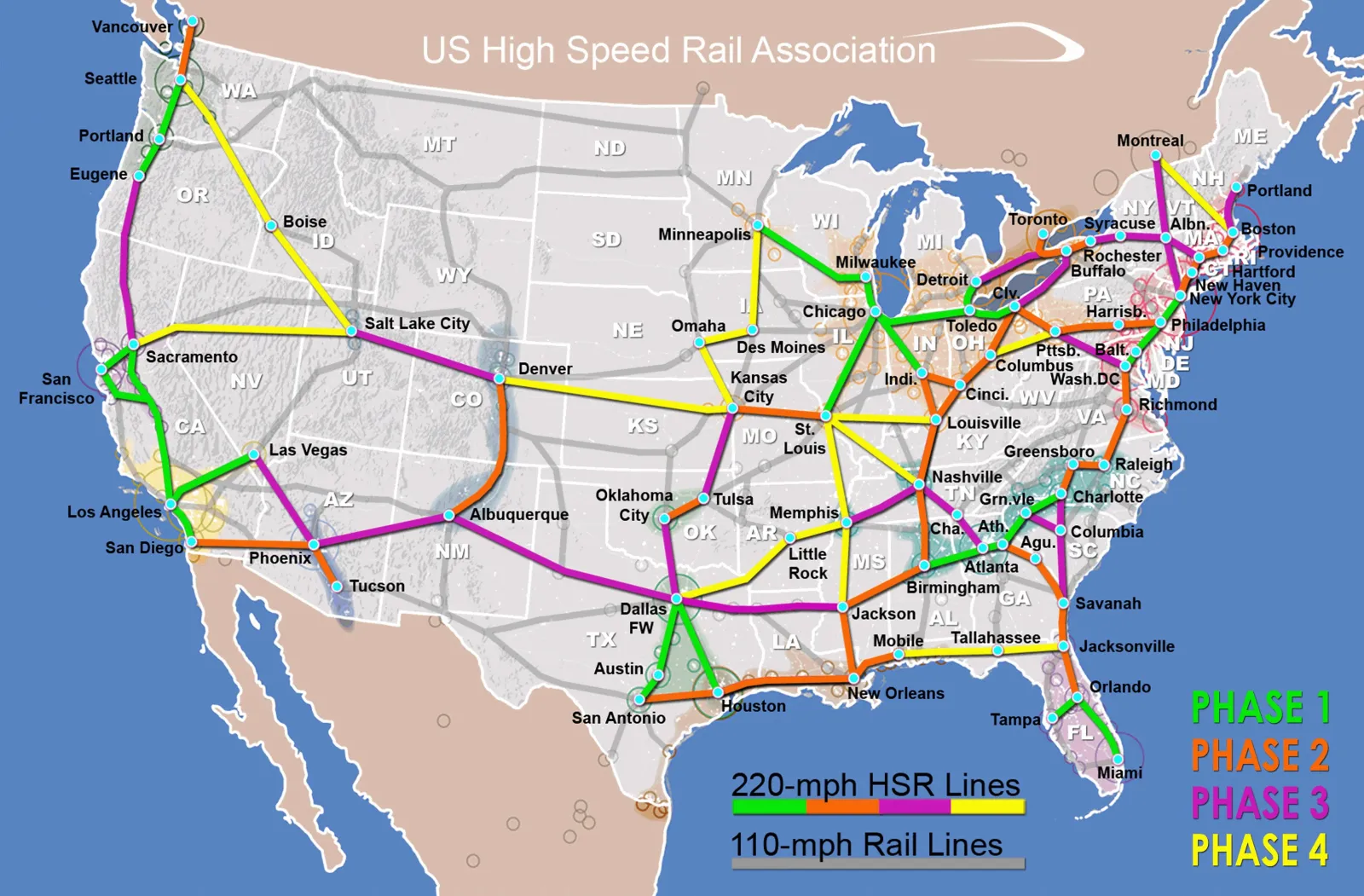
Maps produced by the U.S. High Speed Rail Association (USHSR) show how a new 17,000-mile-long high-speed rail network could be constructed across the United States in four separate stages.
The proposal would create a web of railway lines stretching from San Diego, California, to Vancouver in British Columbia, as well as from San Antonio, Texas, to Montreal, Quebec.
After decades of little activity, there has been an explosion in proposals for new high-speed rail lines in the U.S. over the past few years, with two already under construction in California. The Brightline West high-speed railway is being built to connect Las Vegas, Nevada, to southern California, while the California High-Speed Rail will run between San Francisco and Los Angeles.
Read More on U.S.
The plan proposed by the USHSR, a lobby group founded in 2009 that incorporates multiple manufacturing firms and trade associations, would expand this dramatically, creating 220-mile-per-hour high-speed rail lines right across the U.S. At this stage, the plan is highly preliminary and hasn't received any official authorization.
...
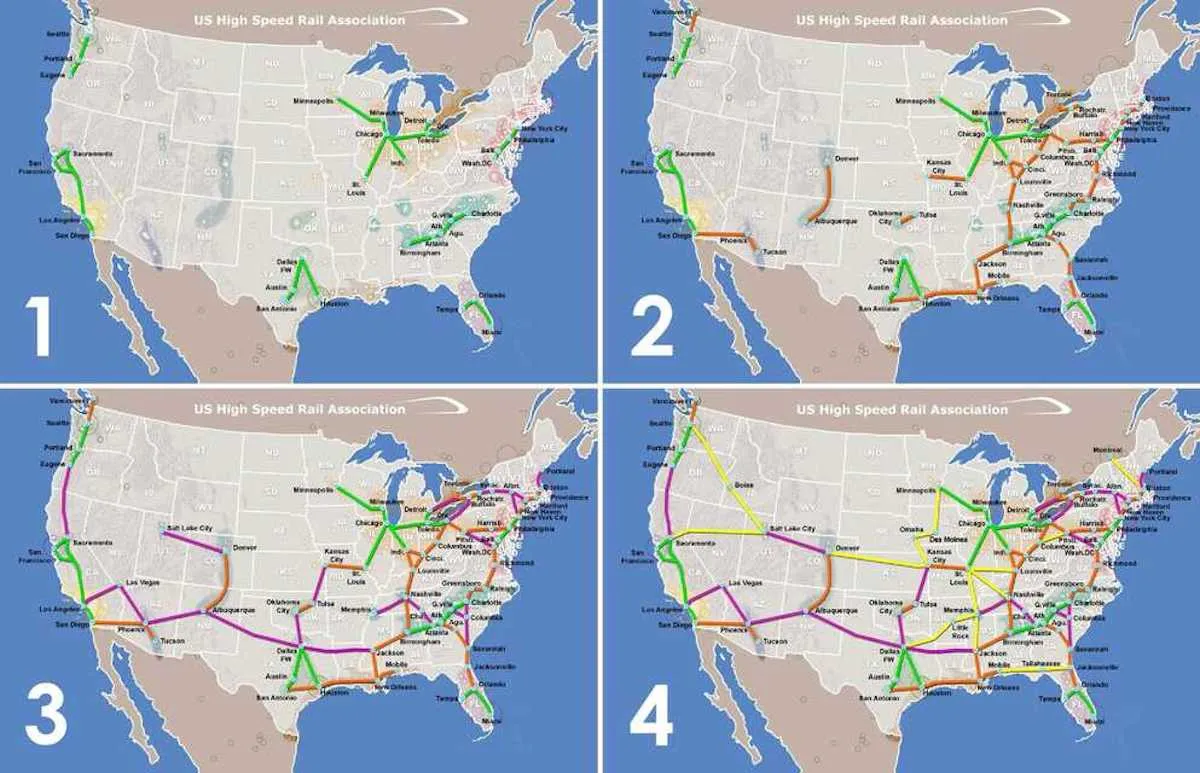
In the first stage on the West Coast, USHSR wants to build several high-speed rail lines connecting Seattle, Washington, with Eugene, Oregon, along with San Francisco and Sacramento to San Diego and Las Vegas.
At the same time, a network would be created in the Midwest centered around Chicago, which would extend to several cities, including Minneapolis, Minnesota; St. Louis, Missouri; and Detroit, Michigan.
Further south lines would be constructed linking Miami, Orlando and Tampa in Florida and San Antonio, Dallas and Houston in Texas. Single lines would also be built going from New York City to Washington, D.C., and Charlotte, North Carolina, to Birmingham, Alabama.
In the second stage, most of the eastern network already constructed would be linked together via lines running between Orlando and Athens, Georgia, and from Houston to Philadelphia, Pennsylvania, via New Orleans, Birmingham, and Louisville, Kentucky. The northeast coastline would be extended north from New York City to Boston, Massachusetts, while a new line would be created between Rochester in New York State and Toronto in Canada.
To the west, the existing Southern California line would be extended to Phoenix and Tucson, Arizona. A new track would link Denver, Colorado, to Albuquerque, New Mexico. A high-speed line would also be created between Tulsa and Oklahoma City, Oklahoma.
...
The third stage would see more substantial construction, which would start to connect the existing eastern and western rail networks. One major line would go from Phoenix to Jackson, Mississippi, via Dallas and Albuquerque.
New railways would also be built connecting Salt Lake City, Utah, with Denver and Tulsa to Kansas City. Another line would link Memphis with Atlanta in Georgia.
In the northeast, the existing network would be extended to Portland, Maine, Montreal, and Detroit.
The fourth and final stage would finish linking the various lines already built to create a unified national high-speed rail network. This would include the construction of lines from Seattle and Sacramento to Salt Lake City, Denver to Minneapolis via Kansas City, and Dallas to St. Louis and Louisville.
New railways would also link Mobile, Alabama, to Jacksonville, Florida; Montreal, to Boston; and Columbus, Ohio, to Pittsburgh, Pennsylvania.
Andy Kunz, CEO of the USHSR, told Newsweek the network could be created within decades if the political will exists.
"The Obama-Biden Administration set a goal of giving 80 percent of Americans access to high-speed rail within 25 years. Such nationwide access remains our goal," Kunz said.
View 0 Comments
Submit Correction
View Editorial & AI Guidelines