...

By Micah McCartney
Reporter
0
Share
Newsweek is a Trust Project member
See more of our trusted coverage when you search.Prefer Newsweek on Googleto see more of our trusted coverage when you search.
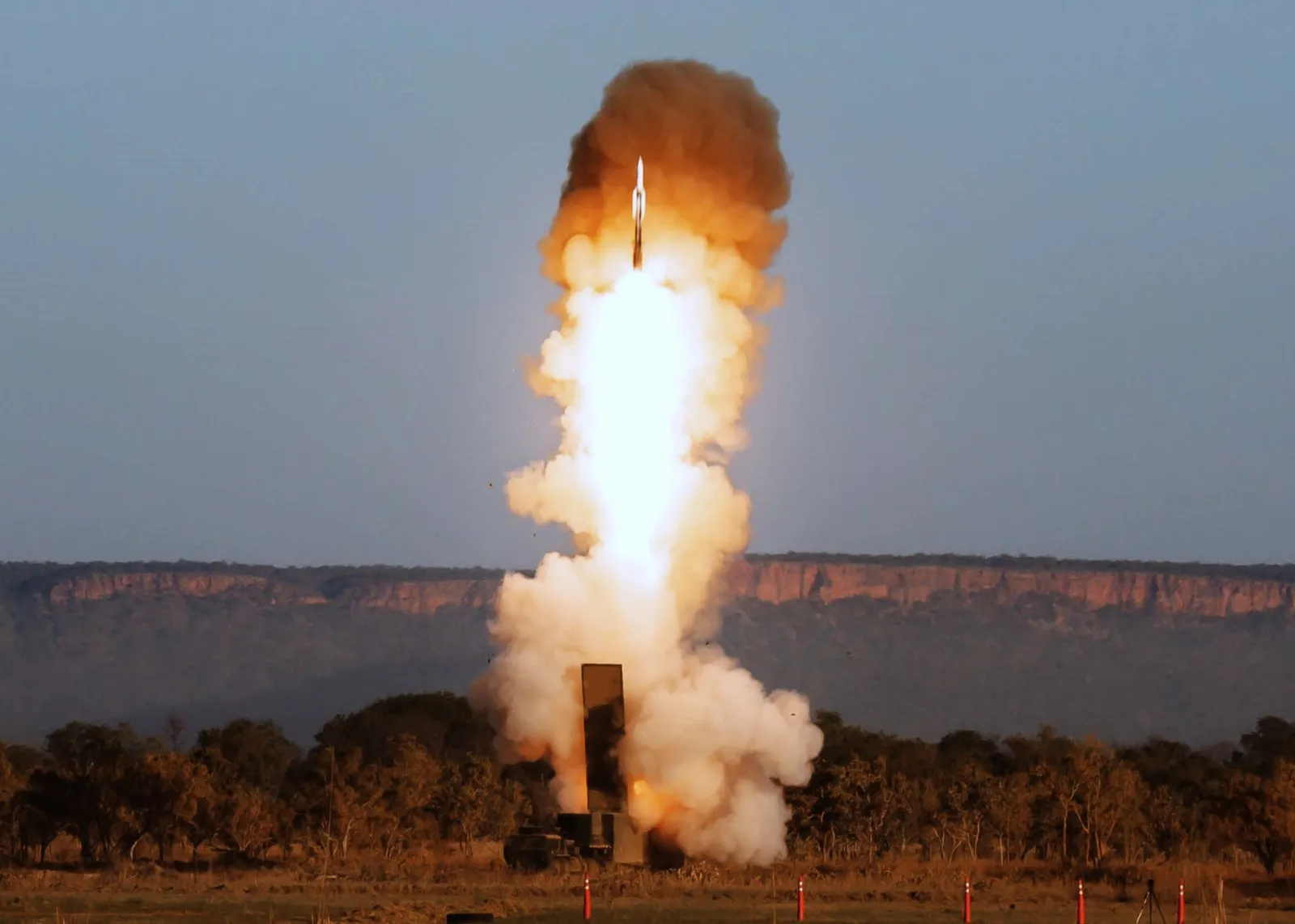
A U.S. military Mid-Range Capability missile system was test-fired on Philippine soil, Manila confirmed Tuesday, in a first for the Southeast Asian country amid ongoing drills that are being closely watched by China.
The U.S. Army moved its Mid-Range Capability, nicknamed the "Typhon," to the Philippines ahead of joint training in April 2024, as the Mutual Defense Treaty allies strengthened defense ties amid rising tensions with China. The week marks the first known instance of the platform being fired.
The Tomahawk missile was fired at around 12:20 a.m. from Tacloban Airport on Leyte Island in the Visayas region, southeast of Manila, Colonel Dennis Hernandez, spokesperson for the ongoing Balikatan exercise, told Newsweek.
Read More on World
About an hour later, the missile struck its target approximately 390 miles to the northwest at Fort Magsaysay in the Philippines' Luzon region, the official said. He clarified that the missile was not mounted with a warhead and that the goal was for the Philippine Army Artillery Regiment to gain experience on firing the platform.
In addition to Tomahawks, whose more than 1,000-mile range potentially puts much of China's eastern seaboard within reach, the Typhon can also fire supersonic Standard Missile-6s, which can fly up to 290 miles.
This puts within reach much of China's eastern seaboard, its militarized islands in the South China Sea, and any People's Liberation Army aircraft or warships in strategic Luzon in the event of a war over Taiwan.
China has repeatedly demanded that the U.S. remove its medium-range missile systems from the Philippines.
The Philippine government has said the deployment is not aimed at any third country and has said it is considering acquiring additional units from the United States.
China Denounces U.S.-Philippine Drills—'Sow Division'
Balikatan—Tagalog for "shoulder-to-shoulder"—is the largest U.S.-Philippine military exercise. This year's is the largest yet, drawing participation from 17,000 troops and seven countries, including, for the first time, Japan. The missile fired was an inert round rather than explosive and used to test accuracy not destroy targets, Hernandez clarified.
Newsweek reached out to the U.S. Indo-Pacific Command, and the Chinese Foreign Ministry by email with requests for comment.
...
China has slammed the drills as provocative.
"What the Asia-Pacific region needs most is peace and tranquility, and what it needs least is the introduction of external forces to sow division and confrontation," Foreign Ministry spokesperson Guo Jiakun told reporters on April 20, the day Balikatan got underway.
"We wish to remind the countries concerned that blindly binding themselves together in the name of security will only be akin to playing with fire—ultimately backfiring upon themselves."
Responding to the U.S.-led drills, the Chinese military's Southern Command on Thursday deployed naval and air forces for patrols around Scarborough Shoal, one of the most contested features in the China-Philippines territorial dispute.
"Forces of the Chinese PLA Southern Theater Command will resolutely safeguard China’s territorial sovereignty and maritime rights and interests, and firmly uphold regional peace and stability," said Southern Theater Command spokesperson Zhai Shichen.
Tuesday's Tomahawk exercise was not directed at any other country, Hernandez told Newsweek while pushing back at China's claim the multinational drills are destabilizing.
"What is destabilizing in our region is not the Philippines building Its defense capabilities but the unlawful occupation, fortification, and militarization of features within the Philippine sovereign waters in violation of international Law and the 2016 Arbitral ruling and award," he added.
An international arbitral tribunal in the Hague largely sided with the Philippines and shot down China's claim of "historic rights" to much of the South China Sea. Beijing chose not to participate in the proceedings and maintains the ruling was illegitimate.
Another point of contention for the Philippines, Mischief Reef, lies within the exclusive economic zone claimed by the Philippines and is one of several fortified outposts constructed during China's island-building spree in the South China Sea in the 2010s.
Concerns Over Taiwan
China claims most of the South China Sea as its territory, putting it at odds with competing claims by several maritime neighbors, including the Philippines.
Philippine President Ferdinand Marcos Jr. has since 2023 stepped up challenges to the increasing presence of Chinese coast guard and naval forces inside the exclusive economic zone claimed by Manila.
This has seen clashes between Chinese maritime forces and the Philippine coast guard, and prompted the Philippines to bolster defense cooperation with its U.S. ally as well as Japan, Australia, and others.
Japan and the Philippines, both U.S. treaty allies and key nodes in the so-called First Island Chain—a string of islands stretching from Japan to Borneo that the Pentagon considers key to containing Chinese forces if a conflict breaks out—have expressed concern over the possibility of a Chinese move against Taiwan, the self-ruled island Beijing claims as its territory.
Marcos has said Philippine involvement would be inevitable. Japanese Prime Minister Sanae Takaichi in November said a Chinese blockade of Taiwan could warrant Japan joining U.S. forces in an intervention, arguing it would present a "survival-threatening situation" to Tokyo.
This Balikatan drills will run until May 8.
View 0 Comments
Submit Correction
View Editorial & AI Guidelines