...

By Matt Cannon
News Editor
0
Share
Newsweek is a Trust Project member
See more of our trusted coverage when you search.Prefer Newsweek on Googleto see more of our trusted coverage when you search.
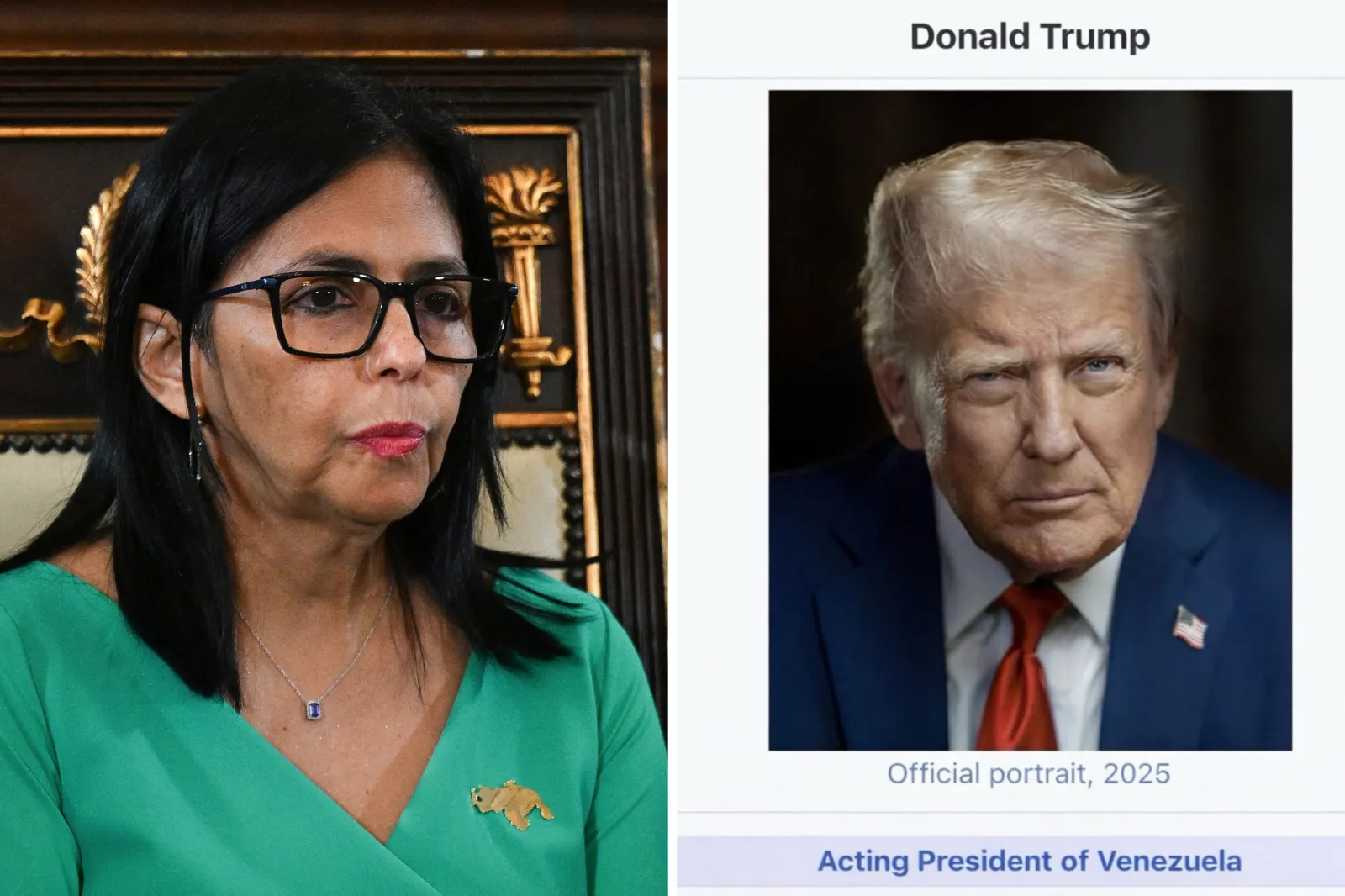
Secretary of State Marco Rubio and the Justice Department dubbed Venezuelan leader Delcy Rodríguez the "so-called Acting President" in court papers filed the day after U.S. President Donald Trump appeared to refer to himself as "acting president" of the South American country.
The Department of Justice (DOJ) said in the filing on Monday that after the U.S. captured Venezuelan leader Nicolás Maduro: "The situation on the ground in Venezuela is in flux; and the United States’ relations with the regime of Maduro’s successor, so-called Acting President Delcy Rodríguez, are at an extraordinarily sensitive juncture."
In a statement adjoing the filing, Rubio said: "The United States remains involved to see changes in Venezuela that are beneficial to the United States and that it also expects will be beneficial for the people of Venezuela, who have suffered tremendously. These efforts entail ongoing, intensive, and extraordinarily delicate engagement with elements within the regime of Maduro’s successor, so-called Acting President Delcy Rodríguez."
Read More on News
On Sunday, Trump shared an image on Truth Social of a mocked-up Wikipedia-type page, showing his portrait, and then referring to him as “Acting President of Venezuela, incumbent January 2026." Trump said the U.S. will “run” Venezuela following the capture of Maduro on January 3.
...
The filing came in the ongoing class-action lawsuit from some of the 137 Venezuelans unlawfully deported from the U.S. to a notorious maximum-security jail prison in El Salvador in March 2025 under the Alien Enemies Act, a wartime provision.
The federal judge in the case, James Boasberg, on December 22 ordered the administration to create plans to facilitate their return to the U.S. for due process they had been denied.
In Monday's filing, the DOJ said it is "unable" to comply with the order because of the situation in Venezuela.
Newsweek contacted the presidential office in Venezuela via email on Tuesday for comment.
Why It Matters
Under Venezuela's constitution, it falls to the vice president to take over should the president be absent.
Yet the U.S. Justice Department's new wording and Trump's social media post raise questions about whether the U.S. government considers Rodríguez or itself to be ruling Venezuela. The filing also goes further in offering insights about the relationship between Washington and Caracas.
Most directly, the filing raises doubts over whether the deportees will be able to return to the U.S. for deportation hearings.
It also potentially sets up the latest in a long line of clashes between Boasberg and the Trump administration. Boasberg is weighing a possible criminal contempt case against Homeland Security Secretary Kristi Noem after the DOJ revealed she made the decision not to turn around planes carrying the deportees, despite the judge's order to do so.
What To Know
The question of who rules Venezuela has been widely asked since Maduro's sudden capture.
Rodríguez, Venezuela's vice president and part of Maduro's inner circle, was sworn in by the country's Supreme Court on the same day Maduro was captured. She immediately demanded Maduro's release, calling him the "only president."
Meanwhile, Trump said the U.S. would run Venezuela until "a safe and proper and judicious transition" could take place.
"We're going to be running it with a group, and we're going to make sure it's run properly," Trump told reporters during a news conference on January 3. Pressed for more details, Trump said the group would include Rubio, and that Rodríguez had expressed her willingness to do "whatever the U.S. asks."
The new court papers were filed in the ongoing case about Venezuelan nationals unlawfully deported from the U.S.
Boasberg blocked the Trump administration from using the Alien Enemies Act to deport the Venezuelan nationals, whom Trump has linked to the crime gang Tren de Aragua, in March last year, ordering the government to turn around planes carrying them to El Salvador.
That order was not carried out. The DOJ has argued in court papers that it came too late and the demand to turn around the planes did not apply because it was omitted from the written order.
In a December 22 order, Boasberg ordered: "The Government shall submit its proposal either to facilitate the return
of Plaintiffs to the United States or to otherwise provide them with hearings that satisfy the requirements of due process."
The DOJ replied on Monday, saying they "do not believe there is any feasible way" to do so "at this time" because of the political situation in Venezuela and almost all of the deportees having been freed to Venezuela in July under a prisoner deal.
What People Are Saying
U.S. Secretary of State Marco Rubio, in a statement: "The U.S. government does not know—nor does it have any way of knowing—the whereabouts of class members, including whether anyone has departed Venezuela or whether the regime subsequently took anyone back into custody." Rubio added tracking them down "would risk material damage to U.S. foreign policy interests in Venezuela" and remote hearings "present a serious risk of intentional interference by anti-American elements in Venezuela."
The Department of Justice, in the statement: "Defendants are unable to retrieve class members from Venezuela at this time, as civilian travel into and out of Venezuela has become heavily restricted. Moreover, requiring engagement with the Rodríguez regime on this issue would disrupt ongoing negotiations. As Secretary Rubio’s declaration makes clear, the situation in Venezuela is still in flux and highly sensitive, such that diplomatic engagement on this issue presents significant foreign-relations concern." The DOJ added that an order otherwise would "intrude on core Article II powers."
What Happens Next
The cases of Maduro and his wife, Cilia Flores, remain ongoing. Both have pleaded not guilty to drugs and weapons charges. The next hearing is scheduled for March 17 in New York.
In a polarized era, the center is dismissed as bland. At Newsweek, ours is different: The Courageous Center—it's not "both sides," it's sharp, challenging and alive with ideas. We follow facts, not factions. If that sounds like the kind of journalism you want to see thrive, we need you.
When you become a Newsweek Member, you support a mission to keep the center strong and vibrant. Members enjoy: Ad-free browsing, exclusive content and editor conversatiopns. Help keep the center courageous. Join today.
Help keep the center courageous. Join today.


View 0 Comments
Submit Correction
View Editorial & AI Guidelines