10
Loading video...

By Mandy Taheri
Reporter
0
Share
Newsweek is a Trust Project member
See more of our trusted coverage when you search.Prefer Newsweek on Googleto see more of our trusted coverage when you search.
As U.S. B-2 stealth bombers launched from Whiteman Air Force Base in Missouri on Saturday and later struck Iran's Fordow nuclear site in the largest B-2 operation in U.S. history, Newsweek spoke with Naveed Jamali, the only journalist to fly and film inside all three U.S. bombers, for insight into one of America's most secretive weapons.
Stealth Characteristics
The U.S. fleet of 19 B-2 Spirit bombers forms part of the airborne leg of America's nuclear triad—a trio of land-, sea-, and air-based deterrence and attack capabilities.
Read More on News
The bombers, designed for low observability, are inherently "stealth" aircraft capable of delivering both conventional and nuclear payloads. Each bomber can carry a payload of up to 40,000 pounds.
...
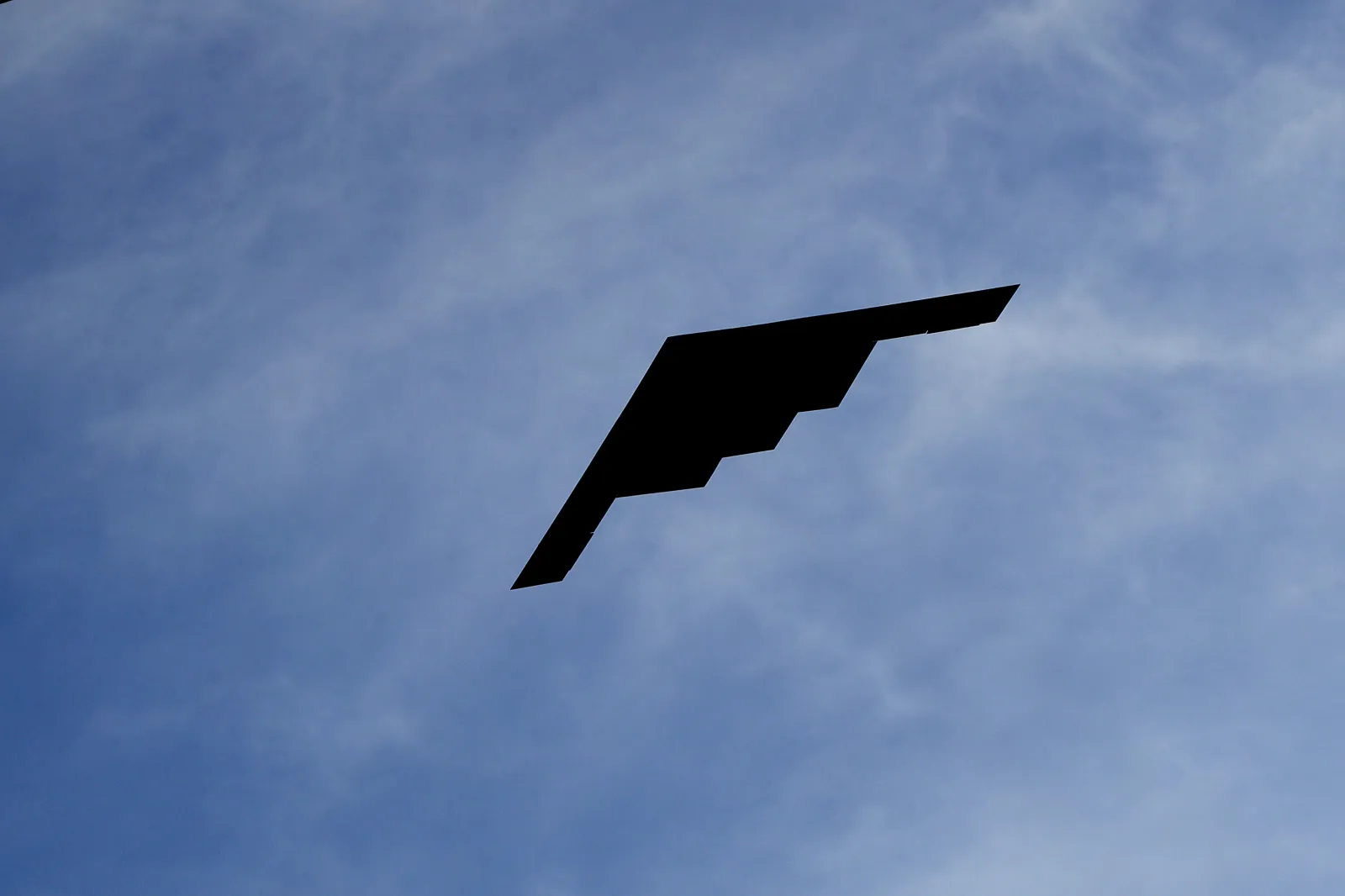
One of the B-2's defining stealth features is its ability to minimize radar detection, with the U.S. Air Force noting it's due to a "combination of reduced infrared, acoustic, electromagnetic, visual and radar signatures. These signatures make it difficult for the sophisticated defensive systems to detect, track and engage the B-2."
While some aspects of its ability to maintain "stealth" are classified, the Air Force has noted that its "composite materials, special coatings and flying-wing design," all contribute.
On Sunday morning, Joint Chiefs of Staff Chairman General Dan Caine said during a press conference that a "large B-2 strike package comprised of bombers" launched from the U.S. on Saturday as part of "Operation Midnight Hammer."
"Part of the package proceeded to the west and into the Pacific as a decoy, a deception effort," he added. A defense official told Newsweek two B-2s were used in Saturday night's bombing. A total of seven were part of the overall mission.
Jamali, who filmed and flew aboard one in 2023, told Newsweek, "If the B-2 wanted to leave Whiteman with no one knowing, they could do it," noting that he believed it was intentional messaging by the U.S. Air Force that the bombers were reportedly en route to Guam.
Following Saturday's bombing and Sunday's military reports, Jamali told Newsweek on Sunday, that the two waves of B-2s further underlines the "stealth" nature of them, as "one wave—that everyone was tracking—went to Guam, and a second, completely unknown wave went to bomb Iran."
He noted that "these weapons are primarily about deterrence," given their lethality. When Jamali flew in one, the call signal was "death—there's no mistaking what that call sign means."
The B-2 bombers involved in the U.S. military mission that dropped more than a dozen Massive Ordnance Penetrator (MOP) bombs on Iranian nuclear facilities departed Whiteman Air Force Base in Missouri early June 21. The strikes occurred between 6:40 p.m. and 7 p.m. ET, with the bombers exiting Iranian airspace by 7:30 p.m., according to the Department of Defense (DOD). The aircrafts returned to the base Sunday.
"We are unaware of any shots fired at the Package on the way out. Iran's fighters did not fly, and it appears that Iran's surface to air missile systems did not see us throughout the mission, we retained the element of surprise," Caine said.
The mission was "the largest B-2 operational strike in US history, and the second longest B-2 mission ever flown," Caine said.
A defense official told Newsweek via email on Sunday, "I cannot give you the flight time, but we routinely do 30+ hour sorties when needed." The estimated flight time is over 36 hours.
The B-2 bomber is built for long-range missions. In 2001, two B-2s flew a non-stop 44-hour mission from the U.S. to strike targets in Afghanistan before returning home, with several in-air fuelings. The stealth bomber's unrefueled range is approximately 6,000 nautical miles.
Midair refueling is always a precise and skilled maneuver, but possibly even more so for B-2 pilots, Jamali said, as the refueling receptacle is located considerably behind the cockpit, limiting the pilots' visibility.
"With most aircraft, you can see where the probe is going, but in B-2s you basically have to fly under the tanker," he said. "You can't see the receptacle because it is all the way behind the cockpit."
Inside the B-2
Unlike the B-1, which has a crew of four, or the B-52, with a crew of six, the B-2 is operated by two pilots, a setup that makes its cockpit "much more spacious than other bombers," Jamali said, adding that there's even room for sleeping bags, as "it's not uncommon for one pilot to sleep while the other flies and to take shifts."
The cockpit, while roomier than those of other bombers, still remains tight, with Jamali describing it as an "industrial setting" that is "by no means built for comfort for the pilots."
The pilots, who are fitted with flight suits, oxygen masks, and helmets, sit in "incredibly uncomfortable ejection seats," Jamali said.
He noted that pilots have to train extensively for long-duration missions, telling Newsweek that "in order for them to be operational, they have to fly a 24-hour, like a full day, in the simulator."
A defense official told Newsweek that the planes are equipped with a toilet, but not a full bathroom.
The aircraft, which Jamali described as "deceivingly big," stands 17 feet tall, requiring a ladder to get into it. The bomber stretches 69 feet long, with a wingspan of 172 feet. The aircraft weighs around 160,000 pounds.
Although B-2 stealth bombers have been operational for 30 years, much about the jet and its operations, remains classified. Jamali noted that, unlike some of the other bombers, B-2s are stored in specialized hangars designed to protect their secrecy and shield them from both satellites and espionage efforts.
Following the U.S. bombing of Iranian nuclear sites, Jamali said, "The B-2, a 30-year-old jet, just demonstrated how relevant the capability, capacity, and lethality of a stealth enabled long-range bomber force is."
Update 6/22/25, 4:05 p.m. ET: This article has been updated with additional information.
Update 6/22/25, 1:15 p.m. ET: This article has been updated.
View 0 Comments
Submit Correction
View Editorial & AI Guidelines