...

By Newsweek Editors
0
Share
Newsweek is a Trust Project member
See more of our trusted coverage when you search.Prefer Newsweek on Googleto see more of our trusted coverage when you search.
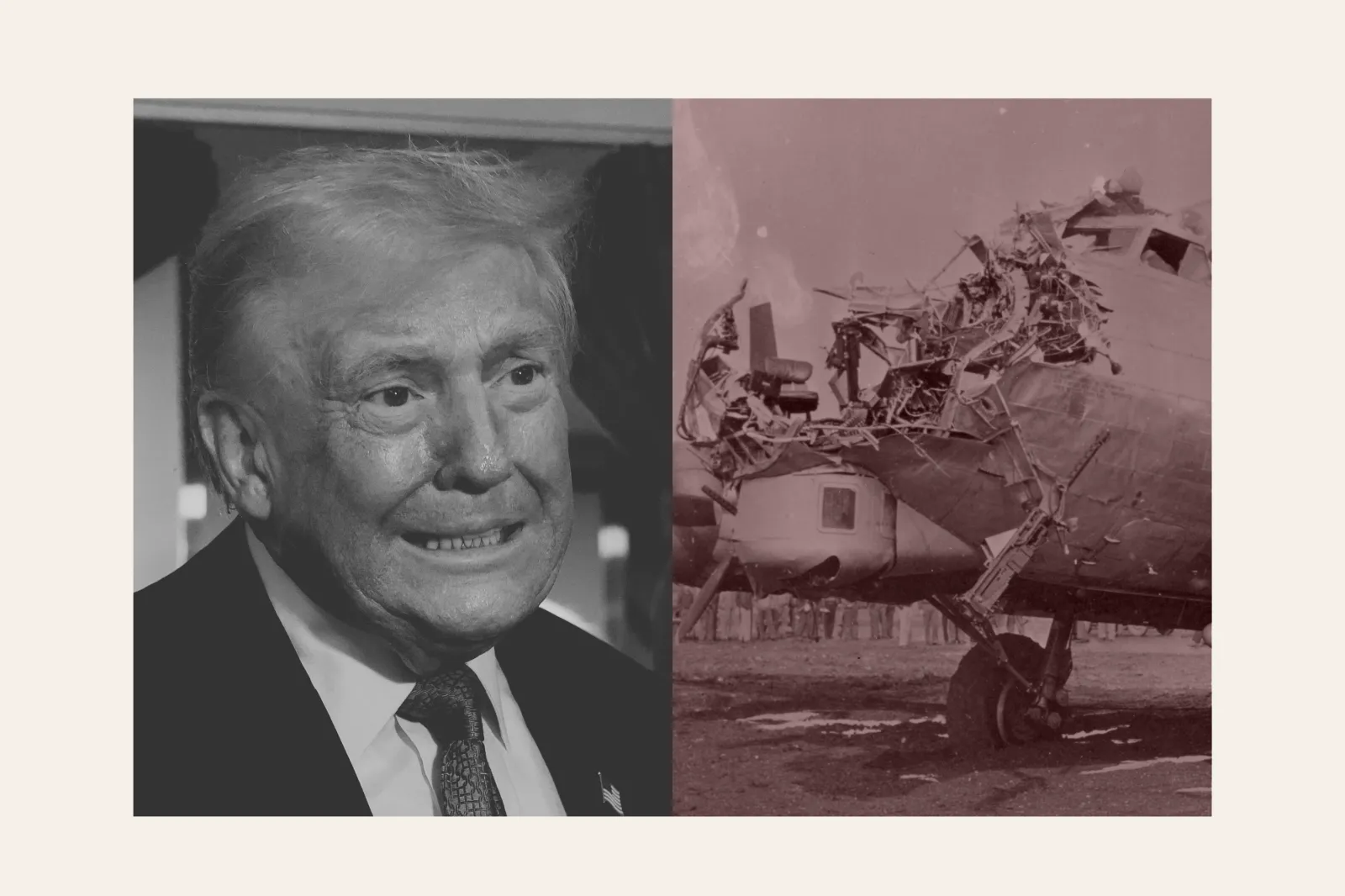
During World War II, faced with shocking bomber losses over Europe, Allied analysts went looking for a fix. They studied the aircraft that limped back to base, mapped out the bullet holes across their wings, fuselages and tails, and reached an obvious conclusion: add armor where the planes had the most damage. Abraham Wald, a Hungarian-born statistician asked to weigh in, said that was neat, but completely wrong. The damage they could see was damage a bomber could survive. It was actually the places that looked untouched that needed armor, he said, because the bombers hit there had not made it home to be counted. That is now known as survivorship bias. What matters is what's missing from view.
It's also one way to think about President Donald Trump’s second term. The visible damage is familiar: tariff wars, public brawling with judges, various conflicts across the world. After the Supreme Court struck down his global tariffs in February, for example, Trump said he was "absolutely ashamed" of "certain" justices. It was an extraordinary moment, but it didn't change the outcome. The Supreme Court's decision took some flak, but it survived.
That was Wald’s point: the obvious damage is not always the fatal damage. The deeper story of Trump 2.0 may be in its absences: the Canadians who stop coming, foreign students who choose another country, scientists who take the European offer, exchange programs quietly starved, civil servants who leave and are not replaced, shipping routes that vanish. These are the parts of America that never made it back to base.
Read More on Analysis
Common Knowledge
Trump framed his anti-red tape agenda in his March 4, 2025, address to Congress. "My administration will reclaim power from this unaccountable bureaucracy," he said. A White House release this month marking one year since "Liberation Day" boasted that Trump had thrown away "the illusions of ‘free trade’" and that the results had been "astonishing": new trade deals, lower goods trade deficits, and trillions in investment. For Trump supporters, the old America was lazy and overly bureaucratic.
The left sees the dismantling of agencies such as USAID, reductions in the federal workforce, and attacks on the Supreme Court as evidence that Trump wants to weaken the foundations of American government. It also says that the reduction in American soft power is not only damaging America but offering a strategic advantage to China.
Uncommon Knowledge
These are visible concerns, and they are often justified. But there are missing bombers too, if you know where to look. For example, Canadian residents made 2.1 million trips to the United States in January 2026, down 22.0 percent from a year earlier, with automobile trips down 26.3 percent. More striking still, Canadian return trips from overseas countries exceeded Canadian return trips from the U.S. by car for the first time since records began in 1972, excluding the pandemic. Statistics Canada says trends shifted "alongside the political tensions between Canada and the United States." This is about more than tourism. It measures the fraying of habit. Under Trump, the default choice for Canadians is no more.
Trade tells a similar story. Reuters reported in May 2025 that major container lines suspended at least six weekly China-U. S. routes, stripping out capacity for 25,682 forty-foot containers a week, or more than 1.3 million annually, as Trump’s tariffs crushed demand.
Then there is higher education, one of the most important American export businesses. In March, State Department data showed 36 percent fewer F-1 visas were issued from May through August 2025 than in the same period of 2024. Its Fall 2025 snapshot found a 17 percent decline in new international student enrollment, translating into more than $1.1 billion in lost revenue and nearly 23,000 fewer jobs. Science looks harsher still. Nature reported in January that more than 7,800 U.S. research grants had been terminated or frozen, about 25,000 scientists and staff had gone from agencies overseeing research, and proposed cuts to science budgets totaled 35 percent, or $32 billion.
Now look at America's federal workforce. In the first half of 2025, about 134,000 federal employees were lost while only about 66,000 were hired, and another 144,000 were approved for deferred resignation. The Bureau of Labor Statistics said federal employment fell another 18,000 in March 2026 and was down 355,000, or 11.8 percent, from its October 2024 peak. Some of that may indeed be healthy trimming. But in its fiscal 2024 annual report, the Council of the Inspectors General on Integrity and Efficiency said such workers generated an "approximate $18” return for every dollar invested. Given there were $162 billion in improper payments in fiscal 2024 and annual fraud losses of up to $521 billion, there is another possibility: some of the least glamorous bureaucrats may be the ones most dangerous to lose.
Survivorship bias warns against confusing what is easiest to see with what matters most. The missing bombers of Trump 2.0 are the people who do not come, the programs that do not run, the routes that do not resume, the grants that do not renew, the exchanges that do not happen, the watchdogs who are no longer watching. The right may yet prove that some of this attrition was long overdue. But the blank spaces on the diagram are growing.
Hey gang, Carlo Versano here. I hope you enjoyed this article. As Newsweek's Director of Politics and Culture and editor of the 1600 newsletter, I'm keen to hear what you think. Now, Newsweek is offering a new service to allow you to communicate directly with me in the form of a text message chat. You can sign up and get a direct line to me, as well as the reporters who work for me. You can shape our coverage, and even get your own Uncommon Knowledge article.
As a Newsweek member, we're offering this service to you for free. You can sign up below, or read more about how it works here. Let's talk!
View 0 Comments
Submit Correction
View Editorial & AI Guidelines