...

By Newsweek Editors
0
Share
Newsweek is a Trust Project member
See more of our trusted coverage when you search.Prefer Newsweek on Googleto see more of our trusted coverage when you search.
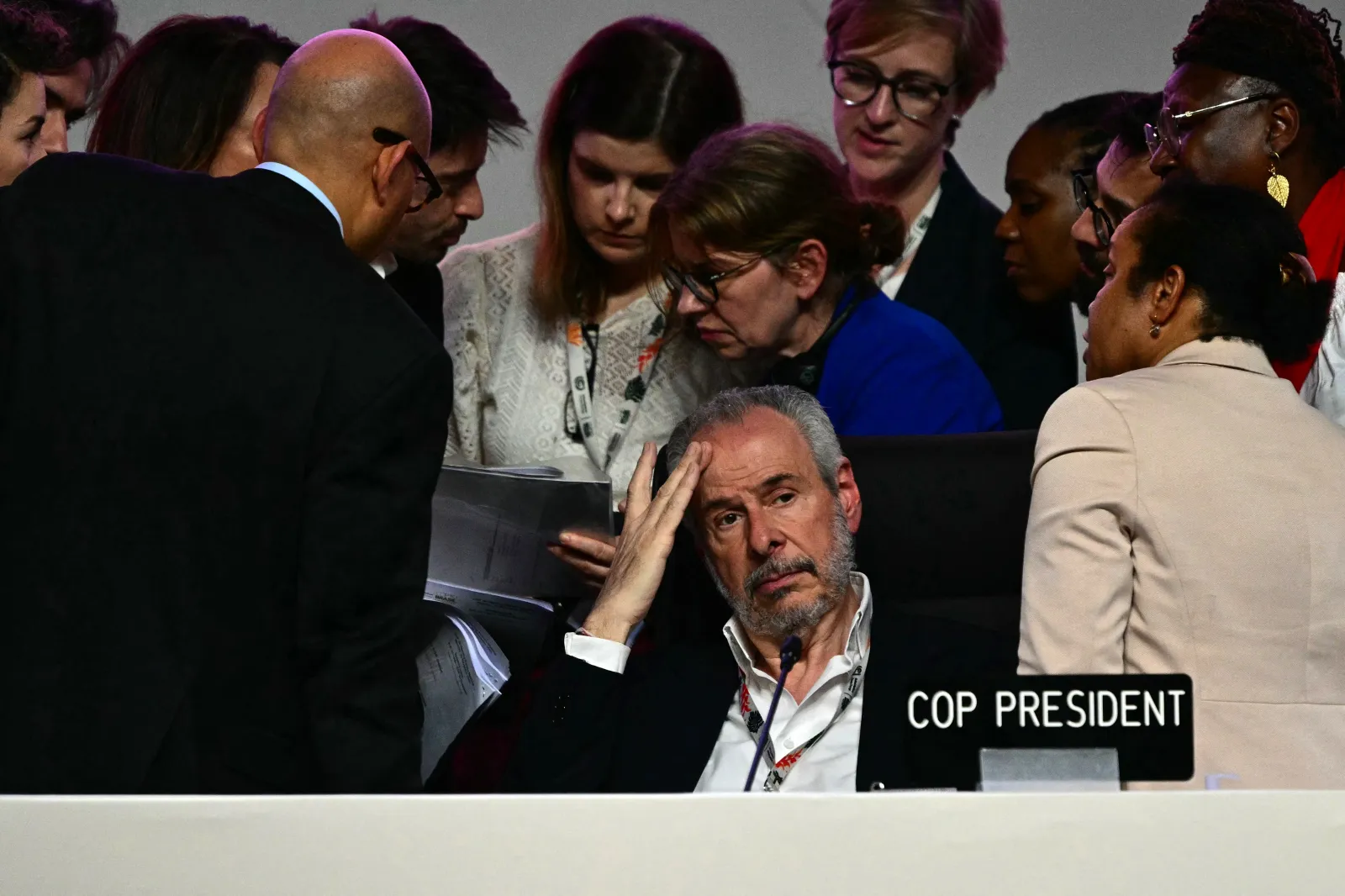
COP30, a U.N. conference on tackling global warming, had to be evacuated because the venue caught fire. The fire was not even the biggest problem at the meeting, which brought together around 200 countries exactly 10 years after the landmark Paris Climate accords. The Trump administration, which has twice pulled the United States out of the Paris accords, did not send a representative to COP30, in Belém, on the Amazon in Brazil. It fell to Gavin Newsom, California governor and 2028 presidential hopeful, to play the role of American headliner. Newsom mocked Donald Trump as an “invasive species” and said he did not want the United States to be a “footnote on climate policy” But by the time the conference ended this weekend, it was Newsom’s climate politics that appeared to be at risk of being consigned to a footnote. And Trump looked like he was winning the argument without even showing up.
Common Knowledge
The 2015 Global Climate Agreement signed in Paris aimed to limit global warming to 1.5C by reducing carbon emissions mainly from burning fossil fuels. Under the agreement, all countries would make commitments to cut greenhouse gas emissions and richer nations would help fund the transition in poorer ones. Democrats under the Obama and Biden administrations have supported these goals and Trump has been a vociferous critic of both the science underpinning the agreement and the policies it promoted.
Read More on News
His skepticism of the science is unfounded—he has dismissed climate change as a Chinese hoax. But his antagonism to the Paris climate policies fits within his wider “America First” framework. In Trump’s view, the United States, the world’s largest oil producer, would be placing itself at a disadvantage by cutting back on fossil fuel use while its major economic competitors, including China, continued to pump out vast amounts of carbon. Trump’s position has often been portrayed as unscientific, outdated and dangerous for the United States and the planet.
From the right, Trump’s energy secretary, Chris Wright, dismissed the summit as “essentially a hoax” and “not an honest organization looking to better human lives.”
Europe’s climate hawks called the emerging deal unacceptable if it dropped fossil-fuel language—EU climate chief Wopke Hoekstra and UK Energy Secretary Ed Miliband pressed for a credible road map to “transition away” from oil, gas, and coal.
India, speaking for many emerging economies, argued that a “just” transition cannot be “uniform” and that developed nations must deliver climate finance “in trillions, not billions.”
Uncommon Knowledge
What is less well known is that since Trump pulled the United States out of the Paris Accords the first time in 2017, much of the global debate has begun to swing in his direction. Climate has slipped down the list of priorities for voters in industrialized countries. A nationally representative AP-NORC survey at the turn of 2025 found only 21 percent of Americans mentioning “environment/climate change” when asked to name up to five top priorities for the year—behind immigration, the economy, and inflation. And in May, Monmouth University reported that 46 percent of Americans call climate change a “very serious problem,” down from 56 percent in 2021. Even among voters who care, intensity is ebbing: Pew’s 2024 issue ranking found just 36 percent calling climate a “very big problem,” compared with 47 percent in 2021. In Europe, climate remains broadly important, but in the 2024 EU elections voters put economy, migration and war ahead of climate, which ranked about fifth across major member states.
Investment flows tell the same story. The International Energy Agency estimates that global clean-energy investment in 2025 will reach about $2.2 trillion—nearly twice fossil-fuel investment, which is running a little over $1 trillion. The catch: fossil spending remains stubbornly high and, in some places, is accelerating. In China, coal power approvals surged to their highest level since 2015, as provinces green-lit 114 gigawatts of new coal capacity in 2023 and continued to push projects in 2024. Those approvals are now becoming concrete and steel.
The International Energy Agency uses these investment and consumption patterns to model energy use. On the world’s “Current Policies” path (policies already on the books), the planet is headed for “almost 3C” of warming by 2100. Even if governments fully deliver their “Stated Policies” (commitments with at least some implementation plan), we’re still on course for “around 2.5C.” In other words, Paris’s 1.5C goal is, as things stand, almost completely out of reach.
Some passionate climate activists now acknowledge this and are calling for a more pragmatic approach that helps people adapt to climate change rather than engineer a wrenching economic transition. Bill Gates’ memo on the climate crisis just before COP30 was something of a turning point for activists. He urged a “new approach” that focuses above all on “improving lives,” arguing that the world should measure success less by temperature alone and more by how well people—especially the poorest—are protected, even as he acknowledged temperatures will most likely end up 2 to 3C above pre-industrial levels by 2100. The Gates Foundation then announced a $1.4 billion COP30 package for smallholder farmers to build resilience. The memo infuriated some climate scientists and campaigners, who accused Gates of setting up “straw-man” choices; but it also landed squarely in the political center, where voters say adaptation funding is easier to defend than bans and mandates.
This changing global backdrop shaped the COP30 talks in Belem. A draft text published before the meeting spelled out the need to transition away from fossil fuels, but in the final version, the mandate was removed. It only contained vague language about declining fossil fuel use as irreversible and the “trend of the future.” India and China joined with the major fossil fuel exporters led by Saudi Arabia and Russia to change the text, to the chagrin of Europeans and island nations vulnerable to rising sea levels. The final text was closer to Trump’s view of the world than Newsom’s.
If you’re enjoying Uncommon Knowledge, please share. If you have suggestions for future editions or feedback, email subscriber.feedback@newsweek.com. We want to hear your voice.
View 0 Comments
Submit Correction
View Editorial & AI Guidelines