...

By Andrew Stanton
Reporter
0
Share
Newsweek is a Trust Project member
See more of our trusted coverage when you search.Prefer Newsweek on Googleto see more of our trusted coverage when you search.
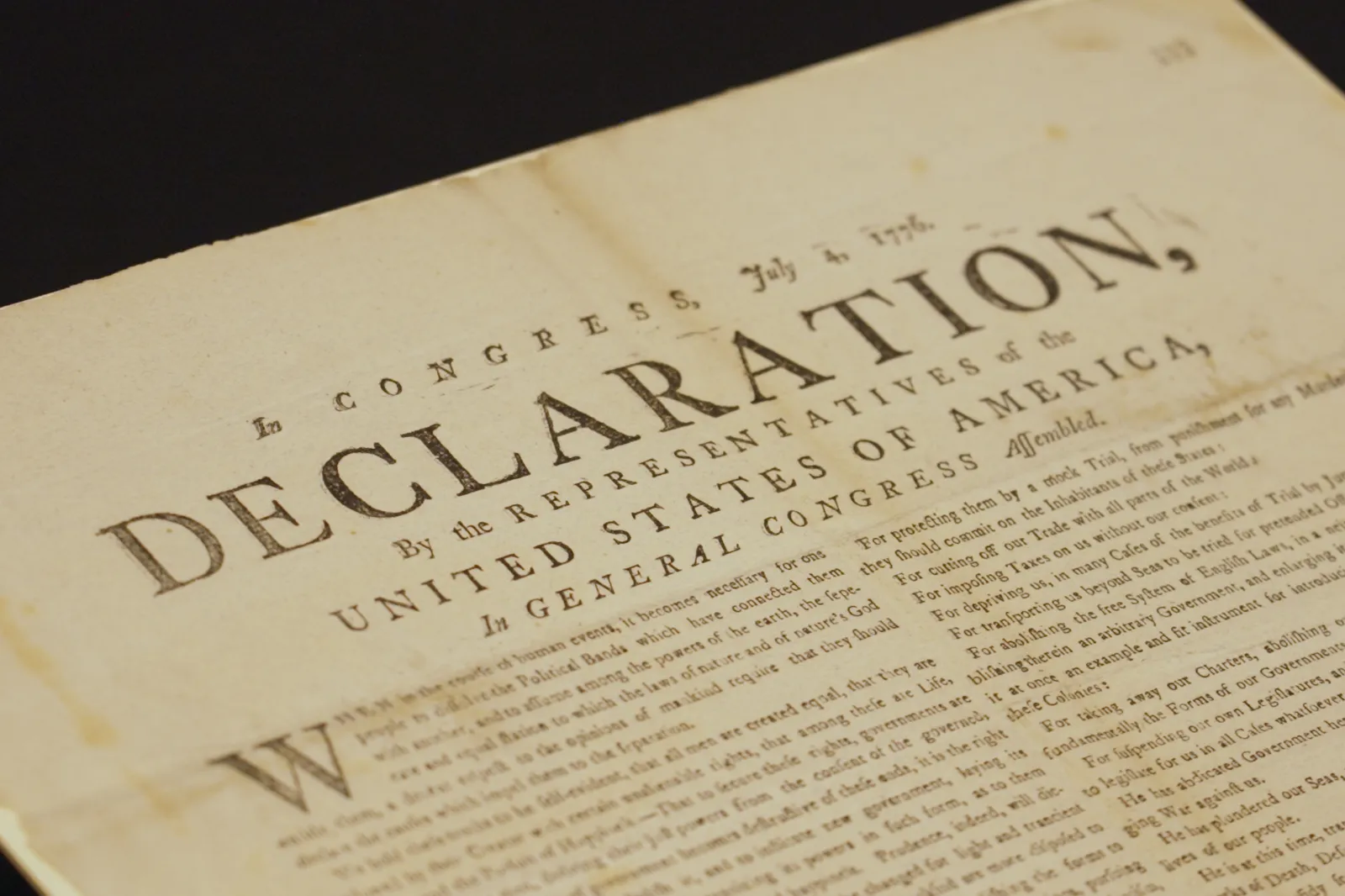
A volunteer at the British National Archives uncovered a new copy of the Declaration of Independence ahead of the United States’ 250th anniversary.
The newly uncovered document is one of the rarest forms of the Declaration, printed in Exeter, New Hampshire, following its adoption. Ten of the surviving copies are held in U.S. libraries and historical societies, but this one offers a unique international link to America’s founding. The discovery was announced as millions of Americans plan to celebrate the semiquincentennial over the weekend.
Emily Sneff, a historian and author of When the Declaration of Independence Was News, told Newsweek the discovery is “astonishing” in a phone interview on Friday.
Read More on News
“The fact that it has survived for 250 years is astonishing,” she said. “Every copy of the Declaration that we have today is evidence of someone thinking ahead and preserving it, folding it up, making sure it would last for generations.”
How a Volunteer Discovered a Rare Copy of the Declaration of Independence in the UK
The copy was found by Michael Scurr, a volunteer on the archives’ America 250 – Royal Navy Admirals’ and Captains’ letters project. He found the copy while cataloging a box of letters, among letters sent by HMS Raisonable Captain Thomas Fitzherbert, according to the British National Archives.
Scurr told the Associated Press that when he found the copy, he thought, "Oh, right, OK, this is definitely a Declaration of Independence. How exciting is this?’’
The copy was taken from the papers of an American vessel called the Dalton, based out of Newburyport, Massachusetts. The ship was captured by the British on December 24, 1776. In a letter dated January 10, 1777, Captain Fitzherbert made a reference to documents seized from the Dalton, including a copy of the Exeter Declaration.
...
The Exeter Declaration broadsides were printed in Exeter by Robert Luis Fowle, printer of the New Hampshire Gazette or Exeter Morning Chronicle, between July 16 and 19, 1776, just days after the 13 colonies declared independence from Great Britain, according to the archives.
Prior to the discovery, only 10 copies of the broadsides were known to have survived.
This is because these printings were typically “just meant for the immediate moments,” Sneff told Newsweek.
“These copies of the Declaration created in the period of time when it was news were not necessarily meant to survive,” she said. “In this case, the New Hampshire broadsides were printed on rag-made paper, not the highest quality of paper, you can see the flecks of different colors of textiles within the broadside paper.”
At the time, the Declaration was printed in newspapers, and there were public readings of it that relied on these broadsides, Sneff said. These copies were mostly intended for local consumption and would have been distributed around the Exeter region.
Copies that ended up in the British National Archives were mostly ones that fell into the hands of British officers who were in the vicinity of a particular printing, she said.
“In this case it seems as though these Exeter, New Hampshire, broadsides were intended for a pretty local audience, and it just happens that it was a local ship that months later ended up in this situation of interception,” she said.
Eric Slauter, deputy dean of arts and humanities at the University of Chicago, told Newsweek that single-sheet printings like this copy were how many Americans received news that the U.S. had declared independence from Great Britain.
“American printers, beginning with John Dunlap in Philadelphia on July 4, 1776, were always careful to print the most important words Congress had declared in capital letters, as the printer of the Exeter, NH Declaration has done. We think Robert Fowle made his version of the Declaration in mid-July, as the news reached New Hampshire,” he said.
It is “fitting” that it was seized in international waters, as the Declaration was an “instrument of international law,” Slauter said.
“Because the philosophy in the second paragraph of the Declaration has been so central to American identity as a charter of liberty, equality, and rights, we tend, mistakenly, to think of the Declaration exclusively in terms of domestic politics,” he said. “But when Thomas Paine pushed in Common Sense in January 1776 for a declaration of independence he described it as a ‘manifesto’ that should be dispatched to European courts, with the hope of securing a military alliance and commerce.”
Where to Find Copies of the Declaration of Independence
There is only one copy of the engrossed, signed Declaration of Independence, and it is housed in the National Archives in Washington, D.C., according to Harvard University’s Declaration Resources Project. However, publishers produced hundreds of copies of the Declaration after its adoption.
Philadelphia printer John Dunlap was the first printer to make a broadside copy of the Declaration and went on to print more than 200 copies. Here are the locations of those broadsides, per Harvard:
- Beinecke Library at Yale University (New Haven, CT)
- Library of Congress (Washington, D.C.)
- National Archives (Washington, DC)
- Lilly Library at Indiana University (Bloomington, IN)
- Chicago Historical Society (Chicago, IL)
- Massachusetts Historical Society (Boston, MA)
- Houghton Library at Harvard University (Cambridge, MA)
- Williams College (Williamstown, MA)
- Maryland Historical Society (Baltimore, MD)
- Maine Historical Society (Portland, ME)
- American Independence Museum (Exeter, NH)
- Scheide Library at Princeton University (Princeton, NJ)
- Morgan Library (New York, NY)
- New York Public Library (New York, NY)
- A private collector in New York
- American Philosophical Society (Philadelphia, PA)
- Independence National Historical Park (Philadelphia, PA)
- Dallas Public Library (Dallas, TX)
- University of Virginia (Charlottesville, VA)
- Norman Lear et al. (Roving)
- Three copies in the British National Archives
How Often Are New Copies of the Declaration Found Like This?
New copies of the Declaration are found or identified every few years, Sneff said. Their discoveries and continued research can help to “explain the stories behind them,” she said. Copies are less likely to be found "in the back of a picture frame at a garage sale*"* compared to archives, particularly those outside of the U.S., where the Declaration is less immediately identifiable.
“I think there's still a lot of opportunities to work with the copies of the Declaration we know about to pull out the stories behind them. But I expect that every so often we will continue to find copies of the declaration like this,” she said.
Contact Newsweek editors on this story: Steve Mollman and Gray R. Thomas
View 0 Comments
Submit Correction
View Editorial & AI Guidelines