...

By Alice Gibbs
Senior Reporter
0
Share
Newsweek is a Trust Project member
See more of our trusted coverage when you search.Prefer Newsweek on Googleto see more of our trusted coverage when you search.
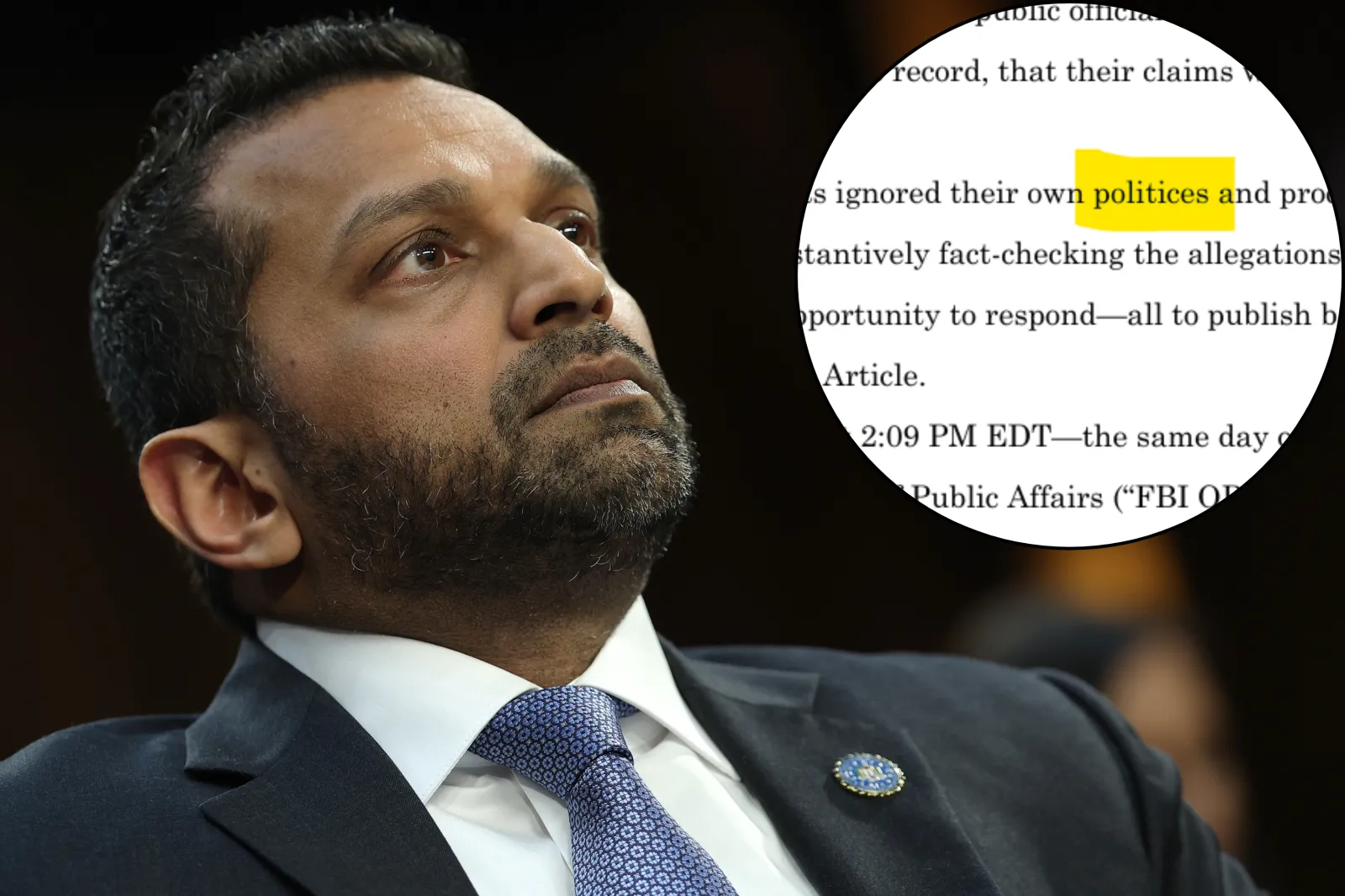
A defamation lawsuit filed this week by FBI Director Kash Patel against The Atlantic contains multiple spelling and copy‑editing errors, including misspelled words and formatting inconsistencies in passages sharply criticizing the magazine’s journalistic standards.
The 19‑page complaint, filed Monday in federal court in Washington, D.C., accuses The Atlantic and one of its reporters of knowingly publishing false and defamatory claims.
But a close review of the lawsuit itself reveals several basic errors in spelling.
Read More
Everyone Saying Same Thing About Mamdani and Obama Singing4 min read

People Point Out One Flaw in Sec Duffy’s Plan To Recruit Gamers to ATC4 min read

JD Vance Says ‘Disagreements’ With Pope Leo Will Happen4 min read

...
Why It Matters
Patel’s lawsuit is seeking at least $250 million in damages, repeatedly emphasizing accuracy, fact-checking and editorial rigor, and argues that The Atlantic acted with "actual malice."
The presence of simple typos in the complaint does not undermine its legal claims, but it does stand out in a filing that centers on alleged journalistic negligence.
Court filings are typically reviewed by multiple attorneys before submission, making such errors notable—particularly in a high‑profile case involving the director of the FBI and one of the country’s most-prominent magazines.
What Is "Actual Malice"?
The principle of "actual malice" was first introduced during New York Times Co. v. Sullivan, 376 U.S. 254 (1964) where the Supreme Court ruled that a public official needed to show that any false and defaming statements were said with "actual malice".
According to the Cornell Law School, the Sullivan Court ruled that "actual malice" means that the defendant made the statement knowing that it was false, or that it was made with reckless disregard - whether it was false or not. This requires the accuser to prove intent with clear and convincing evidence that the defendant made the statement knowing it to be false or made with reckless disregard regardless of truth.
What To Know
The 19-page complaint contains several clear spelling mistakes, including:
- "feable" instead of "feeble," used to describe what the lawsuit calls The Atlantic’s attempt to downplay partisan animus.
- "politices" instead of "policies," in a passage accusing the magazine of ignoring its own editorial rules.
- "dicussed" in place of "discussed."
Jesse R. Binnall, partner at the Binnall Law Group, the legal team behind the filing, told Newsweek: "If three typos in a 19-page complaint filed just days after The Atlantic’s bogus story is the best a left-wing publication can muster, we feel pretty great about our case."
None of the errors affects the substance of the allegations, which claim that The Atlantic relied on anonymous sources to publish false assertions about Patel’s behavior, alcohol use and job performance—claims that the lawsuit says were explicitly denied before publication by the FBI, the Justice Department and the White House.
The complaint also points to earlier defamation litigation involving Patel, arguing that The Atlantic should have known similar allegations had already been publicly disputed and were the subject of ongoing legal action.
According to the filing, Patel previously sued over anonymously sourced claims aired on MSNBC’s Morning Joe, which the lawsuit says were later described by the network as unverified. Patel’s lawyers argue that republishing comparable allegations, despite that history, further demonstrates "actual malice."
What Happens Next
The lawsuit has been filed but not yet responded to in court. The Atlantic and the reporter named in the complaint have not publicly commented on the filing or the copy errors identified in it.
The case will now proceed through early procedural stages, including expected motions from the defendants.
UPDATE 04/22/26 02:40 a.m. ET: This story was updated with comment from the Binnall Law Group.
View 0 Comments
Submit Correction
View Editorial & AI Guidelines