...

By Newsweek Editors
0
Share
Newsweek is a Trust Project member
See more of our trusted coverage when you search.Prefer Newsweek on Googleto see more of our trusted coverage when you search.
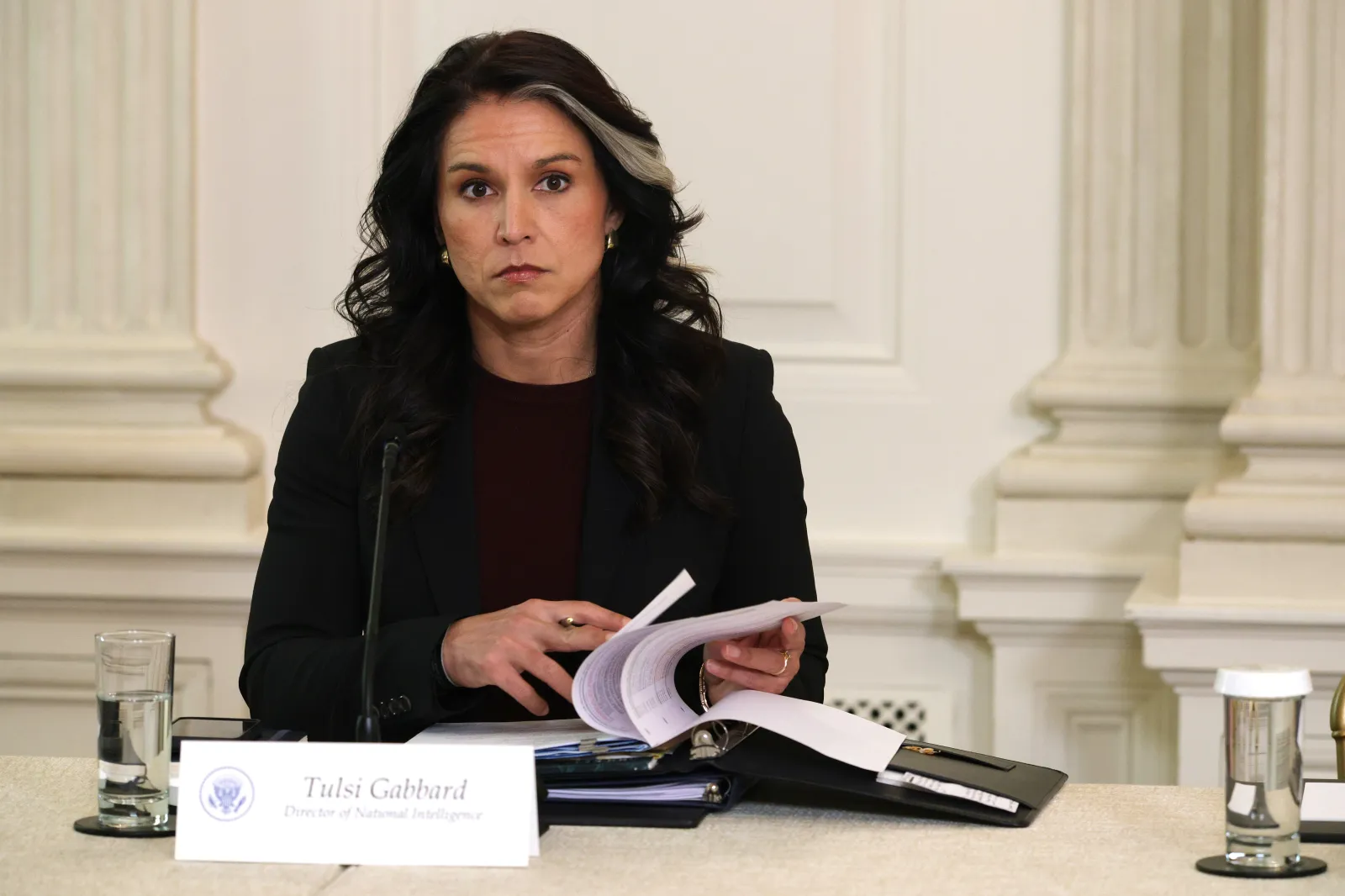
Tulsi Gabbard arrived on Capitol Hill on Wednesday for what is shaping up to be her first truly high‑pressure public test as Director of National Intelligence (DNI).
She was attending the annual worldwide threats hearing in front of the Senate Intelligence Committee, a session now dominated by a war with Iran and questions about whether Tehran truly posed an “imminent threat” as the White House has claimed.
The timing for the intelligence chief is rough.
Read More on Analysis
Just one day earlier, Joe Kent, the director of the National Counterterrorism Center and a close Gabbard ally, resigned in protest, saying he could not “in good conscience” support the war and directly disputing the Trump administration’s premise.
Gabbard responded not by litigating Kent’s claim, but by emphasizing that the president, as commander in chief, determines what constitutes an imminent threat, while ODNI’s job is to integrate intelligence to inform that decision.
The subtext of her posture was clear and illustrates Gabbard’s predicament. The former anti‑interventionist lawmaker, herself a veteran of Iraq, is now the intelligence chief tasked with defending a war she once warned could be catastrophic.
Credibility vs. Loyalty
Gabbard’s first dilemma is the simplest. It’s also the most personal.
Does she protect the credibility she built opposing Middle East intervention on principle, or prove her loyalty to President Donald Trump to remain as DNI?
Her rise in national politics was fueled by a robust critique of “regime change” and the Iraq‑era habit of selling war on thin, politicized threat narratives.
She was forcefully opposed to a war in Iran, backing legislation to force presidents to ask Congress for consent.
In 2020, after the Trump administration killed Iranian commander Qasem Soleimani, Gabbard, then a Democrat, warned the country was “speeding towards an all‑out war with Iran” that would make the wars in Iraq and Afghanistan “look like a picnic.”
Now, she is the face of the intelligence apparatus that helps justify escalation.
That contrast—old Gabbard sounding alarms about an Iran war, new Gabbard defending the president’s threat determination—creates a reputational squeeze.
Even if she believes she is simply doing her job, the politics of it are unforgiving. Her brand was built on calling this movie out before it started. But Trump demands loyalty before all else. She faces a choice.
Institutional Duty vs. Constitutional Scruples
Her second dilemma is more structural than psychological.
Can Gabbard reconcile the institutional imperatives of her office with her long‑standing belief that war‑making power should not sit in one person’s hands?
The hearing’s central question, on whether Iran posed an “imminent threat,” is the constitutional and political hinge that presidents use to justify unilateral action without Congress.
Kent’s resignation letter targeted precisely that, arguing there was “no imminent threat” and therefore no moral or strategic basis for the war.
Gabbard’s response put the responsibility squarely on the president, saying on X that he “is responsible for determining what is and is not an imminent threat”.
The ODNI, Gabbard continued, “is responsible for helping coordinate and integrate all intelligence to provide the President and Commander in Chief with the best information available to inform his decisions.”
She is walking a thin line, balancing her responsibilities as DNI against her instinctive opposition to such wars and what she previously regarded as executive overreach.
That’s the bind. If she leans into her old instincts, she risks looking like she’s undermining the commander in chief in wartime.
But if she leans into the job’s hierarchy, she normalizes the precedent she once argued was corrosive, especially if the “imminence” case remains contested in public.
Influence From Inside vs. Moral Signaling From Outside
The third dilemma is the resignation question.
Is Gabbard more useful as an internal brake on the Trump administration, or does the moment demand she loudly draw a line in the sand?
Kent’s departure raises the stakes because it undermines the argument that responsible officials must stay put to manage the consequences of presidential decisions.
If a top counterterrorism official can walk away on conscience while explicitly disputing the rationale, then Gabbard, as his superior and the administration’s intelligence quarterback, faces a sharper version of the same question.
Staying has an internal logic. DNI is not a policy role; it is a system‑management role, and Gabbard can plausibly argue that resigning would cede the field to more hawkish actors and reduce her ability to limit escalation or mission creep.
But staying also has an external cost.
Her presence lends credibility, fairly or not, to the administration’s threat narrative and war trajectory. To some, another conclusion is true. Staying subtracts from her own credibility rather than transferring it to the White House.
Gabbard has been relatively quiet as Trump’s DNI compared with her earlier media visibility, which makes today’s testimony even more consequential.
It is the clearest public test of how she squares the circle on Iran. In other words, she must decide whether to be a guardrail inside government, or a warning sign outside it.
The Anti-Interventionist Faction
Kent’s resignation has turned Gabbard’s discomfort into a storyline. Today’s hearing cranks up the pressure.
Can the administration’s anti-interventionist faction, a popular cause among "America First" MAGA, survive Trump's war in Iran without abandoning the principles that put it in power? Or will Kent’s resignation trigger a bigger fracture over the issue?
Hey gang, Carlo Versano here. I hope you enjoyed this article. As Newsweek's Director of Politics and Culture and editor of the 1600 newsletter, I'm keen to hear what you think. Now, Newsweek is offering a new service to allow you to communicate directly with me in the form of a text message chat. You can sign up and get a direct line to me, as well as the reporters who work for me. You can shape our coverage.
As a Newsweek member, we're offering this service to you for free. You can sign up below, or read more about how it works here. Let's talk!
View 0 Comments
Submit Correction
View Editorial & AI Guidelines