10
Loading video...

By Helen Vera
0
Share
Newsweek is a Trust Project member
See more of our trusted coverage when you search.Prefer Newsweek on Googleto see more of our trusted coverage when you search.
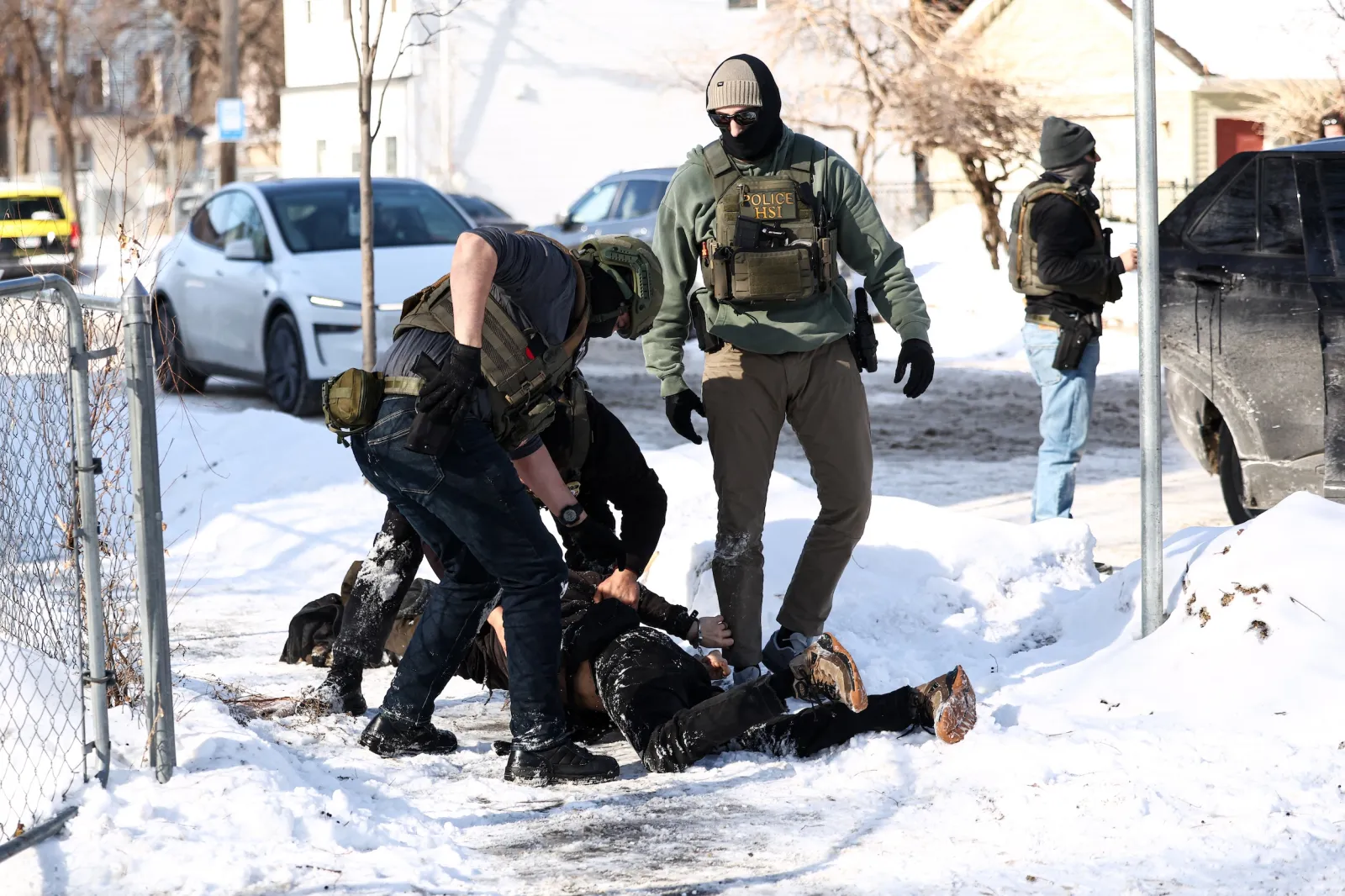
As President Donald Trump reflects on the past year in his State of the Union address later this month, his administration’s violent law enforcement tactics are on the minds of many Americans. In January, federal officers killed two United States citizens on Minneapolis streets in broad daylight. Agents have shoved bystanders, pepper-sprayed observers and protesters, swarmed around cars, broken glass and detained citizens and legal immigrants going about daily activities. President Trump doesn’t just condone this brutality; he has made police violence a signature aspect of his legacy.
State and local officials seem to be on the front lines of the resistance. Minneapolis Mayor Jacob Frey and police chief Brian O’Hara have staked out positions as reform-minded local leaders. Other states, like California and Illinois, have challenged the administration in high-profile lawsuits. State legislatures are pushing to restrict federal civil rights abuses, and Democratic U.S. senators have introduced legislation that would redirect ICE funding to local police departments to hire 200,000 more police officers.
We should, however, be skeptical of the “federal bad, state and local good” narrative, which plays directly into President Trump’s vision of emboldened law enforcement at all levels. The Trump administration has spent the past year methodically “unleashing” state and local law enforcement across the country. The violence perpetrated by ICE and other federal agencies has been alarming, but the potential for harm by state and local police, who make up the vast majority of sworn law enforcement officers in this country, is much greater. Nationwide, there are over 600,000 sworn police and sheriff’s patrol officers. ICE has funding for some 30,000 employees total, even including a huge funding boost from the so-called “Big Beautiful Bill.” Between 2013 and 2025, state and local police reportedly killed more than 14,000 people in America, far more than the roughly 400 deaths in incidents involving federal law enforcement officers during that same time period.
Read More on Opinion
...
The Trump administration’s harmful rhetoric and willingness to fabricate false and easily refutable accounts of deadly encounters to side with federal agents emboldens would-be civil rights abusers in local law enforcement. But perhaps even more troubling, the administration largely has abdicated the federal government’s traditional role in civil rights oversight of state and local law enforcement.
Federal laws task the United States Department of Justice with investigating and, where appropriate, litigating against state and local police departments and prisons and jails and that engage in a “pattern or practice” of constitutional violations. Until last year, I served as a career attorney in DOJ’s Civil Rights Division, where my colleagues and I enforced these laws. In state and local police departments and prisons and jails around the country, we identified civil rights violations not so different from the unnecessary force and escalation on display by ICE in Minneapolis. We negotiated agreements and helped oversee implementation of necessary reforms.
President Trump openly has sought to erase the non-political reforms my colleagues and I worked to effectuate. Shortly after resuming office, he signed an executive order aimed at “unleashing America’s law enforcement,” which, among other provisions, required a “review” within 60 days of all DOJ consent decrees with state and local law enforcement agencies. Within less than a month, newly installed DOJ leadership shuttered investigations and rescinded formal findings in almost all of the Division’s open pattern-or-practice civil rights investigations of state and local police departments.
Some local leaders, including in Minneapolis, have pledged to enact the necessary reforms anyway. This commitment shows clear-eyed leadership, but it is no accident or stroke of luck. It is the result of enormous public pressure on the local government following the 2020 murder of George Floyd—by a local Minneapolis police officer. The resulting public outcry and federal scrutiny, including a DOJ investigation, led to the appointment of a new police chief with a mandate to fix a broken system.
Around the same time, in cities and states across the country, other unjustified killings of Black people by local police also led to calls for reform and federal oversight. The political pressure was so great that even President Trump, then in his first term, issued an executive order geared at police reform.
Today, cracks are beginning to form in the administration’s hard line in Minneapolis, largely because, once again, public outcry reached a fever pitch over unjustified police killings. More course correction is needed, and it should not take such brutality by law enforcement to force it. But we must not so swiftly forget that state and local police can be agents of unjustified violence, too. Learning from both the present moment and the recent past, we must demand both an end to the ICE occupation of American cities and that local, state and federal law enforcement alike be held accountable to the people they are sworn to protect.
The Trump administration is engaged in an all-out offensive against civil liberties. We must hold our leaders—federal, state and local—to account to enforce them, while we still can.
Helen Vera is at attorney at the Roderick & Solange MacArthur Justice Center. She previously served as a career attorney in the Civil Rights Division of the United States Department of Justice.
The views expressed in this article are the writer's own.
View 0 Comments
Submit Correction
View Editorial & AI Guidelines