...

By Hugh Cameron
Reporter
0
Share
Newsweek is a Trust Project member
See more of our trusted coverage when you search.Prefer Newsweek on Googleto see more of our trusted coverage when you search.
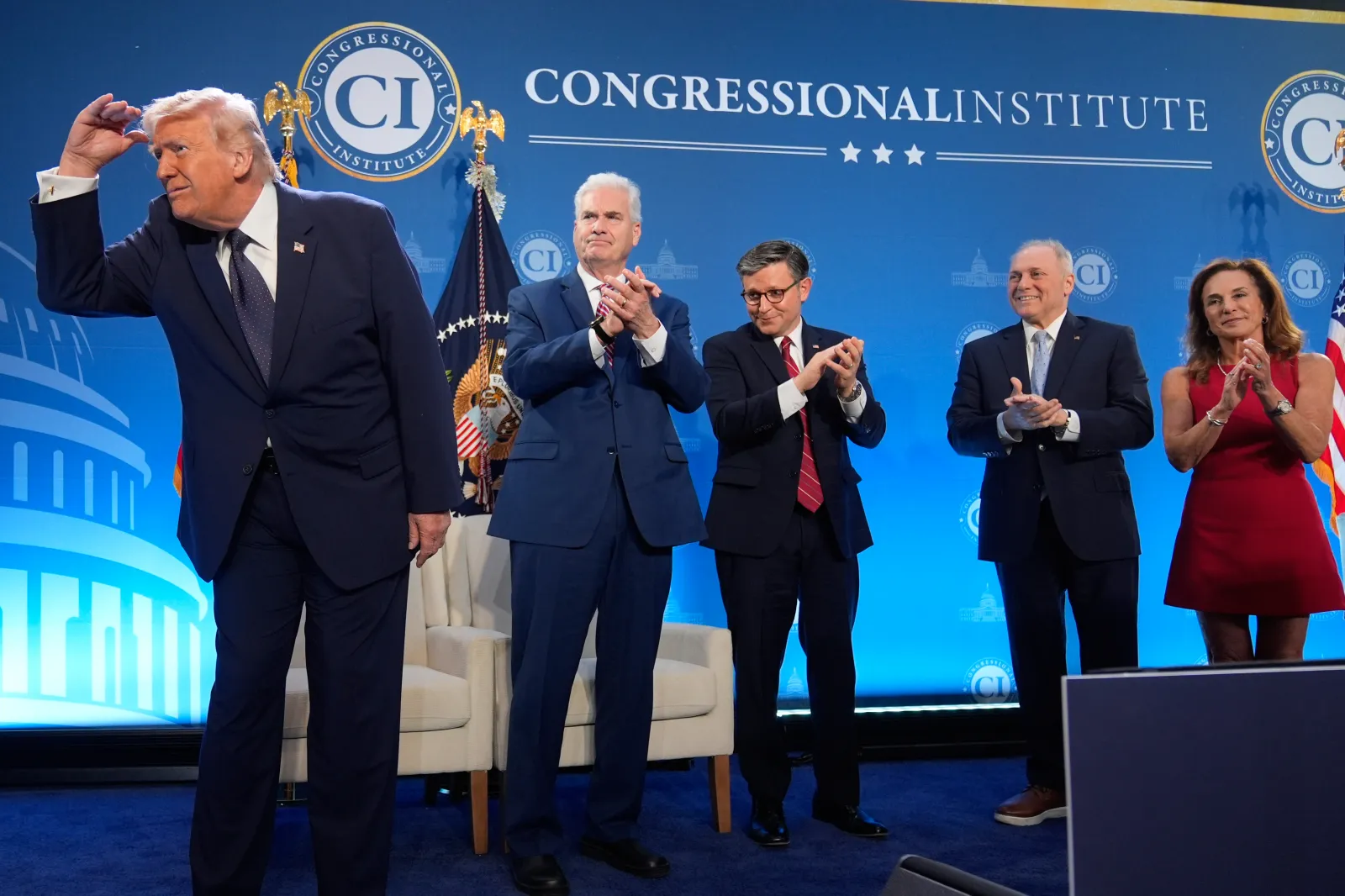
For years, Republican lawmakers have treated proximity to Donald Trump as their key political capital.
But with the president's attention turning to military excursions abroad and legislative crusades at home—issues that may stir the base but appear increasingly disconnected from voters’ immediate concerns—the party that has tethered itself to him may find those priorities becoming a liability as they seek to stave off what some fear could be an embarrassing defeat come November.
“Already, we are behind the eight ball as far as the electoral process,” Kentucky Senator Rand Paul said this week, while projecting that Trump’s latest Middle Eastern gambit could carry “disastrous” consequences for the midterms.
Read More on Politics
“In my polling and focus groups, the cost of living, inflation, affordability are the concerns that are dwarfing all others,” said pollster and political affairs strategist Alex Patton.
“President Trump was elected because of these concerns, and under his watch the economy is perceived to be deteriorating further,” he told Newsweek. “The president's priorities seemingly have changed from what he promised during his campaign to leaving a mark in the world history books, public concerns be damned.”
Trump’s All‑In on the SAVE America Act
While voter ID and registration reform have been a long-standing GOP aim, Trump has now turned this into a marquee matter, and made passing the SAVE America Act his top domestic priority, going as far as to say he will not sign any other piece of legislation until it reaches his desk. And despite the House having already approved the bill, Trump has said the current version does not go far enough, pressing Republicans to add stricter limits on mail‑in ballots and other provisions before he would sign it.
Voting-rights groups say the legislation would disenfranchise tens of millions—21.3 million or nine percent of the voter pool, according to the Brennan Center for Justice—a figure that would likely increase if Republicans can successfully pass it with the limits on mail ballots Trump is also seeking.
Trump has dubbed it “by far the most popular Bill of its kind ever put before Congress,” and White House spokeswoman Abigail Jackson told Newsweek the act “is incredibly popular with the American people and it should be passed immediately.”
According to a recent Harvard/HarrisX poll, 71 percent of Americans support the SAVE America Act, including 69 percent of independents. But other surveys suggest voter priorities are more nuanced. A PBS News/NPR/Marist survey found that they are more concerned with ensuring that those who want to vote can (59 percent) than clamping down on ineligible voters (41 percent).

...
The act still faces an unclear future in the Senate where Republicans lack the requisite 60 votes and GOP leadership is struggling to see a path forward.
Though some members have proposed changing Senate rules to go around the 60-vote threshold or implementing the “talking filibuster”—where lawmakers must speak continuously to delay votes—Senate Majority Leader John Thune this week called the bill’s future “still unclear.”
“Having studied it and researched it pretty thoroughly, you have to show me how, in the end, it prevails and succeeds,” Thune said of these workaround proposals. “We can’t find a piece of legislation in history that’s been passed that way.”
According to political scientist Lonna Atkeson, the SAVE America Act appears a means of mobilizing voters and upsetting the typical turnout boost enjoyed by out‑of‑power parties during midterms—by convincing them that serious threats to election integrity could hurt Republicans’ chances.
But she told Newsweek that the sort of voters who care deeply about voter registration “are already turning out as they’re strong partisans.” This is not the case for the more persuadable voters, for whom midterms could be viewed as “a referendum” on the president.
“It’s not that he hasn’t delivered on voter ID,” she said. “People want inflation to go away.”
Still, elevating the SAVE America Act to a defining party priority without a realistic path to passage carries political risks, particularly given the weeks Trump has spent placing it at the center of his agenda.
“I would close government over it,” the president said in an interview with NBC News last week.
“I want the SAVE America Act,” he told CNN’s Dana Bash on Friday. “It is more important than everything else we’re working on, other than the war.”
Iran's Political Price Tag
Several think tanks and Pentagon sources have estimated that Operation Epic Fury, which began with U.S.-Israeli strikes on Iran in late February, is carrying a daily price tag of nearly $1 billion for American taxpayers.
And beyond potentially upsetting fiscally hawkish Republicans, the immediate impact of the war on voters is already becoming evident as gas prices soar and oil markets reel from Tehran’s effective closure of the Strait of Hormuz, the narrow passage linking the Persian Gulf to global markets and a vital route for oil exports.
“If gas prices rise or economic anxiety grows, voters are likely to hold the governing party accountable—which is why many Republicans would rather keep the midterms focused on stability and affordability than foreign policy crises." Brittany Martinez, Republican strategist and executive director Principles First, an anti-Trump conservative advocacy group, told Newsweek.
Perhaps more than any other consumer expense, U.S. voters have proven themselves highly sensitive to prices at the pump, according to Laurel Harbridge-Yong, a professor at Northwestern University’s Department of Political Science, who authored a 2016 paper on the correlation between gas prices and presidential approval.
“Because many citizens fill up their car with gas weekly and often purchase only gas when they stop for a fill-up, gas prices may be a particularly salient indicator of the economy and the impact on their own pocketbook,” she said.
Harbridge-Yong said the conclusions of her past work on gas prices could reasonably be applied to the legislative elections. And Jeffrey Wooldridge, professor of economics at Michigan State and coauthor of the 2016 paper, similarly told Newsweek that, “if gas prices continue to rise, the effects on the midterm elections could be noticeable.”
He added that Trump’s heavy focus on gas prices in 2024 may have increased the reputational blowback for failing on this now-central issue, and that, “because the recent gasoline price increase is due to the attack on Iran—and therefore viewed by most Americans as avoidable—President Trump may pay an even higher price in terms of approval.”
The president has sought to downplay the issue, calling rising pump prices "a very small price to pay" for the elimination of the Iranian nuclear threat, but party figures are growing anxious over the potential electoral significance.
“The price of gas is always kind of a benchmark,” Thune told reporters on Monday, per Politico. “I do think the fact that we’ve increased our supply here domestically will help ease it, but it’s something obviously we’ve got to pay attention to.”
Republican strategist Matt Klink believes that the military success of Operation Epic Fury could be a boon for the party—"America loves winners"—but he told Newsweek that near-term gas prices “will play a significant role in determining success or failure for the GOP this November,” especially given the “challenging electoral climate” they already face.
...
Party Unity vs. Electoral Peril
Taken together, experts say, Iran and the SAVE America Act run counter to what many Republicans would ordinarily emphasize in a midterm year, namely affordability—an issue that topped voter concerns in a recent NBC News poll.
“Any incumbent should be worried and talking about affordability issues foremost,” according to Patton. “I think the GOP's callousness on the issue is a gale-force wind, not just a headwind.”
Patton said that shifting voter attitudes will mean candidates must choose between their presidential allegiances and self-interest, with those in swing districts now far more likely to “subtly break away from the president” as polls show high levels of opposition to the Iran war.
But showing support for Trump remains high on the list of Republican priorities, with 52 percent of registered voters calling this “very important” in a recent CBS News/YouGov survey. And this will shape candidates’ calculus at least through the next few months of primary elections.
“What matters to a lot of Republican candidates is their primaries—if they run in a Republican district that’s the election that matters,” according to veteran GOP consultant and campaign strategist Carter Wrenn. “And Trump’s incredibly popular with the voters they need to win their primaries. So they don’t want to cross ways with him.”
But Wrenn told Newsweek that those in swing districts “live in a different world, have different problems,” and that courting the undecided and persuadable in these areas may mean distancing themselves from Trump. This applies to affordability, he said, but also foreign policy and now even immigration—6-in-10 independents told a February AP-NORC poll that the president had gone “too far” when it came to immigration enforcement actions in U.S. cities.
“At the end of the day, candidates and campaigns seldom decide elections,” said Wrenn. “Trends and tides decide elections, and in this off-year election the tides—that have something to do with affordability but more to do with how Trump does things—favor Democrats.”
In a polarized era, the center is dismissed as bland. At Newsweek, ours is different: The Courageous Center—it's not "both sides," it's sharp, challenging and alive with ideas. We follow facts, not factions. If that sounds like the kind of journalism you want to see thrive, we need you.
When you become a Newsweek Member, you support a mission to keep the center strong and vibrant. Members enjoy: Ad-free browsing, exclusive content and editor conversations. Help keep the center courageous. Join today.


View 0 Comments
Submit Correction
View Editorial & AI Guidelines