Photo-illustration by Newsweek/Getty

By Brendan Cole
Senior Reporter
0
Share
Newsweek is a Trust Project member
See more of our trusted coverage when you search.Prefer Newsweek on Googleto see more of our trusted coverage when you search.
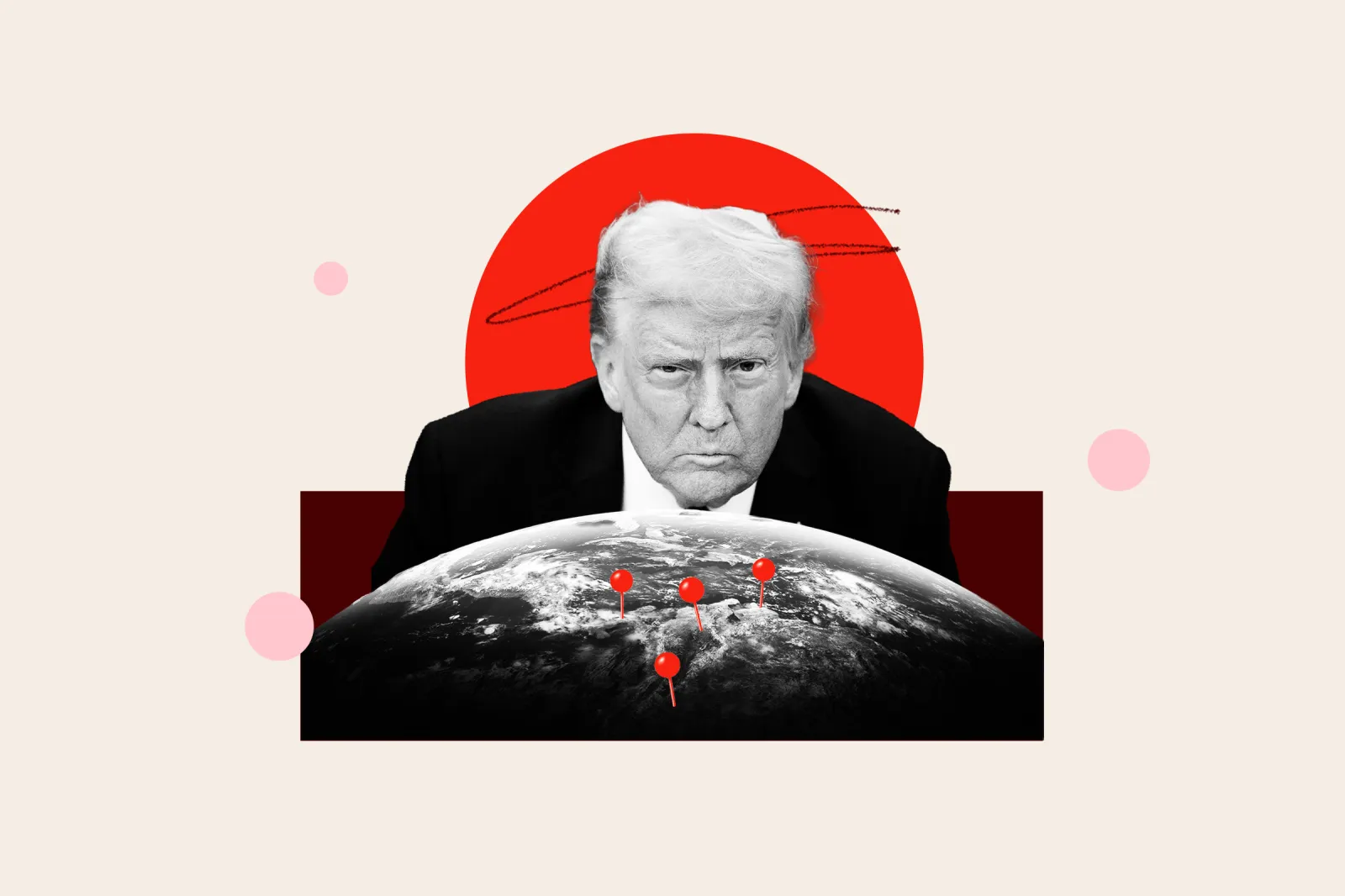
President Donald Trump’s threat to end all aid to Colombia marks the latest stage in his approach to Latin America that has included renaming the Gulf of Mexico, pushing for control of the Panama Canal and talking tough on Venezuela.
Trump’s Truth Social post branding Colombian President Gustavo Petro an “illegal drug leader,” angered Bogota and showed that even American allies are not immune to the president’s vitriol.
Amid tariffs, hardline immigration enforcement and the rise of Chinese economic influence in the region, Trump’s approach to Latin America is tied to personal and ideological alignment rather than consistent policy, experts have told Newsweek.
Read More on News
“His vision of Latin America is very much in the Monroe Doctrine which is not a very popular doctrine in Latin America, having given license to numerous interventions,” said Christopher Sabatini, senior research fellow for Latin America, U.S. and the Americas Program at think tank Chatham House, referring to U.S. dominance of the Western Hemisphere.
“But it's beyond that too—it’s partisan and transactional,” he told Newsweek.
...
Courting The Right-Wing
In Latin America, Trump has sided with the right, favoring leaders like Javier Milei in Argentina and Nayib Bukele in El Salvador. The Trump administration also gave Argentina a $20 billion bailout that prompted criticism amid U.S. government layoffs and a shutdown. Bukele in El Salvador got a White House visit, and his government was rewarded for holding deportees.
Trump has also targeted left-wing governments, such as those of Colombia and Brazil under Luiz Inácio Lula da Silva. He slapped 50 percent levies on Brazil, citing his support for its former far-right president, Jair Bolsonaro, who was facing charges for an alleged coup attempt for which he was jailed for 27 years and three months.
“Trump has shown a specific preference for right-wing leaders, especially populist right-wing leaders, and has not shied away from punishing left-wing leaders,” said Sabatini.
But the political landscape in Latin America could fall further in Trump’s favor during his second term, with the possibility of a conservative candidate winning in Colombia, whose incumbent the U.S. president has picked a fight with.
Peru’s next presidential election in 2026 could see victory for Rafael Lopez Arriaga, a right-wing candidate who is “cut from the same cloth as Trump,” said Sabatini, adding, “in many ways, things are falling in line with Trump's own personal brand of politics.”
Sabatini said that former President Ronald Reagan's doctrine included intervening on behalf of and supporting military governments with the intention of stopping the spread of communism. Trump's policy “is about projecting his ‘make America, make Argentina, make Brazil great again’ personal vision of politics.”
Marcus de Matos, a Latin America expert from Brunel Law School in London, told Newsweek he did not believe that Trump’s policies for the region were new.
“In fact, I believe these policies try to mimic older American doctrines for the region, which is somehow coherent with his electoral campaign slogan, 'Make America Great Again.’”
Renaming the Gulf of Mexico is an example of the symbolic approach to Latin America, and imposing sanctions against the Brazilian Supreme Justice, for sentencing Bolsonaro, was another, de Matos said.
When trade and political interests are vested with symbolism and ideology and seem to lack predictability, this puts the U.S. in a good position to negotiate, because it makes it harder for foreign diplomats to see clearly what they want, de Matos said.
“As Trump considers himself as an experienced and prime negotiator, this strategy might play well for him.”

...
Targeting Venezuela
The Trump administration has denied an Associated Press report that said the U.S. military flew a pair of B-1 Lancer bombers from Texas up to the coast of Venezuela on Thursday, days after American bombers made a similar journey for a training exercise to simulate an attack.
A large U.S. military buildup in the Caribbean Sea off the coast of Venezuela has raised speculation that Trump could try to topple Venezuelan President Nicolás Maduro, who faces charges of narcoterrorism in the U.S that he rejects.
The Trump administration, like those in most democratic countries, including in Latin America, has deemed that last year’s election that Maduro claimed to have won was neither free nor fair.
Trump said he had authorized the Central Intelligence Agency (CIA) to conduct covert action in Venezuela, and a bounty for Maduro's arrest and conviction on drug trafficking charges has been increased to $50 million. Meanwhile, strikes against Venezuelan boats have killed at least 32 people and raised jitters in the region.
“I can't remember a period the U.S. was this aggressive in the region,” Matías Vernengo, professor of economics and director of the Bucknell Institute for Public Policy at Bucknell University, told Newsweek. “It's been a long time since there has been gunboat diplomacy in the region.”
Vernengo said the reclassification of drug dealers as terrorists has led many in the region to assume that there is a push for a possible invasion of Venezuela, whose neighbors have no choice but to have a relationship with the United States.
“It creates a problem when you have a leader that is so erratic as Trump. That is reflected in the strategies of the leaders in the region,” Vernengo said. “Even though I'm pretty sure they dislike him profoundly, but they have avoided antagonizing him for fear of the consequences for their countries.”
“Trump lost some capital that he would have had in the region if his policies towards Maduro were more reasonable and would have been more effective in helping democratize Venezuela,” added Vernengo.
De Matos believes Trump’s approach to Caracas was not too different from what was done during the Reagan administration, when center-left governments were classified as “communists” to justify military interventions in the region.
“Are we seeing a very late spin off stage of the Cold War but now opposing the two main economies in the world, China and the U.S.?” De Matos asked.
Vying With China
Latin America is also the arena for Trump’s trade war with China, which is turning to the region for its soybeans in retaliation for the U.S. president’s tariffs. Beijing imported no U.S. soybeans in September, turning instead to Argentina, Uruguay and Brazil.
The concern among American farmers adds to the pressure on Trump ahead of his talks later this month with Chinese President Xi Jinping, who is increasing his stamp on Latin America. In May this year, the China-CELAC (Community of Latin American and Caribbean States) forum was held in Beijing, where Xi met with heads of state and foreign ministers.
It's quite likely that Trump will not attend the upcoming Summit of the Americas in the Dominican Republic in December, according to Sabatini.
“You have this weird dynamic where Trump’s clumsiness is opening up the pitch for China to have much more presence,” he said.
Trump is facing economic rivalry in Latin America with China as Beijing capitalizes on Trump’s targeting of Chinese influence on campuses, visa restrictions on Central American citizens deemed to have links with Beijing, as well as tariffs.
Sabatini said that Trump has “weaponized visas and trade and in doing so, it allows China to be able to offer more carrots.”
“China has become the number one trade partner of Chile, Argentina, Brazil and many countries would like to preserve that relationship,” Sabatini added.
Q&A With Christopher Sabatini, senior research fellow for Latin America, US and the Americas Program at the Chatham House think tank.
What do President Trump’s actions since he re-entered the White House say about his vision for Latin America?
“It's partisan and it's transactional...the flip side of the partisanship is that he is threatening leaders that he perceives as not bending to his will or being out of step.”
How do you see the Trump administration’s policy towards Latin America developing in the next 12 to 24 months? Will Trump look to wield more influence?
“He's deeply transactional. You'll see a number of these [Latin American] presidents openly ally themselves with him, seeking to curry favor that will tighten his influence in the region.
“But having said that, he has made, basically, Latin America a region for a lot of what he pretends to believe are all the ills in the U.S.—drugs, immigration, competition for factories and investment.
“Even though some of these individuals may have aligned themselves with Trump, that does not guarantee that he will reward them with favorable economic policies.
“There is no guarantee that you can stay on his good side.”
Does this mean Latin American countries have to tiptoe diplomatically around Trump regarding his anti-narcotics maneuvers?
“There's a deep strain of anti-Americanism in the region, and so they have to be careful.
“But in the case of Venezuela, the curious thing is the Venezuelan opposition are so committed to believing that Trump will overthrow Maduro that they aren't saying anything about their own citizens being killed without due process—which is not a good look for a so-called democratic opposition.”
A question posed separately to Matías Vernengo, professor of economics and director of the Bucknell Institute for Public Policy at Bucknell University.
What does the Trump administration’s $20 billion bailout of Argentina (before its midterm elections on Sunday) say about its approach to the region?
“The presentation in Argentina itself was compared to the kinds of meetings with (Ukrainian President) Zelensky, as a bit of a trap.
“It is a peculiar bet. We will see what happens in this Sunday’s election, but I don't think politically it was necessarily a win for Milei. It allowed the simple rhetoric from the opposition that the United States is intervening in our affairs, which, in all fairness, is happening.
“It is a victory for a certain ideological discourse. He's an ally on many things, particularly on free market ideology domestically. Milei is virtually the only (Trump) ally in power in the region in a country of some significance.”
Update 10/27/25, 3:07 p.m. ET: This article was updated to clarify that Jair Bolsonaro has been convicted of attempting a coup.
View 0 Comments
Submit Correction
View Editorial & AI Guidelines