...

By Brendan Cole
Senior Reporter
0
Share
Newsweek is a Trust Project member
See more of our trusted coverage when you search.Prefer Newsweek on Googleto see more of our trusted coverage when you search.
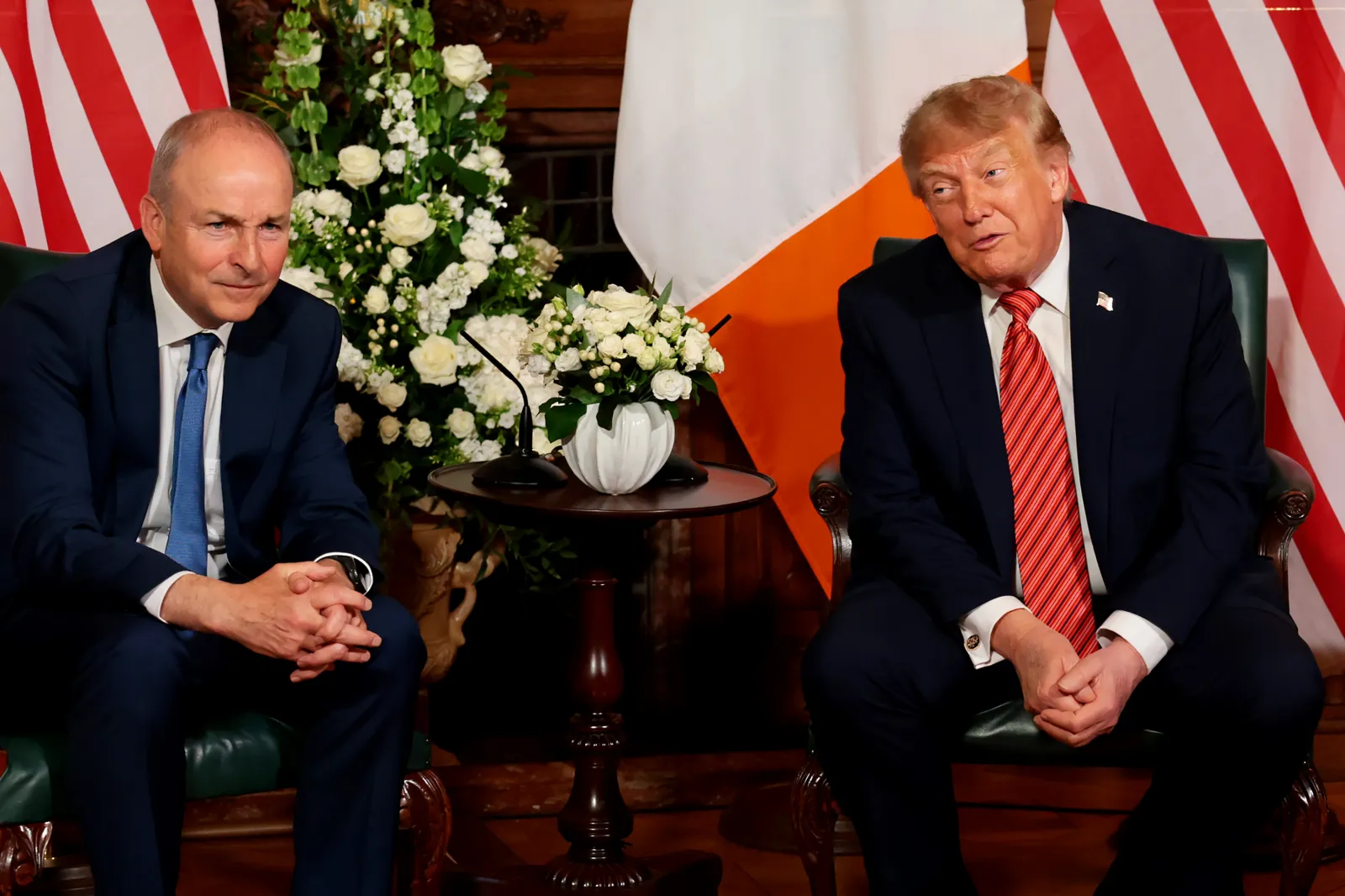
President Donald Trump has said that he would like to see a united Ireland, saying that "it's going to happen eventually."
Sitting next to Irish prime minister Micheál Martin on Saturday hours after arriving in Dublin, Trump was asked about the prospect of the Republic of Ireland joining with Northern Ireland, which is part of the United Kingdom.
"I don't want to cause any problems, but I will tell you, I'd love to see it unified," he replied.
Read More on News
Before Trump, U.S. presidents have generally supported the principle that the people of the island of Ireland should determine their own future and while they have expressed sympathy for Irish unity, Trump’s comments appear to be the first time a sitting president has said he would like to see both sides of the border reunified as one country.
"I think it would be a great feather in everybody's hat if that happened," he said.
...
"I think it would be a fantastic thing. Now the UK will have something to say about it, obviously, but I think it would be a great thing. I mean, how could it be bad?"
Trump later doubled down on his remarks during an address at the U.S. embassy in Dublin, telling media, "I gave a nice answer, I think. We'll read about it tomorrow." He said, "That's one of those questions where no matter what you say, no matter how well you say it, there's no good answer," adding "I think it would be cool."
While Trump's comments will align with the sentiments of many in the Republic of Ireland, and the nationalist community in Northern Ireland, it appears to have raised eyebrows in the British political establishment, prompting the government in London to reaffirm its commitment to the 1998 peace process.
Deputy British Prime Minister Angela Rayner told Sky News that the UK government remained "really serious about the Good Friday Agreement" and "very proud of our history" following Trump’s comments backing Irish reunification, and stressed the government’s commitment to the 1998 accord, under which Northern Ireland’s constitutional future is ultimately determined through the democratic process.
"Donald Trump is Donald Trump," Rayner told the outlet: "The president will say and speak his mind as he sees it."
Opposition Conservative party leader Kemi Badenoch reacted negatively to the remarks, as reported by The Mirror: "This sort of loose talk about the future of democratic countries is deeply unhelpful and creates unnecessary tension."
The remarks have also sparked criticism from the unionist community in Northern Ireland, who wish to remain part of the United Kingdom.
Gavin Robinson, who leads the Democratic Unionist Party, said: "Northern Ireland’s constitutional future will be decided by the people of Northern Ireland, not by commentary in London, Dublin or Washington."
"Northern Ireland is part of the United Kingdom because that is the settled democratic will of its people," his statement added.
Gregory Campbell, another DUP politician dismissed the U.S. president’s comments as a "Trumpism," comparing it to his prior remarks about issues like taking over Greenland, and suggested the comments may have been intended to "smooth things over" with Ireland's left-wing president.
He told Sky News that the Irish republican party Sinn Fein, which pushes for a united Ireland but has opposed Trump’s visit, may go to planned protests against the U.S. president on Saturday "somewhat confused."
"They are saying, 'Look, we arrived here to protest against this guy," said Campbell, "now he seems to be on our side'. If this weren't for real, this would make a Father Ted episode."
Newsweek has contacted the DUP and the White House for further comment.
How Likely Is A United Ireland?
Following the Good Friday Agreement of 1998, which brought an end to the Troubles, the constitutional agreement in Northern Ireland is that the territory will remain part of the United Kingdom until such times as a majority of people living there vote to join a united Ireland.
Under the 1998 agreement, the UK Secretary of State for Northern Ireland must call a referendum once it appears likely a majority in the North would vote for Irish unity. This mechanism would only be triggered from polling in Northern Ireland.
As of Saturday, support for a united Ireland was 34.13 percent in the North, according to Irish politics.ie., citing an aggregate of surveys. Meanwhile, the percentage of those who want to remain as part of the United Kingdom is currently at 46.99 percent.
Last month, the British prime minister Andy Burnham made his first official visit to Northern Ireland in which he said that the issue is "off the table" adding that major referendums such as Brexit and Scottish independence had created divisions that "take a long time to heal."
On Wednesday, Burnham said: "I am not aware that there is majority public support for another referendum, and until that changes, there will not be one."
What Previous U.S. Presidents Have Said On A United Ireland
Donald Trump's comments today are notable because previous American presidents have avoided overtly backing a united Ireland, even those, like Joe Biden, who touted his ancestral ties to the island.
The Democrat administration of Bill Clinton was closely involved in the Northern Ireland peace process that ended in the Good Friday Agreement and he spoke of supporting "a reconciliation between the North and the Republic" without advocating unification.
His successors, George W Bush and Barack Obama also expressed support for the Good Friday Agreement and peace process efforts without commenting on reunification.
Biden visited Belfast in 2023 visit to mark the 25th anniversary of the Good Friday Agreement in which he praised the peace process and the institutions established by the agreement rather than returning to division.
Presidents in office before then also professed backing for democratic processes rather than calling for Northern Ireland to leave the UK., such as Ronald Reagan. Meanwhile, John F. Kennedy who celebrated his Irish heritage ancestry and visited Ireland in 1963, did not publicly call for Irish reunification.
09/13/2026 5:54 a.m ET: This article was updated with additional information.
View 0 Comments
Submit Correction
View Editorial & AI Guidelines