10
Loading video...

By Steve Mollman
News Editor
0
Share
Newsweek is a Trust Project member
See more of our trusted coverage when you search.Prefer Newsweek on Googleto see more of our trusted coverage when you search.
A federal appeals court has left in place restrictions on part of the Trump administration's voter fraud investigations in nine states through Tuesday's midterm elections, rejecting another attempt to lift an order limiting federal agents' field operations and interviews involving actual or suspected U.S. citizens.
The U.S. Court of Appeals for the Ninth Circuit on Friday declined to have a larger group of its judges reconsider a three-judge panel's refusal to stay the preliminary injunction. Seven judges dissented from the decision not to rehear the matter, arguing that the lower court had improperly constrained the executive branch's authority to investigate suspected illegal voting.
The restrictions apply in California, Connecticut, Georgia, Missouri, Nevada, New York, Pennsylvania, Washington and Wisconsin. According to the seven-judge dissent, six of those states were identified in the record as part of the Department of Homeland Security's enforcement campaign, while three others were identified through media reports.
Read More on News
The decision is one of several recent legal setbacks for the administration's escalating push against alleged noncitizen voting in the closing days before the midterms. The Department of Justice (DOJ) has brought election-related charges around the country, while federal immigration agents have been sent to homes to investigate suspected illegal voting.
Newsweek reached out Saturday to the Department of Homeland Security (DHS) and U.S. Immigration and Customs Enforcement for comment on the ruling.
Ninth Circuit Leaves Trump Administration Restrictions in Place
The case, California Nurses Association v. Mullin, was brought in September by the California Nurses Association, National Nurses United, Voto Latino Foundation, Santa Clara County and the City and County of San Francisco against DHS, immigration agencies and federal officials.
The nursing organizations said U.S.-citizen members feared being wrongly identified, investigated or detained under the federal initiative and had curtailed election-related activities as a result. The district court found at this preliminary stage that the organizations likely had standing to sue on their members' behalf.
The plaintiffs argued that the administration's investigation of potential noncitizen voters could wrongly target U.S. citizens and amount to voter intimidation prohibited by Section 11(b) of the Voting Rights Act.
On October 21, U.S. District Judge Araceli Martínez-Olguín granted a preliminary injunction. The order bars the government in the nine states from conducting certain election-related field operations and interviews involving people whom officials know, suspect, or reasonably should know or suspect are U.S. citizens. It also restricts election-related field operations based wholly on certain federal records when those operations involve people officials know, suspect, or reasonably should suspect are U.S. citizens.
The Trump administration appealed and sought to put the injunction on hold while the appeal proceeds. A Ninth Circuit panel denied that request Friday, concluding that the government had not demonstrated the irreparable harm required for a stay.
A Ninth Circuit judge then requested a vote on rehearing the panel's decision en banc, meaning before a larger group of judges. A majority of the court's nonrecused active judges did not vote to rehear the order, according to the court's October 30 filing.
The result leaves the injunction intact during the final days of voting.
How DHS Is Investigating Suspected Noncitizen Voters
The court filing provides additional detail about an enforcement program previously reported by Newsweek, in which armed Homeland Security Investigations (HSI) agents have visited homes to question people about citizenship and voting.
According to the court record, U.S. Citizenship and Immigration Services (USCIS) identifies potential illegal voters by comparing voter information from state and local governments and publicly available sources against DHS and commercial databases. USCIS then manually reviews potential matches, with the stated goal of excluding U.S. citizens before cases are referred to HSI.
Appearing on Fox News on Saturday, DHS Secretary Markwayne Mullin put the scale of the administration's effort at more than 300,000 investigations.
“We’re investigating over 300,000 cases,” Mullin said during a discussion of alleged noncitizen voting. The figure refers to cases under investigation, not confirmed instances of illegal voting.
If USCIS concludes that someone likely voted illegally, it creates a record for that individual in TECS, a federal law-enforcement database. HSI then decides whether further investigation is warranted, and field offices independently review records before deciding whether to act. One possible step is an interview with the suspected voter.
DHS previously told Newsweek that federal agencies used government and commercial data to supplement voter-registration information, verify identities and eliminate false positives.
A DHS spokesperson also previously defended the door-to-door operations to Newsweek, saying HSI would "continue to investigate election fraud."
"HSI is committed to restoring integrity to our election systems and ensuring that American citizens and only American citizens are electing American leaders," the spokesperson said.
Critics have challenged both the reliability of the government's data and the decision to send federal agents to people's homes shortly before an election.
Wendy Weiser, vice president for democracy at the Brennan Center for Justice, previously told Newsweek that the approach was "highly irregular and inappropriate," arguing that the tactics risked intimidating legitimate voters.
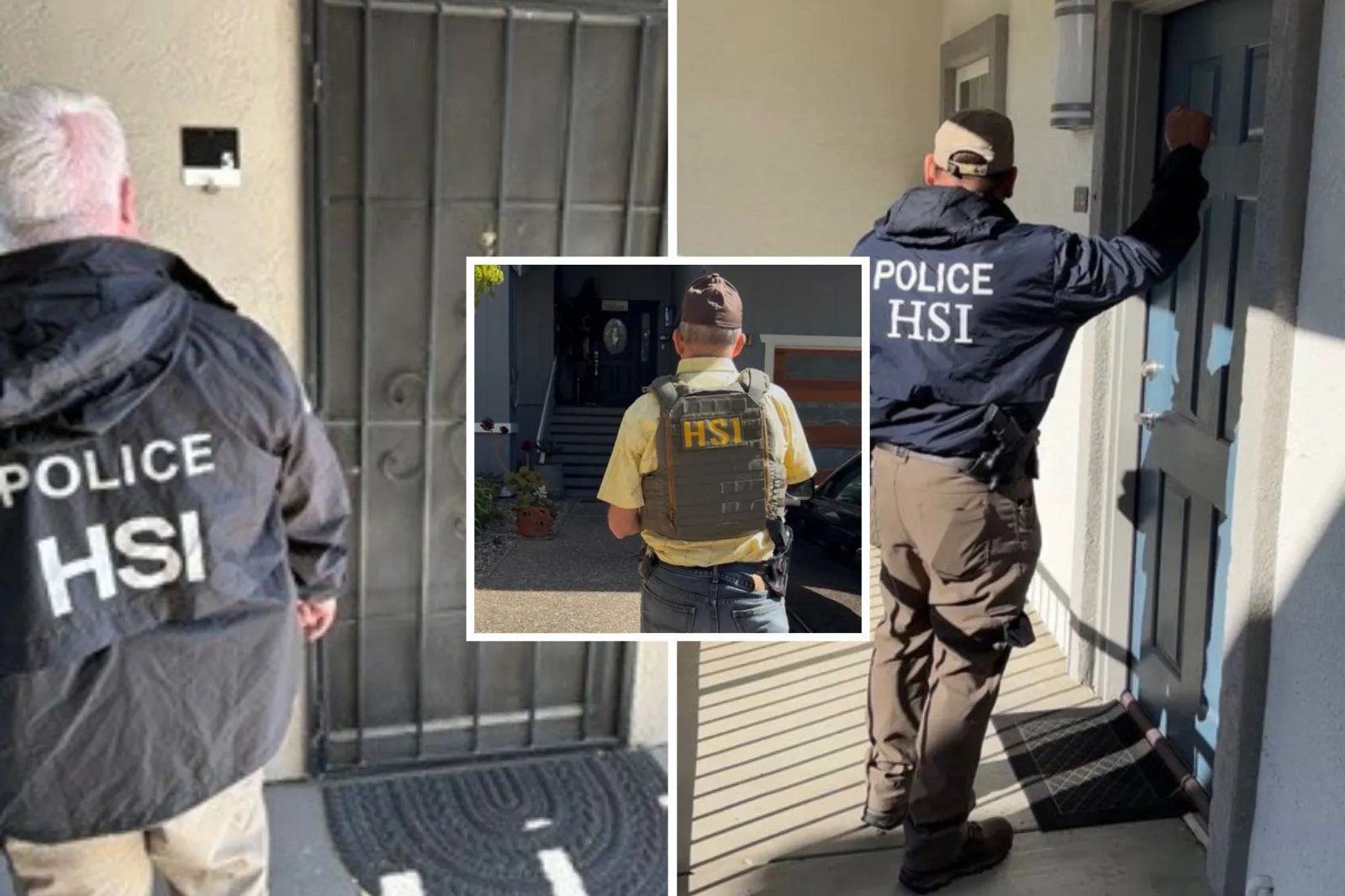
...
Seven Ninth Circuit Judges Dissent
Friday's Ninth Circuit order drew a 33-page dissent from Judge Eric Tung, joined by Judges Consuelo Callahan, Ryan Nelson, Daniel Collins, Daniel Bress, Patrick Bumatay and Lawrence VanDyke.
Tung argued that the district court had gone too far in restricting legitimate law-enforcement activity.
"By enjoining the government from even investigating illegal voting, the district court departed from its limited role," Tung wrote. He argued that the district court had confused investigations of suspected illegal voting with the voter intimidation prohibited by federal law.
The dissent argued that the plaintiffs lacked standing, that private parties could not bring a lawsuit to enforce Section 11(b) of the Voting Rights Act and that the government's investigations did not violate that provision in any event.
Tung also argued that the injunction was vague and overbroad, writing that its language could effectively prevent the government from conducting lawful election investigations whenever officials had reason to think an investigation could involve a U.S. citizen.
"The many errors in this case warranted en banc review," Tung concluded. "The district court allowed abstract fear to substitute for concrete injury. It invented a right of action where Congress supplied none. It equated investigation with intimidation."
The dissent represents the views of the seven judges and does not alter the injunction, because a majority of the eligible active Ninth Circuit judges did not vote to rehear the panel's ruling.
Trump Steps Up Voter Fraud Push Before Election Day
The court fight comes as President Donald Trump and his administration have made alleged voter fraud and noncitizen voting a major focus in the closing stretch of the midterm campaign.
The Justice Department has announced scores of election-related criminal cases in recent weeks, including cases accusing noncitizens of voting, falsely claiming U.S. citizenship while registering and committing related offenses. The charges are allegations, and defendants are presumed innocent unless proven guilty.
Trump also announced Monday that anyone reporting voter fraud in past elections or the 2026 midterms would receive $1 million if the information resulted in an arrest and conviction. The White House did not provide Newsweek with details about how the proposed reward would be funded or administered when asked earlier this week.
In a separate case Friday, U.S. District Judge Trina Thompson temporarily barred DOJ and DHS officials nationwide from threatening state and local election workers with prosecution for processing or counting ballots in compliance with governing election laws. The order also restricts federal demands that states remove specific people from voter rolls or treat their ballots differently based on the administration's allegations that they are ineligible.
Thompson wrote that the administration's actions were likely to interfere with election administration and disenfranchise lawful voters. The ruling is temporary and does not resolve the underlying lawsuit.
In California, the administration is separately fighting state officials over roughly 20,000 registered voters it says are likely noncitizens. A federal judge this week refused the Justice Department's request to require election officials to segregate ballots associated with people on that list, and the Ninth Circuit on Friday also rejected the government's request for emergency relief in that separate dispute.
The administration maintains that heightened enforcement is necessary to protect election integrity. Critics counter that noncitizen voting is rare and that unreliable citizenship data can wrongly flag eligible voters.
The litigation will continue, but Friday's action leaves the restrictions on DHS field investigations in force across the nine states through the close of polls Tuesday.
Newsweek reporters and editors used Martyn, our AI assistant, to produce this story. Learn more about Martyn here.
View 0 Comments
Submit Correction
View Editorial & AI Guidelines