...

By Jesus Mesa
Reporter
0
Share
Newsweek is a Trust Project member
See more of our trusted coverage when you search.Prefer Newsweek on Googleto see more of our trusted coverage when you search.
Soccer tournament draws were once quiet, procedural affairs: televised formalities where the only drama came from which team landed in which group. That changed dramatically in December 1993 in Las Vegas, when the United States hosted the draw for the 1994 World Cup. Robin Williams ad-libbed jokes on stage, James Brown brought the soul, and Stevie Wonder closed the show. The spectacle set a new precedent: World Cup draws could be showbiz.
Nearly 30 years later, with the World Cup again returning to American soil, the draw has taken another sharp turn into the realm of politics and personal branding. Originally set for Las Vegas, FIFA officials moved the 2026 draw to Washington, D.C., reportedly at the request of President Donald Trump, who preferred the setting.
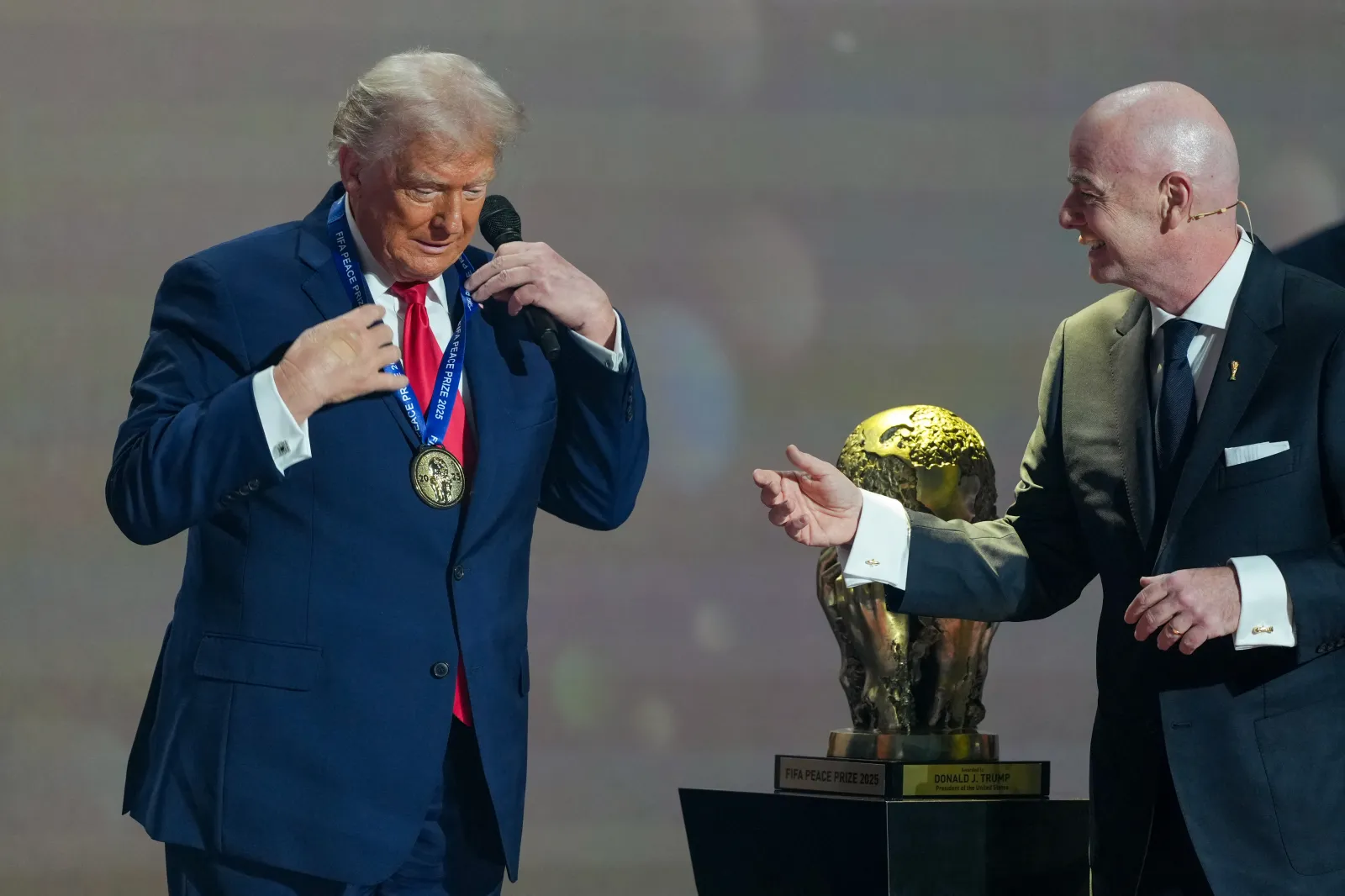
What followed was less about soccer and more about Trump. He delivered a featured speech, drew the United States into its tournament group, and accepted FIFA’s inaugural “Peace Prize,” a new honor created without formal council approval by FIFA President Gianni Infantino, a longtime Trump associate who has described the U.S. leader as a “winner” and personal friend.
Read More on News
"This is what we want from a leader, a leader that cares about the people," Infantino said during the ceremony, praising Trump from the stage. “You can always count on my support—on the support of the entire soccer community,” he added.
Trump, meanwhile, used the spotlight to frame himself as a global peacemaker, claiming his administration had helped resolve conflicts from Gaza to Ukraine. “Gianni and I were discussing this,” Trump said. “We’ve saved millions and millions of lives.” The comment came moments before Infantino handed him a gold medal and a specially commissioned trophy, an act that drew rebuke from civil rights groups and members of FIFA’s own leadership, who said the prize was never formally approved by FIFA's governing council.
The show was tailored to Trump’s sensibilities. Andrea Bocelli, a personal favorite of the president who recently visited the Oval Office, performed early in the program. The Village People—whose song “Y.M.C.A.” has become a staple at Trump rallies—closed the show. Hockey legend Wayne Gretzky, former NFL quarterback Tom Brady, NBA star Shaquille O'Neal, and baseball slugger Aaron Judge assisted in drawing the tournament groups, alongside Trump and other guests.
FIFA’s embrace of Trump extended beyond the ceremony. Earlier this year, the organization leased office space in Trump Tower, despite already having U.S. headquarters in Miami. Infantino also allowed Trump to hold the World Cup trophy—normally reserved for FIFA officials and champions—during a White House visit. “Can I keep it? Trump joked. “That’s a beautiful piece of gold.” Months later, after the Club World Cup wrapped up in New Jersey, Trump asked Infantino if he could have a replica of the new trophy. Infantino agreed.
World Stage, Narrow Spotlight
The political optics were stark. Although the 2026 tournament is jointly hosted by the United States, Canada, and Mexico, the roles of Canadian Prime Minister Mark Carney and Mexican President Claudia Sheinbaum were largely sidelined during the ceremony. They appeared only briefly in a group selfie onstage, offered a few remarks at Infantino’s prompting, and otherwise played no meaningful part in the draw.
Another sensitive subject went unaddressed: immigration. As President Trump has intensified his immigration agenda following the shooting of two National Guardsmen in Washington, D.C., last November, questions about how the administration’s measures are affecting qualified teams received no answers. The Iranian federation ultimately attended the event after initially deciding to skip it when several officials were denied visas. Haitian officials, meanwhile, told Newsweek they hope a solution can be found.
President Trump addressed the issue himself during a brief exchange with journalists on the red carpet. “We’re gonna make it easy for everyone,” he said as he walked alongside Infantino into the Kennedy Center.
Eyebrows were raised over Infantino’s role, whose close relationship with Trump has prompted questions within FIFA’s inner circles. Whispers spread through the hall when Infantino suddenly returned to the stage to award Trump the Peace Prize, a gesture that came days after Trump missed out on the Nobel Peace Prize, which Infantino had said he “deserved.”
The moment quickly drew backlash outside the Kennedy Center as well. In a sharply worded statement, the American Civil Liberties Union warned that by awarding Trump its inaugural “Peace Prize,” FIFA was “risking becoming a stage for authoritarianism.” Jamil Dakwar, director of the ACLU’s Human Rights Program, pointed to the Trump administration’s sweeping immigration raids, mass detentions, and the deployment of National Guard units in several World Cup host cities, saying that FIFA should be leveraging its influence to stop human rights abuses, “not to whitewash and capitulate.”
Awarding Trump a trophy, Dakwar said, “instead of a red card,” sent the opposite message.
A MAGA Problem
But that success is beginning to weaken Infantino, as the third-term FIFA president faces newfound internal opposition for his over-the-top courtship of Trump. Six international soccer officials across three continents spoke to POLITICO and revealed widespread frustration with Infantino’s decision to side with Trump, even as White House policies cause chaos for World Cup-bound teams, fans, and local organizers—clashing with Infantino’s promise to have a tournament that welcomes the world.
Infantino, who arrived at FIFA in 2016 in the aftermath of the “FIFAGate” corruption scandal, a sweeping U.S. Justice Department investigation that led to dozens of indictments and the eventual downfall of longtime president Sepp Blatter, promised to clean up an organization tainted by years of bribery and influence-peddling. But his tenure has also drawn criticism for being overly accommodating to leaders such as Russian President Vladimir Putin and Saudi Crown Prince Mohammed bin Salman, both of whom have used major soccer events to bolster their global image.
Under Infantino’s leadership, FIFA has staged two World Cups: one in Russia and another in Qatar, both widely criticized by human rights organizations for alleged sportswashing. In 2034, after the centennial World Cup hosted by Spain, Portugal, and Morocco, Saudi Arabia is set to stage the tournament as a showcase of its Vision 2030 plan championed by Crown Prince Mohammed bin Salman.
Against this backdrop, Trump is hardly the first—and won’t be the last—leader to use soccer to advance political goals. He secured the 2026 hosting rights during his first term and has admitted he didn’t expect to be president when the tournament arrived. Yet when Infantino asked about the symbolism of hosting a World Cup during America’s 250th anniversary next year, Trump simply called it a “nice coincidence.”
View 0 Comments
Submit Correction
View Editorial & AI Guidelines