10
Loading video...

By Jesus Mesa
Reporter
0
Share
Newsweek is a Trust Project member
See more of our trusted coverage when you search.Prefer Newsweek on Googleto see more of our trusted coverage when you search.
President Donald Trump on Wednesday imposed sweeping new tariffs on all imported goods and unveiled a detailed list of reciprocal duties targeting more than 60 countries, asserting that the move is necessary to combat trade imbalances and restore U.S. manufacturing.
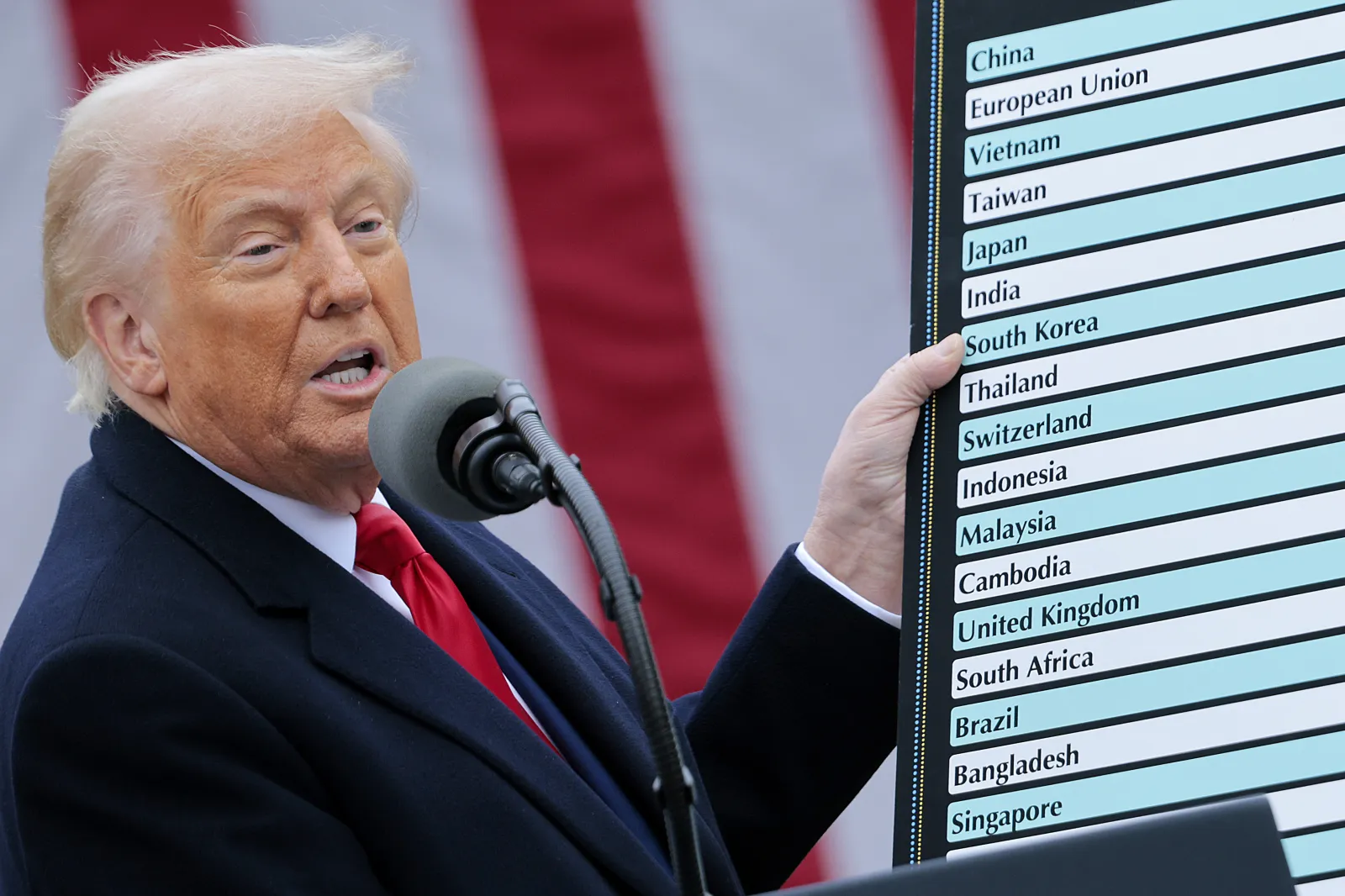
"This is Liberation Day," Trump said during a Rose Garden ceremony, holding up a printed chart of countries and their new tariff rates. "For decades, our country has been looted, pillaged, raped and plundered by nations near and far, both friend and foe alike."
Why It Matters
The tariffs, which he described as "reciprocal," fulfill a key campaign pledge and are aimed at pressuring trade partners to lower their own barriers. The administration expects the new rates to remain in place until the U.S. narrows a $1.2 trillion trade imbalance recorded last year.
Read More
Donald Trump’s Tariffs May Be a Win for China5 min read

Kamala Harris Was ‘Completely Shocked’ She Lost to Trump—New Book5 min read

Donald Trump’s Tariff Formula ‘Based on an Error’—Conservative Think Tank5 min read

But the extensive list of tariffs also threatens to upend the U.S. economy, as many — but not all — economists say they amount to taxes on American companies that will be passed down to consumers.
What To Know
The president said there will be a "baseline" tariff of 10 percent on all imports.
Some nations will face "discounted reciprocal tariffs" which are at half the rate those countries currently charge the U.S.
According to a chart Trump held up, the U.S. will impose a 34 percent tariff on Chinese imports; 20 percent on goods from the European Union; 25 percent on South Korean products; 24 percent on Japanese imports; and 32 percent on goods from Taiwan.
The 34 percent reciprocal tariff that China will face is in addition to a 20 percent tariff on the country which is already in effect, the White House said.
...
The move also includes specific tariffs on countries with low formal tariff rates but significant trade surpluses with the U.S., including the UK, Australia and Brazil.
The U.S. had an overall trade deficit of $918.4 billion in 2024, with the largest gaps coming from China ($295.4 billion), the European Union ($235.6 billion), Mexico ($171.8 billion) and Vietnam ($123.5 billion), according to the U.S. Bureau of Economic Analysis.
While announcing the measures, Trump invoked national security powers under a continuing state of emergency to justify the action, circumventing Congressional approval.
While specifics about enforcement and duration of the new tariffs remain unclear, a document distributed to reporters included a list of 65 countries with calculated reciprocal rates.
Cambodia topped the chart at a 49% tariff, followed by Madagascar (47%), Sri Lanka (44%), and Vietnam (46%).
Major U.S. partners like Japan, South Korea and India were also included, despite active trade negotiations in recent years.
How Trump's Tariff Rates Were Set
President Trump said the new tariffs on U.S. trading partners were "reciprocal," meant to reflect the trade barriers those countries place on American goods. He didn't explain how the rates were calculated, but a clearer method appeared later on Wednesday.
According to analysts and later White House clarification, each country's tariff rate was based on the U.S. trade deficit with that country, divided by the value of that country's exports to the U.S. Trump then cut that number in half, saying he was being "kind."
While Trump originally claimed the tariffs would reflect not just trade deficits but also non-monetary barriers and "cheating," experts believe the administration used a quick, simple formula to push the policy through.
Full List of Countries Hit With Reciprocal Tariffs
*White House officials said the calculations came from the Council of Economic Advisers.
What People Are Saying
President Donald Trump while announcing the new tariffs on Wednesday: "Chronic trade deficits are a national emergency."
Ernie Tedeschi, director of economics at the Budget Lab at Yale, told Newsweek: "Obviously it's still unclear whether this is the policy that will be announced. But with that caveat: this idea would bring tariffs back to where they were in America in the early 1900s. It would raise about $3 trillion over a decade—enough to pay for about half of the tax cut extension—but it would also raise prices by the equivalent of more than a year's worth of normal inflation and cut U.S. economic growth in 2025 in half."
What Happens Next
A 25% tariff on "all foreign-made automobiles" will take effect on April 3. The 10% "baseline" tariffs will take effect on April 5 and the reciprocal tariffs will kick in on April 9.
Markets reacted sharply to the announcement.
Stock futures plunged and after-hours trading descended into turmoil as Trump pledged steep tariffs on some of the U.S.'s top trading partners. The SPDR S&P 500 ETF Trust (SPY), which tracks the S&P 500, fell 2.47 percent. The SPDR Dow Jones Industrial Average ETF Trust (DIA) dropped 1.37 percent, while the Invesco QQQ ETF, which tracks the Nasdaq Composite Index, sank 3.45 percent.
Update 4/2/25, 10:27p.m. ET: This article has been updated to include additional information.
View 0 Comments
Submit Correction
View Editorial & AI Guidelines