...

By Newsweek Editors
0
Share
Newsweek is a Trust Project member
See more of our trusted coverage when you search.Prefer Newsweek on Googleto see more of our trusted coverage when you search.
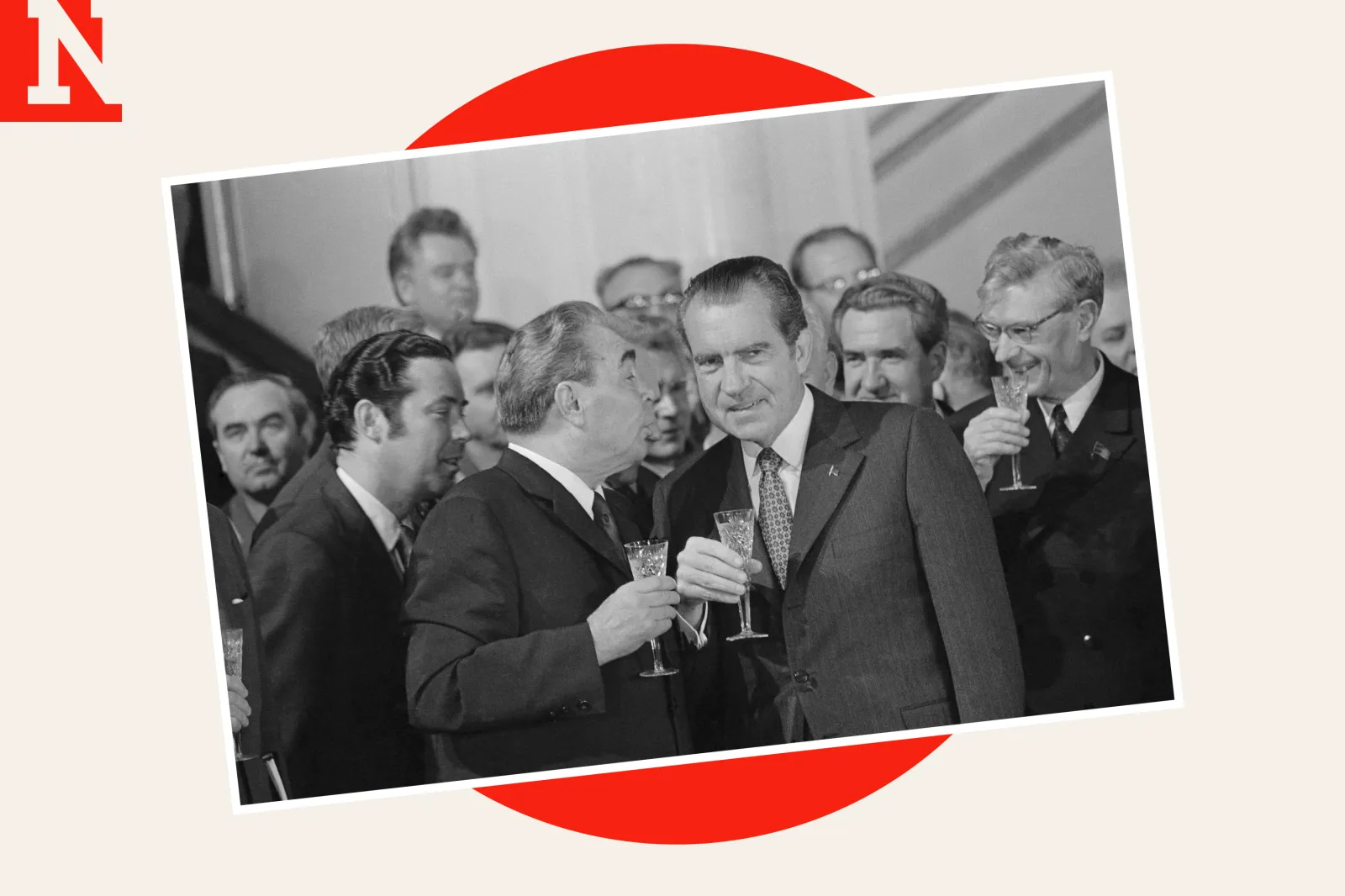
Richard Nixon flew to Moscow in May 1972 to sign a pair of agreements with Leonid Brezhnev that tried—imperfectly—to put guardrails around the superpowers’ worst instincts. The logic seems quaint today: capping nuclear capability so the other guy isn't tempted to shoot first. It wasn't just about offensive weapons, however. The paperwork nodded to the "relationship between strategic offensive and defensive arms," a reminder that missile shields can make missiles feel "necessary."
Today, February 5, 2026, the last big surviving guardrail—the New START treaty—expires, and Washington under Donald Trump and Moscow under Vladimir Putin are already advertising the freedom they think comes with that. A week ago, the Bulletin of the Atomic Scientists moved its Doomsday Clock to 85 seconds to midnight, citing (among other things) a failure of leadership and escalating nuclear danger.
While the nuclear guardrails quietly rot, Washington is obsessed with something even shinier: AI war. In recent hearings, lawmakers have talked about "winning the AI arms race" with the kind of black-and-white urgency usually reserved for missile gaps. NATO, meanwhile, has been buying the software plumbing for algorithmic battle-management—an AI-enabled system from Palantir built on the lineage of the Pentagon’s Project Maven—because Europe is also terrified of being outpaced in the next fight.
Read More on Analysis
Peace prize calls notwithstanding, Trump and Putin are taking the world into an objectively more dangerous place, when it was already becoming more dangerous.
Why Is This Happening?
New START, signed in 2010 and extended in 2021 to run until today, capped each side at 1,550 deployed warheads and 700 deployed launchers, plus notifications and inspections that—when functioning—provided priceless visibility into the other side. Russia "suspended" participation in 2023. Now the treaty itself has timed out, and Russia’s foreign ministry is warning it is ready to take "decisive action" while complaining it got no U.S. response to a proposed one-year voluntary extension of the limits.
The stakes are high because the U.S. and Russia still dominate the nuclear ledger. The Federation of American Scientists estimates 12,321 nuclear warheads worldwide at the start of 2026, with the U.S. and Russia holding the overwhelming majority. The moment New START’s ceiling disappears, the constraints are only politics, budgets, and paranoia.
When Nixon and Brezhnev signed their original agreement, the U.S. had an estimated 26,516 nuclear warheads and the Soviet Union 14,478—and yet both sides still felt insecure enough to negotiate, because each feared the other’s next move.
What’s changed is the mood, and arguably the fear. Trump's reported shrug— "If it expires, it expires"—treats arms control as décor rather than architecture. Russia’s elite has its own nihilism. Dmitry Medvedev has argued that "No START-4 is better than a treaty that only masks mutual distrust," not a sentence that signals stability.
Alongside Trump's apocalyptic threats to his changing cast of enemies, Russia has already been using nuclear-capable systems in a conventional war in ways that would have been considered reckless in earlier decades. Its Oreshnik is as an intermediate-range ballistic missile with multiple independently targetable reentry vehicle (MIRV) capability, meaning it can attack with several different warheads simultaneously, including nuclear warheads. Russia used it against Ukraine in 2024 and 2026, likely the first time a MIRV has been used in combat. The psychological firewall between "nuclear things" and "normal war" is being weakened.
The same war is also becoming a laboratory for AI-enabled autonomy—drones that navigate, identify, and coordinate faster than humans can comfortably supervise. The race between Russia and Ukraine to perfect ever more autonomous, AI-assisted drones is pushing warfare toward cheaper, scalable lethality, exactly the kind of "new normal" that makes nuclear escalation feel like a separate problem, until it isn’t.
Finally, there’s the defense spiral that 1972 negotiators warned about, and that Trump is now reviving. His "Golden Dome" plan is a missile defense system that reaches into space. If one side believes the other is building a shield, it starts buying more swords.
The Pentagon’s own AI pivot is already underway: Replicator, led by the Defense Innovation Unit, was designed to field "multiple thousands" of "attritable autonomous" uncrewed systems at speed and scale. NATO has updated its own AI strategy to accelerate adoption while trying to mitigate risk, a tacit admission that "responsible AI" is now a military requirement.
This feels like the quiet start of a darker nuclear age: not a single moment like the Cuban missile crisis, but a drip of decisions that raise the risk. As one recent Bulletin essay put it, nuclear deterrence isn’t collapsing "with a bang"—it’s "fading, quietly and unevenly," as leaders behave as if nuclear risk can be "managed" or "accepted."
The irony is that AI doesn’t simply replace nuclear danger, it may accelerate it. AI-amplified misinformation can worsen confusion in crises, raising the chance of catastrophic miscalculation.
What Is the Right Saying?
The hawkish case is that arms control is outdated. Secretary of State Marco Rubio argues "it’s impossible to do something that doesn’t include China," given Beijing’s "vast and rapidly growing stockpile." Trump’s camp also leans hard into technology: he has pitched the Golden Dome as a next-generation shield spanning "land, sea and space," including "space-based sensors and interceptors." And on nuclear capability, Trump has said of resuming U.S. nuclear testing: "with others doing testing I think it’s appropriate to do so."
What Is the Left Saying?
The left's reply is that this is how arms races restart. Barack Obama warned that letting New START expire "could spark another arms race that makes the world less safe." Nuclear experts also warn that restarting U.S. nuclear testing would be dangerous and could benefit U.S. adversaries.
On AI warfare, U.N. Secretary-General António Guterres has warned that "machines that have the power and discretion to take human lives without human control are politically unacceptable, morally repugnant and should be banned by international law."
What Happens Next?
The likeliest near-term outcome is a bureaucratic arms race that starts before either side announces one, such as expanding production capacity, moves that look "reversible." Russia will keep normalizing dual-capable missiles in Ukraine, because it has learned the West will not object in a substantive way.
There may yet be a path back to the negotiating table. But it would be incomplete if it treats AI war as separate. The AI battlefield compresses timelines and multiplies ambiguity, two things that make nuclear crises go bad fast. Without that discussion, we won’t just be turning the Doomsday Clock back to 1972, but importing the worst logic of the Cold War into a world where machines help decide what humans do next.
Once a core feature of Newsweek’s print edition, Perspectives distilled the week’s news into a chorus of standout quotes. Today, we’re relaunching Perspectives in a different format, but with the same mission of keeping our members informed by showcasing the views that shape the conversation.
View 0 Comments
Submit Correction
View Editorial & AI Guidelines