...

By Brendan Cole
Senior Reporter
0
Share
Newsweek is a Trust Project member
See more of our trusted coverage when you search.Prefer Newsweek on Googleto see more of our trusted coverage when you search.
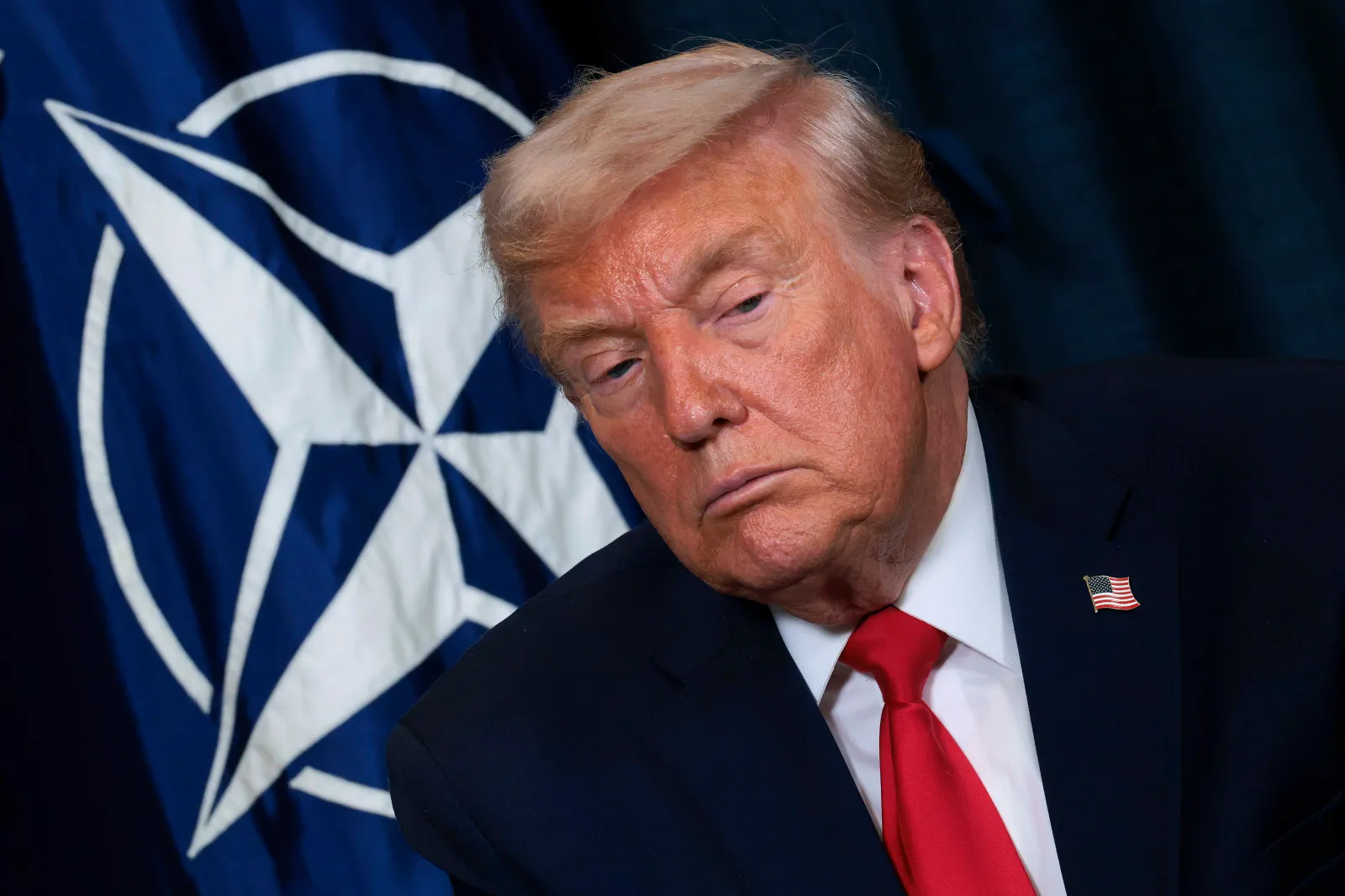
President Donald Trump faces legislative obstacles if he wants to make good on threats to pull the U.S. out of NATO.
However, Trump could try to sidestep 2023 legislation preventing a president from unilaterally withdrawing from the security bloc, with one U.S. political expert telling Newsweek he could ensure the U.S. "quit NATO in all but name."
Trump has long railed at the alliance for not spending enough. Since the start of the Iran war on February 28, he has also been angered by what he perceives as a lack of assistance from NATO members.
Read More on World
When asked by the Daily Telegraph about whether he would withdraw the U.S. from the alliance that it helped found in 1949, Trump replied that an exit was "beyond reconsideration."
White House spokesperson Anna Kelly told Newsweek in a statement, "President Trump has made his disappointment with NATO and other allies clear, and as the President has emphasized, 'the United States will remember.'" Newsweek has contacted NATO for comment.
...
Law Prohibits NATO Withdrawal Without Congressional Backing
Secretary of State Marco Rubio has also said this week that the U.S. may "reexamine" its role in NATO. However, a law that he spearheaded would mitigate against this.
In 2023, Rubio, along with Senator Tim Kaine (D-VA) authored legislation requiring that any presidential decision to exit NATO needed either two-thirds Senate approval or to be authorized through an act of Congress.
It prohibits the president from suspending, terminating, denouncing or withdrawing the U.S. from the North Atlantic Treaty, which established NATO, without the advice and consent of the Senate or an act of Congress.
Lawmakers passed the measure as part of the fiscal 2024 National Defense Authorization Act, which former President Joe Biden signed into law. But there is a possibility that Trump could sidestep this legislation by citing presidential authority over foreign policy.
If Trump declared he were to pull the U.S. out of the alliance, it's unclear whether Congress on its own could sue the president for ignoring the law, said Scott R. Anderson, a fellow in governance studies at the Brookings Institution who has argued for firmer restrictions on a president trying to leave NATO.
Anderson said for broad policy measures, there is often a question over who can be a plaintiff with standing to sue, meaning meeting the threshold legal requirement determining who can bring a lawsuit in U.S. courts.
"I think the language is quite clear that there's a statutory bar," Anderson told Newsweek on Wednesday. "The difficulty that's not addressed with the legislation is that it's not clear who has standing to sue to try and bar the president from acting illegally to withdraw."
In theory, Congress could initiate a lawsuit via a majority of both chambers but that could be tricky given the current partisan control of the House and the Senate, Anderson said. "Even without Congress as a whole, I think either chamber individually could have a reasonably strong argument for standing as well."
There are also probably a range of possible plaintiffs, such as service members, people with family members or property in Europe, he said.
Adding to uncertainty is that the Supreme Court usually considers conflicts between the government's branches as best resolved through the political process rather than judicial intervention.
Anderson said it would likely go to the Supreme Court if one or more plaintiffs stepped forward with arguments. In any case, a withdrawal from NATO would not happen immediately. Under the terms of the NATO treaty, a member state has to make a "notice of denunciation" and its membership would not officially end until after a one-year waiting period.
"The Supreme Court will have to resolve it within a year," Anderson said. "There's one year based notice during which time the president has to give one year advance notice on the exit from NATO. "So, presumably, you have a year during which you could litigate this and then try to get a judicial outcome that says, 'Mr. President, you can't do this.'"
But there could be other avenues Trump could pursue. "He simply doesn't have the votes," U.S. political expert Mark Shanahan, from the University of Surrey in England, told Newsweek regarding getting congressional approval for withdrawing from NATO.
"He could simply redeploy troops from Europe, refuse to uphold US obligations to the treaty organization and quit NATO in all but name," Shanahan added. "Trump sees Congress is merely a lapdog to be bypassed."
Update 4/1/26, 11:58 a.m. ET: This article has been updated with a White House statement and comment from Scott R. Anderson.
View 0 Comments
Submit Correction
View Editorial & AI Guidelines